

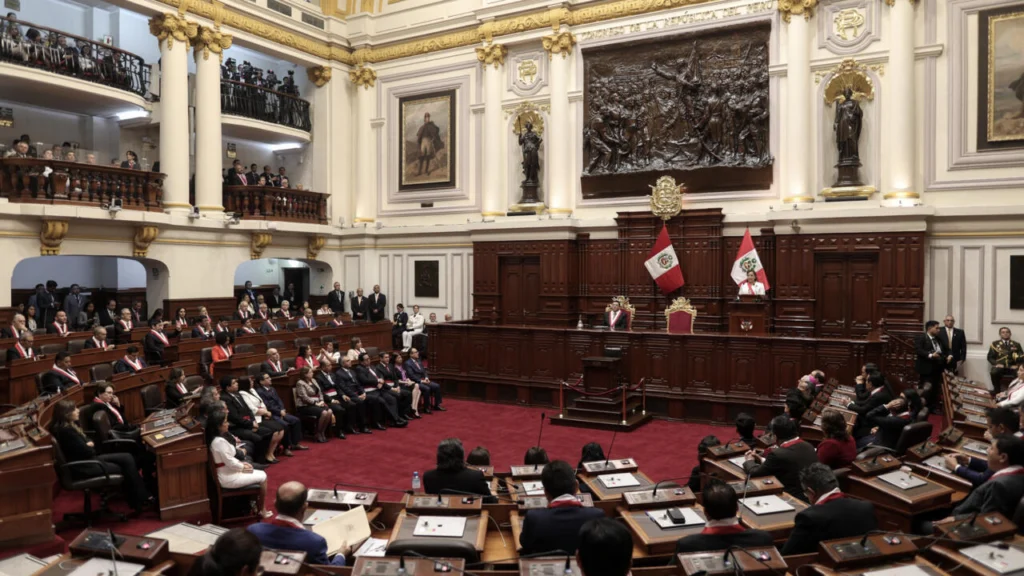
A law excluding police and military personnel from ordinary justice when they commit crimes while on duty came into effect this Tuesday in Peru. The law, published in the official gazette El Peruano, was promoted and enacted by the president of the Peruvian Congress, Fernando Rospigliosi, a member of the Fujimori party, after the deadline for interim president José María Balcázar to order its publication had passed.
The legal text modifies the Military and Police Penal Code and the New Criminal Procedure Code. The legislation establishes that, under no circumstances, may simultaneous criminal proceedings be pursued in both the ordinary and military and police jurisdictions against the same officer, provided that the facts and the individuals under investigation are the same.
RELATED:
Peru Approves Penal Code Changes That Could Archive Abuse Cases Under Military Jurisdiction
In this sense, priority is given to ensuring that agents of the state forces are prosecuted and tried by police and military courts, composed of members of the same institution, instead of being evaluated by judges of the ordinary justice system.
Under this new provision, judges in the ordinary jurisdiction must dismiss investigations or proceedings when they find that the same facts are already under investigation in the military-police courts.
The law also includes a clarification regarding crimes committed in the line of duty, incorporating actions or omissions committed while performing military or police functions. In parallel, it establishes penalties of 20 to 30 years in prison and disqualification from holding public office, and even life imprisonment in cases of death, for military or police personnel who collaborate with illegal armed groups or criminal gangs by taking advantage of their position.
Solo alguien que nunca entendió el dolor de los familiares de la CANTUTA o Barrios Altos, o de todas las mujeres esterilizadas cruelmente por Fujimori, se permite escribir esto desde la burbuja donde “lucha por la democracia”. #NiPerdonNiOlvido para los Fujimori y sus cómplices https://t.co/1x2LSvXYfP pic.twitter.com/H8Yx62KcO8
— JoxeKarlos (@Joxe_Kar) June 7, 2026
The text reads, “Only someone who never understood the pain of the families of the victims of La Cantuta or Barrios Altos, or of all the women cruelly sterilized by Fujimori, would dare to write this from the bubble where they “fight for democracy.” #NoForgivenessNoForgetting for the Fujimoris and their accomplices”
The Fujimori bloc promoted the initiative with the argument of protecting hundreds of police officers and military personnel who are currently facing charges for alleged human rights violations. These investigations are linked to events that occurred more than three decades ago during the regime of Alberto Fujimori (1990-2000) or in the context of the social protests of 2022 and 2023.
This measure complements other legislation promoted by Rospigliosi, such as the amnesty for police officers, military personnel, and civilians who were members of self-defense committees and were prosecuted or convicted for crimes committed during the internal armed conflict against Shining Path and the MRTA.
Additionally, Parliament approved a bill that incorporates crimes against humanity into the Penal Code. The text specifies that cases of murder, torture, enforced disappearance, or sexual violence can only be considered crimes against humanity if it is proven that they were committed as part of a widespread or systematic attack against a civilian population.
If the acts do not meet these criteria, they will be prosecuted as common crimes. Furthermore, the law stipulates that events that occurred before 2002, the year the Rome Statute came into effect in Peru, cannot be prosecuted under this provision.
The law’s entry into force has been met with rejection from human rights organizations. The National Human Rights Coordinator (CNDDHH) and Amnesty International (AI) warned of the creation of a mechanism of impunity for state agents responsible for deaths.
For his part, the UN High Commissioner for Human Rights, Volker Türk, urged against the law’s approval, stating that alleged violations should be heard by a competent, independent, and impartial ordinary court.
#Peru | Former presidential candidate Roberto Sanchez called on Interim President Jose Maria Balcazar to release imprisoned former President Pedro Castillo.https://t.co/gsJeeLUwBC
— teleSUR English (@telesurenglish) July 14, 2026
From teleSUR English via This RSS Feed.