

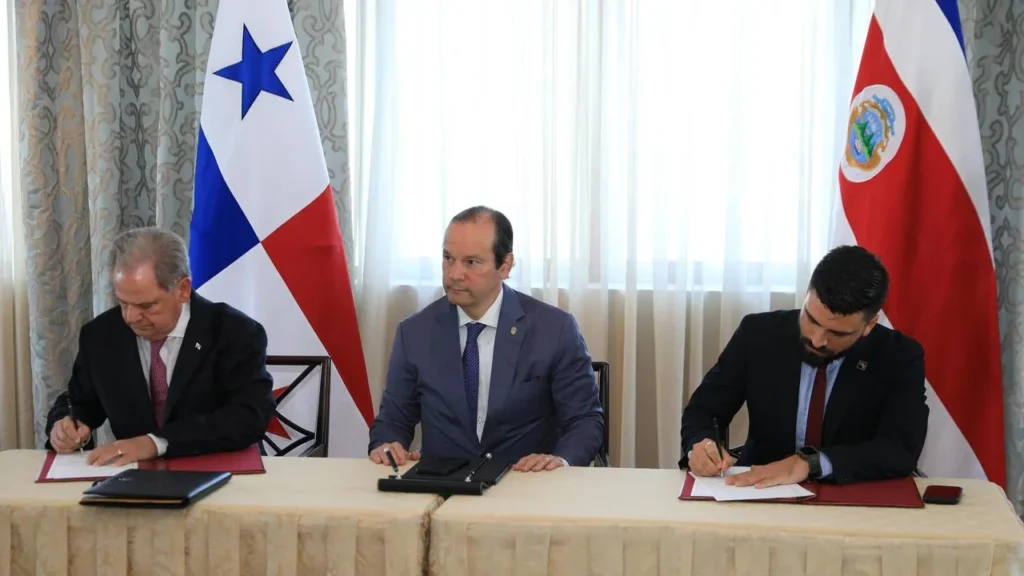
The Panamanian Ministry of Health (Minsa) confirmed that this tool aims to track the medical history of people who travel temporarily between the two countries, especially during the coffee harvest season.
The initiative seeks to guarantee more organized and efficient medical care for migrant workers and their families, through a system that facilitates continuity of treatment and the secure exchange of medical information between health authorities.
RELATED:
Maritime Cooperation Focuses Talks Between Panama and China
The agreement was formalized after the signing of a Memorandum of Understanding in San José, where both parties defined actions to strengthen bilateral cooperation in health matters.
Panamanian Health Minister Fernando Boyd explained that the document will allow access to vaccination records and other relevant clinical data, preventing patients from losing continuity of care when crossing the border, regardless of the country they are in. Boyd emphasized that the measure will be a significant milestone for the health of the Ngäbe Buglé region, characterized by seasonal migration to Costa Rica for work.
One of the main benefits will be for children, as it will prevent the need for repeated vaccinations due to the lack of medical records during these migrations. The document will be free and can be obtained at health centers authorized by the Ministry of Health (MINSA). It will be valid for six months and will begin distribution each year in July, coinciding with the start of the agricultural workers’ migration season.
Panamá y Costa Rica crean Carné Sanitario Binacional para garantizar atención médica a trabajadores Ngäbe-Buglé https://t.co/pXd94DfxeI
— Panama Hoy (@PanamaHoy_) July 20, 2026
The text reads, “Panama and Costa Rica create a Binational Health Card to guarantee medical care for Ngäbe-Buglé workers”
As part of the implementation, the Panamanian Ministry of Health will maintain the Bugaba Intermediate Care Post, in the Chiriquí Health Region, as the main center for issuing and renewing the document, ensuring coverage in the border area. The memorandum was signed by Boyd and his Costa Rican counterpart, Alexander Sánchez Cabo, in the presence of Costa Rica’s First Vice President, Douglas Soto, as part of a joint strategy to strengthen health protection for a historically vulnerable population.
The health card will unify relevant data such as priority vaccination schedules, medical history, and the monitoring of chronic diseases, allowing health personnel to provide coordinated care during cross-border movement.
In addition to improving continuity of care, the tool will strengthen epidemiological surveillance in the border region, improve monitoring of immunization schedules, and ensure continuous medical care for migrant communities on both sides of the border.
#Panama | The mayor of Panama City, Mayer Mizrachi, was exposed for placing tracking devices on aid supplies sent to Venezuela and falsely reporting that they had been diverted.
However, the General Directorate of Military Counterintelligence (DGCIM) located the GPS signal in… pic.twitter.com/mIqZ868jwe
— teleSUR English (@telesurenglish) July 6, 2026
From teleSUR English via This RSS Feed.