

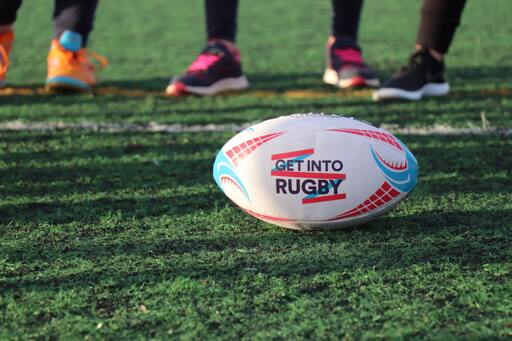

Photo by Edgar Pimenta on Unsplash
Erin In The Morning is a reader-supported publication. To receive new posts and support my work, consider becoming a subscriber.
The Baltimore Ferals will not be tamed.
The Maryland Division 3 rugby team—and its opponents—made headlines this week for speaking out in defiance of trans-exclusionary attacks from the Trump Administration.
“I’m ready to keep playing rugby until they drag me off the field,” Ferals forward Christa Robinson told Kyle Goon of The Banner. “You can pry this ball out of my cold, dead hands.”
In February, after years of fighting the rising tide of global transphobia, USA Rugby bowed to federal pressures, adopting a policy to indicate that only those “assigned female at birth” could play on women’s teams. That hasn’t stopped the Ferals—a team playing under the Baltimore Flamingos Club, which specifically welcomes LGBTQ rugby players—from playing the game they love with the teammates they refuse to sideline.
They aren’t the only D3 rugby team with trans players—the Banner article notes that they faced another trans-inclusive team, too—but the new rules stipulate complaints about trans athletes can only come from an opposing team. As The Banner reports: “The Capital Union teams decided not to tell on one another, rendering the ban functionally meaningless in regionwide games.”
However, the Ferals are taking it one step even further. They refuse to keep quiet and hope nobody notices; instead, they are outwardly taking up space, making noise, and calling out discriminatory policies from USA Rugby and the Trump regime.
“Trans women are women and belong in women’s sports,” a post by the Flamingos read, issued shortly after Trump’s anti-trans Executive Order 14201 earlier this year.
“We are proud that so many of our opponents have shown us that they share these values and we hope that clubs around the nation continue to recruit and uplift trans players, especially in the face of transphobic policies.”
And of the Trump regime?
“They Can’t Stop Us.”
So while anti-trans groups offer cash rewards and viral fame to athletes who refuse to compete against trans opponents, it is clear that rugby teams across the country are going the other way—welcoming trans women, trans men, and nonbinary players wherever they feel most comfortable. If USA Rugby won’t fight for trans players, these teams say, they simply won’t comply. And they’re not being quiet about it—they are openly defying the demands.
“We’re not asking for permission to be here,” Val Pizzo, a trans man and former Flamingos president, told The Banner. “We’re playing.”
Now, teams from across the globe are preparing for August’s Bingham Cup and Amanda Mark Cup, the world’s foremost rugby tournament for LGBTQ rugby leagues and players, which will take place in Australia this year.
Pizzo helped organize the first all-trans competition within the tournament series. “We’re not going to forfeit matches,” Pizzo said. “We’re gonna show up as we are. We’re gonna shoulder that burden for our players.”
There were some fears by rugby players and officials alike that there would be backlash from within the league itself—that even if other Flamingos or Ferals accepted trans teammates, their opponents might take umbrage with trans athletes on the field. But the exact opposite happened. There was an outpouring of support from women’s rugby teams across the board, with players donning trans flags at games in protest.
Rugby in the U.S. is uniquely queer and trans friendly. “While most trans-exclusionary policies in sports face opposition, advocates say that no sport has seen the immediate, collective cry of resistance that US women’s rugby has in the aftermath of its ban,” [The Guardian](https://www.theguardian.com/us-news/2026/apr/30/womens-rugby-trans-ban#%3A~%3Atext=During+the+emergency+organizing+meeting%2C-regulated%2C+play+(known+as) reports. Even when World Rugby first began adopting anti-trans policies in 2020—the first international sports federation to do so—USA Rugby resisted.
But World Rugby wouldn’t budge, and not long after Trump’s return to office, the US Olympic and Paralympic Committee followed suit. USA Rugby finally implemented its own ban on trans women in the women’s category in March. Otherwise, the organization faced the threat of decertification, which would seemingly render it powerless as a sports governing body, and further allow the government to “replace USA Rugby with a governing body of its own design,” The Banner reports.
But that hasn’t stopped rugby players across the country from continuing to compete—and continuing to fight. Your Scrumhalf Connection, a women’s rugby news blog, called for a nationwide campaign for all women’s teams to rebrand as “open” or mixed-gender teams, rendering a restrictive women’s category functionally useless—there can’t be a competition in a category with no teams. The resulting campaign, Rugby for All, is continuing to work behind the scenes, [The Guardian](https://www.theguardian.com/us-news/2026/apr/30/womens-rugby-trans-ban#%3A~%3Atext=During+the+emergency+organizing+meeting%2C-regulated%2C+play+(known+as) [reported](https://www.theguardian.com/us-news/2026/apr/30/womens-rugby-trans-ban#%3A~%3Atext=During+the+emergency+organizing+meeting%2C-regulated%2C+play+(known+as). The group is “building a collective bargaining movement across the sport.”
“As International Rugby Athletes, we love the game and have dedicated years of our lives to it, including doing the work that leaves rugby better than we found it,” the Rugby For All campaign mission statement reads. “We are deeply committed to equity and access for all girls and women, including trans girls and women. This is why we firmly oppose World Rugby’s reversal of inclusive policies that have allowed transgender women to train and compete in women’s rugby for decades.”
Countless other rugby teams are also speaking out against the ban, including the Golden Badgers of Golden, Colorado—a Division 1 team, meaning it competes at the most elite level. The Badgers posted in May that trans players “will always be welcome and protected on our team.”
Erin In The Morning is a reader-supported publication. To receive new posts and support my work, consider becoming a subscriber.
From Erin In The Morning via This RSS Feed.