

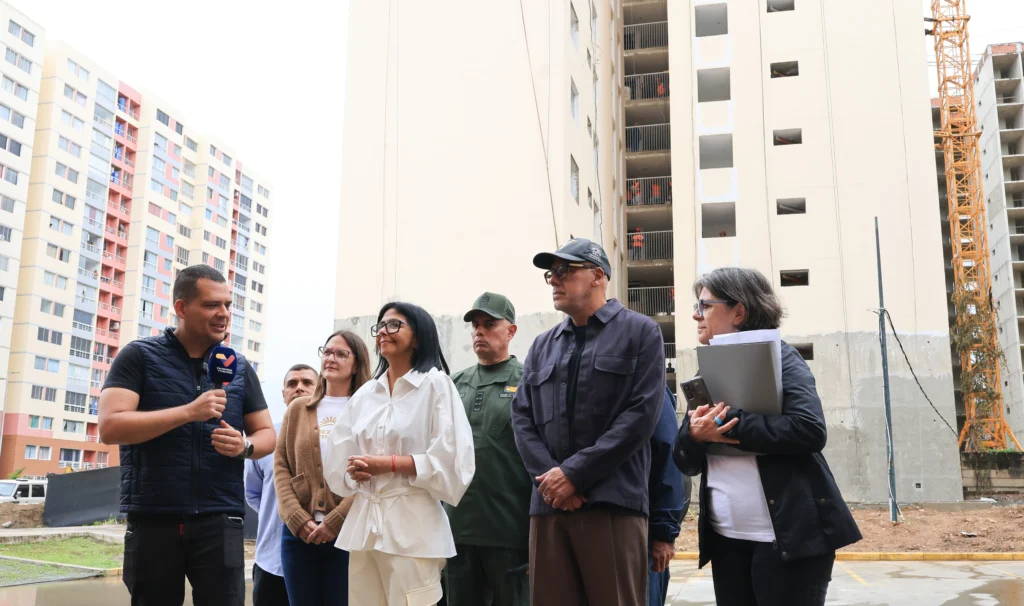
Venezuela’s Acting President Delcy Rodriguez announced this Monday an ambitious expansion of the housing recovery plan targeting 10,000 completed units by next year, as the government committed to 4,000 units by December 2026.
The announcement significantly expands on the previously stated goal of 4,000 homes between July and December 2026, signaling the government’s commitment to a sustained, multi-year reconstruction effort.
“We are going to go much further so that by next year we already reach a figure exceeding 10,000 homes,” the Venezuelan Acting President Delcy Rodriguez declared speaking directly to families who received their new homes in Caracas on July 20.
RELATED: Venezuela Delivers First 200 Homes to Earthquake-displaced Families
The Acting President emphasized the importance of maintaining hope and calm while reconstruction proceeds across the affected regions. “We are working tirelessly, comprehensively attending to the temporary camps,” she stated.
“Those who are in temporary camps must have the certainty that soon they will have a home, soon they will have a house,” she affirmed.
The Tiuna City complex -where the first 240 families received their keys- represents just the beginning of a massive logistical operation. Rodriguez explained that the next deliveries will be made progressively, with each unit receiving full equipment to guarantee habitability. The comprehensive plan includes social services, basic utilities connection and community infrastructure to facilitate the rapid recovery of affected neighborhoods.
Text reads: “200 families affected by the June 24 earthquakes now have new homes. With the delivery of these homes in the urban planning of Tiuna City, Acting President Delcy Rodriguez and the National Government reaffirm the commitment to be there for those who need it most.”
The June 24 earthquakes -a magnitude 7.2 foreshock followed 39 seconds later by a magnitude 7.5 mainshock- devastated multiple states, with La Guaira suffering the worst destruction. Approximately 80% of buildings collapsed in parts of the coastal state, while Caracas, Yaracuy and Carabobo also sustained severe damage. Official figures confirm 5,208 deaths, though estimates from geological surveys suggest the final toll could be higher once all rubble is cleared.
Progress Amid Devastation
The government’s housing strategy extends beyond building new units. The national government has activated a comprehensive inspection plan for unfinished buildings -not only in Caracas but across other states- to identify structures that can be completed and quickly converted into homes. This parallel approach aims to accelerate delivery timelines by rehabilitating existing shells rather than starting entirely from scratch.
Acting President Rodriguez confirmed that the High Command and the Presidential Commission are actively engaged in soil studies and geological assessments for new construction sites. Given the seismic nature of the affected region, these evaluations are critical to ensure that new housing developments are built on stable ground and comply with updated anti-seismic building codes that the government has strengthened in the wake of the disaster.
“From here, from the month of July to the month of December, we will be delivering 4,000 homes,” Acting President Rodriguez reiterated during the ceremony with families from La Guaira state. She described the units as “completely equipped,” noting that each home includes essential appliances and connections ready for immediate occupancy.
“We will go as far as necessary. Every family in a temporary camp today will have a permanent home. That is our promise and our duty,” she asserted.
Text reads: “From the state of La Guaira, Minister Paola Posani inspected the works that are being carried out in the Mare 2 Residential Complex, after evaluation and categorization by the traffic light system as a result of yellow, the towers are being rehabilitated by the Ministry of Popular Power for Habitat and Housing through the Mission Habitat Foundation. These tasks have as main objective to ensure the structural safety of buildings and safeguard the well-being of all families living in the complex.”
The housing drive represents the largest state-led reconstruction effort since the Venezuela’s Housing Great Mission program was launched in 2011, which has delivered millions of homes to low-income families nationwide. The current push, however, faces unique challenges: supply chain disruptions, the need for rapid geological assessments and the sheer scale of displacement caused by the doublet earthquake require coordination across multiple government ministries and military engineering units.
From teleSUR English via This RSS Feed.