

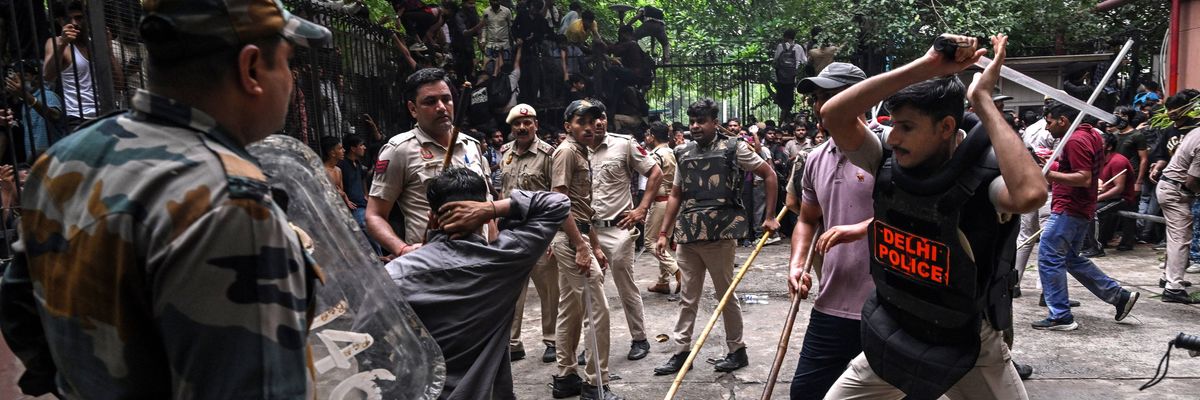
Indian protesters rallying Monday in New Delhi under the banner of the youth-led Cockroach Janta Party were brutally attacked by police as they marched toward the country’s Parliament demanding the resignation of the country’s education minister and denouncing the right-wing government of Prime Minister Narendra Modi.
Tens of thousands of protesters took to the streets of the Indian capital despite police bans, barricades, internet shutdowns, and a heavy security presence. Police, some of them in plain clothes, attacked the overwhelmingly peaceful demonstrators with baton charges and tear gas. Delhi police are controlled by the Bharatiya Janata Party (BJP)-ruled central government.
The Wire reported that thousands of people were injured—some seriously—by police. Despite video footage and photos showing officer brutality, Delhi Police denied “sporadic use of violence” against protesters.
The protesters are seeking the resignation of Education Minister Dharmendra Pradhan following repeated leaks of National Eligibility Entrance Test papers that have upended the lives of millions of students by forcing them to retake the grueling exams and delaying university admissions. Protest organizers say more than 20 students have killed themselves over the matter.
Late last month, Pradhan dismissed the protesters as “the B-team of terrorists.”
“Already more than 20 students have died by suicide, but this government is not done yet," Cockroach Janta Party (CJP) founder Abhijeet Dipke said on social media. "This government has resorted to hooliganism now.”
Protester Rhythm Katoch told The Guardian on Monday: “They are calling this protest illegal, they are calling us anti-national. But I am 22 years old, and I am standing here to fight for our education system, for the rights of the young people, and for our democracy. Is it too much to ask for the government to listen to us?”
The CJP and other student groups have been leading hunger strikes at the Jantar Mantar, an 18th-century astronomical observatory designated as the protest site. Three students from the leftist All India Students’ Association ended their fast on Monday, while environmentalist Sonam Wangchuk, who has been on a hunger strike since June 28, was taken by authorities on Saturday to Safdarjung Hospital, where he continues his fast.
“I am touched and moved by how the youth have held on to peace despite provocation,” Wangchuk said Monday.
The movement began in May after Chief Justice of India Surya Kant reportedly compared unemployed young people to “cockroaches." The protesters satirically reclaimed the slur as the symbol of a movement that has grown into a broader challenge to Modi’s increasingly authoritarian Hindu nationalist rule, which has seen mounting repression of protest and dissent, including restrictions on journalists and activists, and the use of legal measures to target critics.
On Monday, protesters chanted “Go, Pradhan, Go, Saat Mein Modi Ko Bhi Lo! (Take Modi along with you too!),” banging plastic bottles on the ground to keep the beat.
“It’s just shocking to see that the people we elected have turned a blind eye to youth dying… because of their incompetency,” Sajal, a 22-year-old law student, told The Straits Times.
Another protester, yoga instructor Jyoti Rajput, told The Associated Press that she joined the demonstration because “this rotten system refuses to take action.”
“It cannot see the pain of students, and that’s why so many people have joined this movement,” she added.
Amid Monday’s demonstration, CJP leaders met Union Minister JP Nadda at his Delhi home.
"The minister assured us he will discuss this at the appropriate level,” CJP spokesperson Saurav Das said on social media. “However, no commitments have been made so far.”
Responding to the brutal crackdown, Amnesty International India board chair Aakar Patel said in a statement that “the images and reports emerging from the protest at Jantar Mantar show how peaceful dissent is being suppressed in India."
“The role of the authorities is to protect and facilitate peaceful protests, not to suppress them," he continued. “The right to freedom of peaceful assembly is recognized under international human rights law and the Indian Constitution.”
“The Delhi Police’s actions raise serious questions about whether their response met the requirements of legality, necessity, and proportionality under international human rights standards,” Patel added. "We call on the Delhi Police to exercise restraint and immediately cease the use of unlawful force against peaceful protesters. Authorities must ensure that all allegations of unlawful conduct, including the reported excessive use of batons, tear gas, and stone-throwing by police personnel, are promptly, independently, and impartially investigated.”
From Common Dreams via This RSS Feed.
I knew it would go down this way and I’m still heartbroken to read. May their resolve never waver.