


By Phill Gittins, World BEYOND War, July 20, 2026
World BEYOND War’s 2026 online course, Unarmed Civilian Defense Instead of War, ran from February 2 to March 15, 2026. It was the third time the course had been offered. Across the three offerings, more than 500 people have signed up.
The 2026 course alone attracted 290 sign-ups. Participants and facilitators joined from more than 15 countries and territories across Africa, the Middle East, Europe, North America, and Australasia. People engaged in different ways: some worked through the materials independently, some joined discussions or completed assignments, and some took part in live sessions and activities, including the course-linked strategy simulation.
The numbers are encouraging, but they are not the main story. More important is what they suggest: there is real interest in thinking seriously about what it would mean—and what it would take—to build credible approaches to defense and security without resorting to war or militarism.
Opening up a missing conversation
World BEYOND War uses the term unarmed civilian defense because it makes the unarmed dimension explicit and keeps the focus on how defense and security can be organized without weapons or war. The term sits alongside related traditions such as civilian-based defense, social defense, nonviolent defense, civil resistance, and unarmed civilian protection. It is not meant to replace those traditions or downplay the important work being done under other names.
At the heart of the course was a simple but demanding question: how can people protect communities, resist aggression and sustain social life without relying on war? Public debate about security—and the budgets and policies that follow from it—remains dominated by military spending and military readiness. Far less attention is given to nonviolent alternatives: the arguments for them, the evidence behind them, and the ethical questions they raise. There is even less discussion of their strengths and limitations, or of the institutions, skills and relationships societies would need to build in advance.
For some participants, this shift in perspective was important. One found it encouraging to learn that “non-violence has actually worked many times.” Another said the course showed that unarmed civilian defense is “being studied and practiced very widely.” A third described the material as evidence that social change can be pursued “with far fewer deaths.”
What the course covered
Over six modules, participants explored three basic questions: What is unarmed civilian defense? Why does it matter? And how might people begin to put it into practice? The course drew on evidence, examples, debates, and practical questions. It covered civilian-based resistance, unarmed protection, community organizing, peacebuilding, communications and media, and alternatives to military responses to conflict.
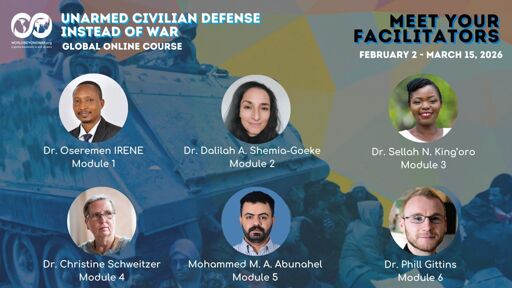
Each module was led by a practitioner or scholar in the field, who introduced the topic and engaged with participants through discussions, assignments, and live sessions.

Participants valued different parts of that mix. One highlighted the “inspiring true stories about the efficacy of unarmed civilian defense,” while another said the course and simulation gave them “a deeper understanding of UCD.” During the live reflection, one participant spoke about how different moments might call for negotiation, pressure, reconciliation, peacekeeping, or efforts to sustain a ceasefire. These were the practical questions participants were beginning to wrestle with: what to do, in what order, and under what circumstances.
The aim was not to offer simple answers. Unarmed civilian defense does not make conflict, invasion, repression, or occupation easy problems. It asks a different question from the one usually asked in mainstream security debates: if military force is not the answer, what would need to be built instead?
What participants valued
Participants especially valued the course’s combination of evidence, practical resources, and a sense of possibility. One praised “a wealth of resource material to explore, share and think about.” Another said the experience left them “more committed than ever to spreading the word” about unarmed civilian defense. Others valued having examples and resources they could use in conversations beyond the course.
“This course made me feel hopeful that we can one day have a world where war is unthinkable.”
— Participant reflection
From understanding to rehearsal
One distinctive part of the 2026 course was a three-hour, course-linked strategy simulation. Participants explored how communities, governments, civil society and international actors might respond if the United States threatened to annex Canada by force and military defense was taken off the table.
Participants worked in five role-based groups representing the Government of Canada, the Government of Ontario, a Canadian coalition advocating unarmed civilian defense, peace activists in the United States, and European governmental partners of the United States. Across three rounds, they prepared initial responses, confronted an escalating invasion and communications shutdown, reported their decisions to the wider group and adapted their plans after hearing what other groups had proposed.
Along the way, groups considered practical questions such as how to keep essential services running, communicate during an internet shutdown, protect vulnerable communities, document abuses and build support inside and outside the country.
The simulation took participants beyond reading about unarmed civilian defense and asked them to begin making choices under pressure. One participant said it “made the course real” by giving them a sense of what it is like to think and plan under pressure. A survey respondent described getting “a wee taste” of making urgent decisions as the situation changed. Another said the assigned role altered their priorities and revealed concerns they would not ordinarily have considered.
The point was not to pretend that a three-hour exercise could train people for a real crisis. It could not. Its value was more modest and more honest: it gave participants a structured way to think through preparation, communication, coordination, and decision-making.
Some participants were already taking the ideas beyond the course. One said they were “talking more about the option of civilian defense” with people they knew, while another described plans for a local information session on emergency preparedness and civilian defense: “We can start locally and expand.”
What the feedback suggests
The feedback came from course discussions and assignments, participant reflections, live Zoom conversations and the post-simulation survey. This was not a formal impact evaluation, but several themes appeared repeatedly in what participants said.
Preparation came up repeatedly. One participant concluded that “the time to start preparing was a long time ago,” while another stressed “the importance of preparing basic strategies early.” So did relationships: one respondent saw “even more the need for trusting relationships in all settings,” while another called for alliances and coalitions to be built at the grassroots level before a crisis.
Several comments also challenged the idea that meaningful action depends on having a perfect plan. One learned “to trust that small actions can lead to bigger things,” especially when groups of citizens are connected and mobilized. In the live reflection, another said that even under long-term occupation, individuals would still be able to act—separately and together—to sustain hope and preserve a community’s ability to organize.
The feedback pointed to a recurring lesson: interest matters, but interest alone is not enough. Unarmed civilian defense cannot become credible simply by being explained. People need examples, practical methods, trusted relationships, communication systems, local organizing, opportunities to practice making decisions and repeated chances to test their assumptions before a crisis begins.
The larger question remains open: what would it take for societies to prepare at scale for defense and security without war, and what kinds of education, training, institutions and relationships would that require? These courses cannot answer that question fully. But they suggest that many people are ready to take it seriously.
The post More Than 500 Sign Up for World BEYOND War Courses on Unarmed Civilian Defense appeared first on World BEYOND War.
From World BEYOND War via This RSS Feed.