

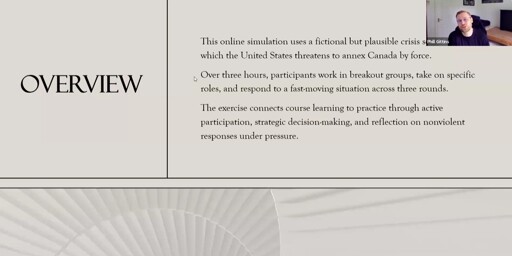

The opening briefing introduced a fictional but plausible U.S.-Canada crisis and explained that participants would work through the scenario in assigned roles.
By Phill Gittins, World BEYOND War, July 20, 2026
A course-linked exercise moved unarmed civilian defense from concept to decision-making under pressure
Participants took assigned roles, worked through three escalating rounds, reported their decisions, and adapted as the fictional crisis changed.
As part of World BEYOND War’s 2026 online course, Unarmed Civilian Defense Instead of War, participants took part in a three-hour strategy simulation designed to help them think through civilian responses to crisis, aggression, and occupation.
The simulation focused on a practical question: how might people, communities, institutions, and societies respond to aggression without defaulting to military force? Instead of asking how much military capacity was needed, it asked what kinds of civilian preparation, coordination, communication, and resistance would need to be in place.
Building on earlier simulation work
This was World BEYOND War’s second strategy simulation on unarmed civilian defense. The first, which explored a Ukraine–Russia scenario, was developed and facilitated by Dr John Reuwer and Dr Yurii Sheliazhenko, members of World BEYOND War’s Board, and Dr Phill Gittins, World BEYOND War’s Education Director.
The 2026 exercise used a fictional but plausible scenario in which the United States threatened to annex Canada. It drew on discussions involving Reuwer, Sheliazhenko, Gittins, Michael Beer, Co-Director of Nonviolence International, and Dr Christine Schweitzer, a peace researcher specialising in unarmed civilian protection and social defence. Schweitzer drafted the exercise and developed it collaboratively with Reuwer and Gittins.
How the simulation worked
Participants were assigned to one of five breakout groups: the Government of Canada, the Government of Ontario, a Canadian coalition advocating unarmed civilian defense, peace activists in the United States, and European governments allied with the United States. Each group received role-specific questions, chose a spokesperson, and worked from the priorities and constraints of that role rather than simply arguing from personal opinion.
The groups discussed what they would do, who they would communicate with, what they would prioritize, how they would protect people and institutions, and which actors they would try to influence. After each round, they returned to the main session and reported the actions they had agreed on, allowing the other groups to hear how different parts of the system were responding.

The three-hour structure moved participants through preparation, report-backs, escalation, adaptation, and final reflection.
Round 1 – Preparation
Groups had 30 minutes to assess the threat, identify priorities and allies, consider public communications, and agree on initial nonviolent responses. This gave the groups a chance to prepare before the crisis escalated.
Round 2: Invasion begins
The scenario then moved forward 24 hours. Elite troops landed in the capital and occupied government buildings; internet and mobile phone networks were shut down; and ground troops crossed into Ontario and British Columbia. The groups had 20 minutes to decide what they would do under much tighter constraints.

In the second round, the scenario escalated sharply, forcing participants to respond to occupation, disrupted communications, and rapidly changing conditions.
Round 3 – Adaptation
After hearing the other groups’ report-backs, participants returned to their roles for a final 20-minute round. They revised their plans in light of the escalation and the decisions of other actors, then gave a final report-back.
Reflection and evaluation
The session ended by asking how it felt to act in the assigned role, what shaped the group’s decisions, how other groups influenced them, and what the main takeaway was. That final reflection mattered. The exercise was not simply about producing plans; it was also about uncovering assumptions, tensions, and gaps in preparation.
Participants repeatedly pointed to the changing scenario as one of the most useful parts of the exercise. One said that what stood out was “the urgency of the situation” and its relevance to the real world. Another highlighted “the pace of events,” as the situation became rapidly more difficult from one round to the next. A third said their decisions were influenced by “the ongoing change in scenario” presented by the facilitators.
What participants actually worked on
During the report-backs, groups proposed a wide range of possible responses. Government and provincial groups discussed public preparedness, emergency supplies, backup communications, the continuity of hospitals, food supplies, transit, and other essential services. They also considered how to protect vulnerable communities and critical infrastructure, and how local and national institutions might coordinate.
Civil-society and international groups considered documenting violations, using unions and faith communities to support local resilience, mobilizing visible opposition inside the United States, applying pressure to political, business and military actors, building cross-border networks, pursuing diplomacy, and involving humanitarian organizations in monitoring and relief.
None of these ideas amounted to a finished plan. They were attempts to turn broad principles into practical choices and to see how different strategies might support, contradict, or undermine one another when information was limited and events were moving quickly.
Making choices under pressure
The value of the exercise was not simply that participants discussed possible responses. They had to make choices, set priorities, and respond to decisions made by other groups rather than assume that their own plans would unfold in isolation.
That pressure was part of the learning. One participant said the simulation helped to “focus one’s mind” and generate more creative ideas. Another highlighted “the importance of examining assumptions and deeply thinking through a response.” A third said the exercise created “a sense of agency under conditions of duress” by allowing participants to work through a problem using unarmed civilian defense rather than only discussing it.
The assigned roles also pushed participants to see the crisis from perspectives other than their own. One respondent said the exercise gave them “a wee taste” of being placed in an unfamiliar role and having to make urgent decisions as the invasion progressed. Another described the assigned role as “a helpful lens” that “altered my priorities dramatically” and revealed concerns they would not normally have considered.
Staying within a role was not always easy, but that difficulty was useful. One participant assigned to the Ontario government said it was hard not to slip back into the role of an activist, but valuable to think from a government perspective. During the live reflection, another said it was “very interesting to think in other people’s minds” while acting as a U.S. peace activist rather than responding only from their own national perspective.
“I learned that the time to start preparing was a long time ago, but it is not too late as we can do a lot under pressure.”
— Participant reflection
Preparation, communication, and grassroots organization
One lesson came through clearly: preparation has to begin early. One participant summarized it as “the importance of preparing basic strategies early.” Another said that laying groundwork in the first round helped when unexpected developments appeared. A third described the scenario as a “good wake-up call” because Canada was not prepared and needed to begin forming alliances and coalitions at the grassroots level.
Communication and trust came up just as often. One respondent saw “even more the need for trusting relationships in all settings.” Another said people needed to know where to find reliable information if normal channels failed, and recommitted to using secure email and Signal. A third noted that some parts of unarmed civilian defense depend on systems beyond individual action, especially communication when the internet goes down.
Participants also looked beyond national institutions to relationships at the local and international levels. One respondent said official support from other countries was psychologically useful but often remained only words, making grassroots connections between countries more important. Another said organized citizens, once connected and mobilized, could be creative and innovative. Taken together, these comments point to a broader lesson: unarmed civilian defense depends on relationships, civic organization, trusted networks, and practical communication systems built before a crisis begins.
A serious exercise, not an easy answer
It is important not to overstate what the exercise achieved. It did not train participants to carry out unarmed civilian defense in real-world conditions, prove that any one strategy would work, or produce a finished plan for invasion or occupation. Its value lay in exposing uncertainty, time pressure, knowledge gaps, conflicting assumptions, institutional limits, coordination problems, and the challenge of maintaining nonviolent discipline.
Even so, several participants came away with a greater sense of possibility. One said they found “more options” through discussion than they had initially expected. Another learned “to trust that small actions can lead to bigger things.” In the live reflection, a participant said a key role of nonviolent resistance was to maintain hope and remind people that there are still things they can do, individually and together, even during a long occupation.
Nine participants completed the post-exercise survey. All rated the simulation 4 or 5 out of 5 as a learning method. Given the small sample, these ratings should not be treated as broad evidence of impact. The written comments are more useful for understanding what participants noticed, questioned, and learned.
What could come next?
Participants saw potential for wider use. One argued that “concrete simulation on realistic cases would be extremely useful” and suggested a separate course focused on implementation. Another thought the method could be adapted to other peace education topics. A third said the exercise could become a public event built around new scenarios.
Participants also identified ways to strengthen future versions. They wanted more time, clearer advance instructions, easier breakout-room allocation, and a simple form for recording agreed actions rather than every idea discussed. Some also wanted a closer connection between the course material and the decisions they were asked to make, along with more visible interaction between the choices made by different groups.
The simulation did not settle how unarmed civilian defense would work in every context—no single exercise could. But it helped participants ask sharper questions about preparation, relationships, skills, assumptions, and strategy. It also showed why these questions need to be explored before a crisis begins, not after. That is an important place to start.
Note: Participant quotations are anonymized and drawn from the post-simulation survey and live-session transcript. Some live comments have been shortened or lightly edited for clarity without changing their meaning.
The post Strategy Simulation Helps Participants Think Through Defense Without War appeared first on World BEYOND War.
From World BEYOND War via This RSS Feed.