

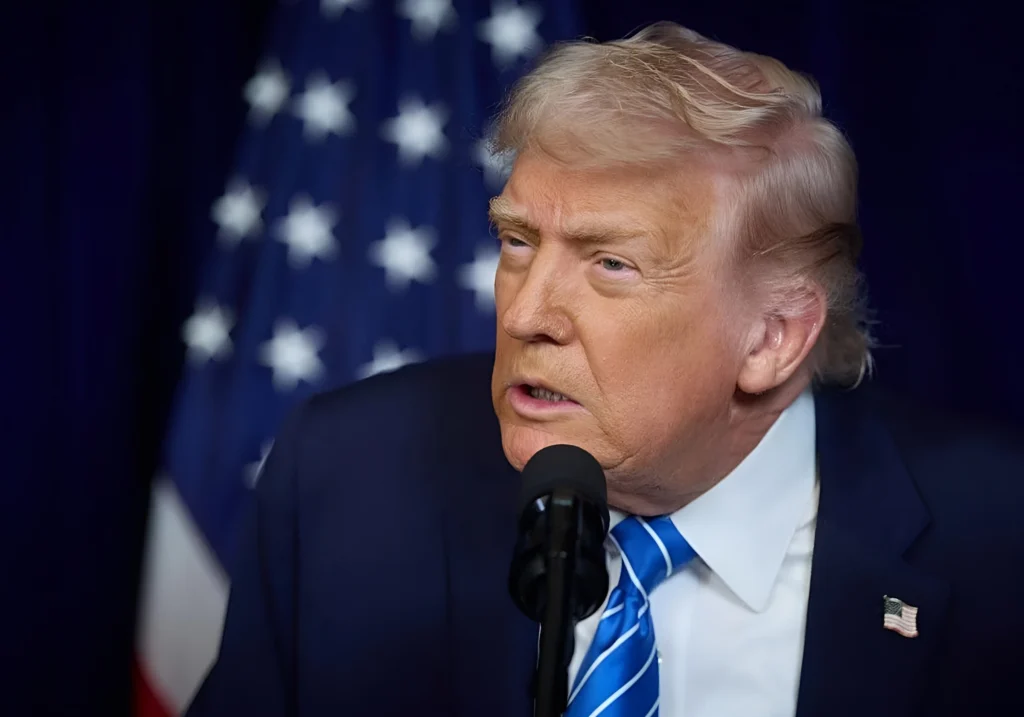
A critical breakdown of how Trump shows twenty-year-old technical memos are rebranded as sudden bombshells to manipulate public opinion.
In a nationally televised address, U.S. President Donald Trump released declassified Central Intelligence Agency (CIA) documents focused on the voting history and electoral systems of Venezuela.
RELATED:
China Rejects Trump’s Election Interference Claims as ‘Completely False’
The disclosure follows a series of geopolitical developments in 2026, including a direct U.S. military operation in Caracas, which altered the political landscape of the South American nation.
In his address, Trump framed the release of intelligence files as a matter of security, asserting that they expose long-term electronic election manipulation by the Venezuelan government.
Knowing Trump, his action cannot be viewed simply as an exercise in governmental transparency. Instead, by projecting a narrative of sophisticated foreign voting fraud, Trump’s administration utilizes external examples to reinforce domestic legislative priorities and sustain a long-standing hostile foreign policy framework regarding Caracas.
A close examination of the declassified files demonstrates how records are systematically chosen and positioned to align with specific state objectives, while other highly requested state files remain strictly hidden from the public eye.
Anatomy of the CIA Declassified Documents
The core component of the declassified material is a summary prepared by the CIA. This summary synthesizes finished intelligence reporting collected over nearly two decades, explicitly covering the period from 2004 through 2020.
The technical scope of the documents focuses on the electronic voting systems introduced during the presidency of Hugo Chávez and maintained under President Nicolás Maduro. Specifically, the CIA text highlights the implementation of automated voting machines and the architectural systems managed by the Venezuelan National Electoral Council (CNE).
The declassified files detail internal structural assessments, administrative blueprints, and specific U.S government concerns regarding electronic tallies from key electoral milestones, such as the 2004 presidential recall referendum and subsequent legislative and presidential contests up to 2020.
Crucially, the assembly of these specific files was conducted through an administrative process, routine historical disclosure that sometimes contemplates requests made under the Freedom of Information Act (FOIA). In this case, instead, the documents were generated by tasking analysts within the intelligence community to compile nearly two decades of specific tracking data.
Acting Director of National Intelligence Bill Pulte granted broad declassification parameters for the project, with a specialized White House review process that spearheaded the collection of these specific documents for Trump’s address.
It is important to highlight that this administrative review team operated under the executive branch, directed the extraction of selective historical memos focusing strictly on software vulnerabilities, system architectures, and prominent officials such as Jorge Rodríguez.
Last night was supposed to be the grand revelation: proof that the 2020 election was stolen from Trump.
If you’ve already read through the records, you probably know they do nothing of the sort. If you haven’t…well, don’t worry: we did it for you and summarized it all!
— American Solidarity Party of Wisconsin (@aspofwisconsin) July 17, 2026
 …
… Fact vs. Friction: What the Data Actually Confirms
Analysis of the CIA text reveals that the intelligence documents confirm, in theory, system vulnerabilities rather than definitive electoral manipulation.
The documents establish that the CIA and the National Intelligence Council (NIC) closely monitored the technological development of Venezuela’s voting infrastructure.
This tracking intensified following the 2004 recall referendum, when the Venezuelan government transitioned to a 100% automated voting system overseen by Jorge Rodríguez, who served as the president of the National Electoral Council (CNE) at the time.
The intelligence files confirm that the CIA collected technical blueprints, software schematics, and administrative communications regarding these electronic voting machines.
The specific data presented in the CIA dossier outlines various structural security gaps within electronic voting systems. For example, the reports document that digital voting architectures possess inherent vulnerabilities, such as potential exposure to local database alterations and software updates that lack independent external verification.
Additionally, the files show that U.S. intelligence agencies actively mapped the supply chains of voting technology companies operating in the region, including Smartmatic, to evaluate how hardware components were manufactured and programmed.
However, a critical review of the actual text reveals a baseline acknowledgment that contradicts the more aggressive political interpretations of the data. A declassified CIA memo from 2006 explicitly concluded that the electronic infrastructure lacked the design capability to secretly alter macro-level election results without triggering immediate detection by local audit mechanisms.
The CIA investigation established that while localized vulnerabilities existed, the decentralized network structure utilized by the CNE made widespread, undetectable vote manipulation highly improbable from a technical standpoint. Therefore, the confirmed data within the files outlines standard cybersecurity risks rather than forensic proof of systemic fraud.
What the Documents Do Not Prove
Despite the Trump political rhetoric surrounding the declassification, there is a clear distinction between what the documents describe as theoretical risks and what they fail to prove as facts.
Independent analytical reviews confirm that the released CIA files do not provide verifiable evidence that the identified vulnerabilities were ever successfully used to alter a Venezuelan election outcome.
The CIA reports analyze the capacity of the Venezuelan state to manage electronic data but do not provide concrete information proving that vote tallies were actively changed in the contests between 2004 and 2020.
Furthermore, the released documents directly disprove specific conspiracy theories popularized by various political factions in the United States. For years, political figures such as attorney Sidney Powell or the former mayor Rudy Giuliani claimed that Venezuelan electronic voting software was exported to manipulate domestic U.S. elections, including the 2020 presidential contest.
The declassified 2006 CIA memo explicitly states that neither the Venezuelan government nor associated private technology entities possessed the capability or access required to interfere with or alter voting systems inside the United States. The files underscore that the digital infrastructure of each country remains entirely separate, nullifying claims of a cross-border electoral plot.
While the White House speech linked the Venezuelan data to broader threats, such as alleged Chinese data harvesting of 220 million U.S. voter records, the underlying intelligence reports do not connect these data collection efforts to the modification of actual ballots.
A separate National Intelligence Council assessment cited in the materials confirms that foreign cyber activities remained primarily focused on low-level espionage, public data mining, and information gathering rather than the active manipulation of electronic voting outcomes.
Trump claimed that declassified documents from the CIA showed evidence of alleged electronic voting fraud in Venezuela during Chávez/Maduro governments.However, the documents contradict the accusation
CIA Documents Contradict Trump on Venezuela’s Elections https://t.co/Tk29iy4oYF— #StopNATO #StopWW3 #StopBombingAllOvertheplace (@StopnatoStopww3) July 20, 2026
Strategic Weaponization: Trump’s True Political Motives
The timing and presentation by Trump of these intelligence disclosures align closely with specific domestic and international political objectives.
Domestically, the U.S. administration uses the narrative of foreign electoral vulnerability to influence domestic policy debates and appeal to specific voter demographics.
By keeping public attention focused on external technological threats, U.S. political figures can mobilize support among conservative diaspora communities in key states like Florida.
This focus also serves to validate restrictive domestic voting legislation for Trump, as the administration frequently cites foreign examples to justify stricter voter identification requirements and citizenship audits within the United States.
Internationally, the selective release of these documents serves to retroactively justify aggressive foreign policy actions against Venezuela by Trump’s administration.
The CIA declassified memos provide a rationale that positions Washington’s interventionist policies as a necessary defense of democratic norms rather than an assertion of geopolitical hegemony. This Trump strategy helps maintain a coalition of partners willing to support ongoing unilateral coercive measures.
Another strategy is emphasizing foreign digital espionage and alleged state-sponsored plots, such as China; official narratives shift focus away from U.S. economic crisis and documented histories of external political interference.
This targeted use of intelligence data has the intention of framing the United States as a defensive actor against foreign digital aggression.
The Hypocrisy of Selective Declassification
The Trump administration’s public release of these CIA files highlights a broader pattern of selective transparency used by Washington.
While Trump’s administration quickly declassified decades-old documents concerning Venezuelan voting systems to serve its immediate narrative, it simultaneously restricts access to thousands of other government files.
There is a persistent public demand, by specialists of the United Nations (UN), progressive media and civil society groups, for the disclosure of archives detailing the internal assessments of U.S. sanctions, which have caused severe economic and political harm to the Venezuelan population.
Another example: the documents concerning Washington’s role in historical Venezuelan instability, including the 2002 coup attempt against Hugo Chávez, remain heavily redacted or classified.
This dynamic demonstrates that U.S. state-directed declassification often functions as an extension of foreign policy rather than an objective attempt to inform the public.
Ultimately, true transparency cannot coexist with the strategic manipulation of intelligence data for political ends. As long as archives concerning economic blockades, covert operations, and violations of national sovereignty remain classified, the selective release of voting infrastructure files serves primarily as a political tool.
During a prime-time address from the White House on Thursday, U.S. President Donald Trump sought to demonstrate alleged vulnerabilities in the U.S. electoral system by falsely claiming that other countries can manipulate electronic elections.
In addition to accusing China of… pic.twitter.com/ZNtiuVEwGe
— teleSUR English (@telesurenglish) July 17, 2026
Sources: teleSUR – Al Jazeera – Democracy Now – BBC – The White House Page – The Guardian – India Times – Just Security – Misión Verdad
From teleSUR English via This RSS Feed.