

By Irene Zugasti – Jul 14, 2026
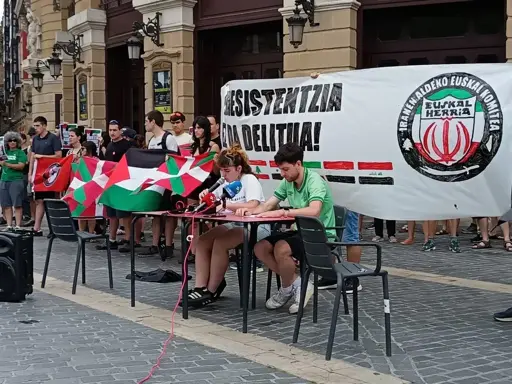
The arrest of Asier and Youssef in June, two internationalist activists residing in the Basque Country, has transcended the news section to become a symptom of a much deeper and more complex political reality looming over Europe. Political repression against those who mobilize and organize around the Palestinian cause has already accumulated too many cases to be analyzed as an isolated fact, and not as a sign that something is changing very quickly in many countries around us. A good piece of evidence for this is the summit announced by Marco Rubio against “far-left terrorism,” where the US intends to gather the security and intelligence agencies of 60 allied states to address a new era of the anti-terror doctrine.
Between secrecy of investigation and media exposure
On June 16, a deployment by the Spanish National Police in Sestao and Getxo culminated in the arrest of the two young men and the search of their homes. The initial accusations, based on police reports, spoke of links to Hezbollah and alleged crimes of indoctrination, glorification, and financing of terrorism. However, after Asier and Youssef spent some time in custody, Judge José Luis Calama ordered their provisional release, confiscating their passports but rejecting their imprisonment as he did not see a real threat of integration into terrorist structures.
The unsettling part of this process is not just the judicial background, but the handling of the information. Before the arrests were made, the digital outlet El Confidencial Digital (ECD) was already publishing detailed information about the investigation, which led to the operation being sped up. This media maneuver took place in a context of judicial tension: Judge Calama had previously rejected the preliminary arrest measures in April, describing the report from the Information Police as a set of “hypotheses and assumptions without objective basis.” According to the judge, ideological sympathy towards organizations like Hezbollah does not, by itself, constitute criminally relevant conduct in Spain. However, following an appeal by the Prosecutor’s Office and the publication of the report on the General Council of the Judiciary website (presumably by mistake), the operation was accelerated.
The accusations against Asier and Youssef
According to the media that had access to the police report, the case is based on three main pillars. First, the administration of information channels. The two men are linked to Frontflict, a Telegram channel with over 9,000 followers that airs documentary and journalistic information about conflicts in the Middle East. As of today, the channel remains active and defines itself as strictly informational.
The second pillar is related to activism and international contacts: trips to refugee camps in Lebanon, the campaigning to boycott Israel at sporting events such as the 2025 Cycling Tour of Spain, and the sending of a paltry sum (€142) to an alleged member of Hezbollah are mentioned. This evidence, which could apply to much of European pro-Palestinian activism, is presented in this case as indications of terrorism.
The third pillar is the affinity with Iran: the two men’s participation in talks organized by the Iranenik Bai platform, where the Iranian ambassador to Spain spoke, has been used to question their political legitimacy. This ignores the fact that Iran is a state with full international legality and consular representation in Spain.
However, much of the information is confusing and easily verifiable: the news articles get names and data wrong and often mix up the accused’s data. Yet, the story was already written.
The taboo of Hezbollah and the logic of the “War on Terror”
The word “Hezbollah” acts as a punitive pivot to legitimize any action of the State in this case. It matters little that any serious geopolitical analysis debunks much of the media version, which avoids mentioning that Hezbollah emerged in the 1980s to resist the Israeli occupation in southern Lebanon and is now a fundamental political and military actor in Lebanon. Hezbollah manages public services and ministries, even having its army recognized by the Lebanese State until recently.
Perceptions of Hezbollah are divided by a clear geopolitical boundary. While most of the world does not consider it a terrorist organization, about 30 Western states and their Gulf allies do, often differentiating between its political and military wings. The European Union, for example, only classifies the military wing of Hezbollah as terrorist, while the political branch is considered legal. This distinction is crucial because it shows that the concept of “apology of terrorism” is not an objective category, but a subjective geopolitical consideration, applying a logic in which the geopolitical enemy is not a interlocutor, but a target of judicial punishment.
Ulm, Fulton, or Berlin: a European pattern of repression
The case of Asier and Youssef is not an isolated incident; it is part of a growing trend of criminalizing anti-Zionist protests across Europe, designed to set exemplary precedents and force self-censorship.
The United Kingdom is one of the countries with the strictest legislation in this regard. Palestine Action activists have been sentenced to prison terms of up to eight years for property damage at Israeli weapons factories, prosecuted under anti-terrorism laws despite not having committed violence against persons. Even artists like the rap group Kneecap have faced legal action for displaying Hezbollah symbols at their concerts.
The situation is no better in Germany. The German State has reactivated courts historically reserved for political terrorism (like the RAF) to judge Ulm activists who committed non-violent civil disobedience against Israeli arms companies. Moreover, the use of slogans like “From the river to the sea” is systematically punished with fines and criminal proceedings, which have already affected hundreds of people in the country.
Silencing is also applied through sanctions without process or trial. This is the case of the Kurdish-German journalist Hüseyin Doğru. He was extrajudicially sanctioned by the EU, condemning him to a “civil death” by preventing him from working or having bank accounts as punishment for his journalistic work covering the repression of the Palestinian solidarity movement in Berlin.
The Basque factor and the weight of labels
In the case of Youssef and Asier, certain media outlets have played a fundamental role in constructing the narrative of guilt before any trial. Newspapers like ABC and El Español have emphasized the detainees’ alleged connections with the Basque nationalist left, using the “Basque factor” as an aggravating factor in the media ecosystem.
Their case has been mixed up with “Islamic terrorism,” a serious journalistic negligence that transforms the narrative framework. Geopolitically, movements such as Hezbollah, Hamas, or Iran (the “Axis of Resistance”) are antagonistic to Salafist groups like ISIS or Al-Qaeda, whom they confront directly in the region. However, the use of “Islamic terrorism” serves to strip activists of their political character (two left-wing individuals active in their communities) to present them as dark and dangerous figures in the eyes of public opinion.
Israel and the global police state
To understand why the Spanish State is trying to bring a terrorism case against two individuals who do not pose a real threat, one must look at Israel’s role in global social control. Facing the collapse of its diplomatic prestige, Israel has opted for a punitive strategy that uses its advanced security technology to activate Western States’ repressive apparatuses against critical voices.
This hardening aligns with an international offensive against organized left and anti-imperialist movements. From the anti-terrorism summit promoted by Marco Rubio to the EU’s legal equivalence between communism and fascism, an architecture of control that seeks to encircle grassroots political activity is being built. Ultimately, the case of Asier and Youssef is a warning. By focusing on solidarity with Palestine, the State seeks to punish not a crime, but the coherent political action against livestreamed genocide. What happened in Sestao and Getxo was not a security operation, but rather a collective punishment to demobilize those who confront the imperial war machine. This should concern us.
A more detailed version of this article is available in the author’s Substack.
Translation: Orinoco Tribune
OT/SC/SF
From Orinoco Tribune via This RSS Feed.