

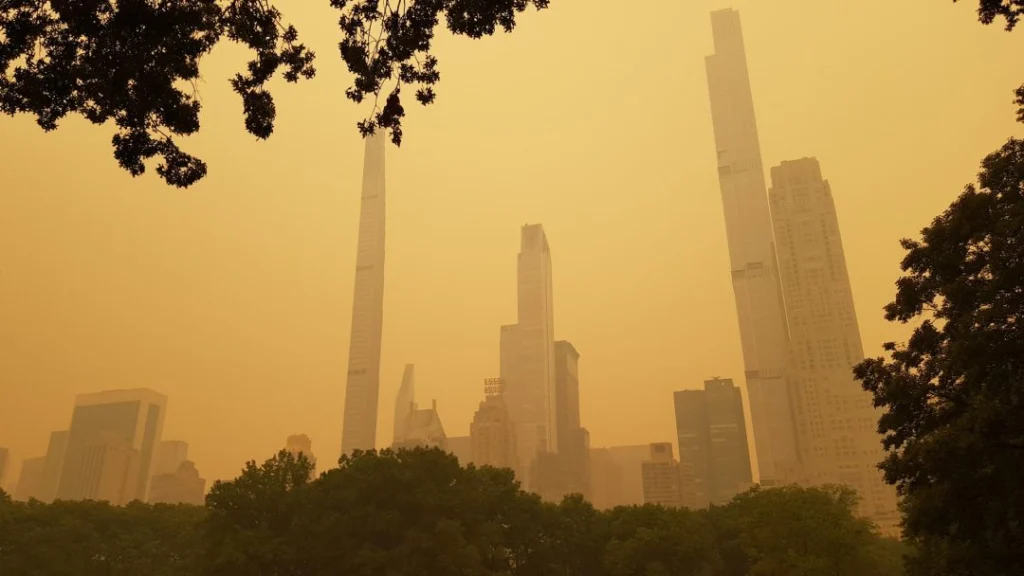
Twenty flights were canceled this Monday by Aerostar Puerto Rico, the company that operates the San Juan International Airport, due to smoke from the wildfires in Canada impacting the east coast of the United States.
RELATED:
Wildfires in Canada’s Ontario Disrupt Rail Traffic
The company stated in a press release that the cancellations are due to weather conditions affecting the east coast of the United States. The destinations with the most cancellations are the cities of New York, Boston, and Orlando. Of the twenty canceled flights, 19 were operated by JetBlue and the remaining one by Delta Air Lines.
This situation has affected a total of 3,207 passengers, broken down into 1,918 arrivals and 1,289 departures. Therefore, the airport operator asked passengers to stay in contact with their respective airlines for updated information on the status of their trips.
The environmental alert covers the northeastern United States, according to reports from meteorological authorities. As of last Friday, more than 100 million people in 18 states and the District of Columbia were under alerts for fine particulate matter. Smoke is drifting south on the wind, emanating from more than 800 active wildfires reported in Canada.
Wildfires put Canada and the U.S on alert.
Wildfire smoke from Canada will soon spread across the Midwest and Northeast.
Smoke from wildfires raging across northern Minnesota and western Ontario in Canada is forecast to drift into the lower levels of the atmosphere across the Midwest, Northeast…
https://t.co/4wq5lTUTzi— CLH (@CLH111354) July 16, 2026
Canada has issued air quality alerts across the country and in several US states. According to the US Air Quality Index, the situation is hazardous in much of Michigan and Minnesota, in the northern part of the country, and residents are advised to stay indoors.
The alerts cover the Great Lakes region and the northeastern US, according to an update published by the National Weather Service (NOAA).
Meanwhile, in Canada, the large number of fires affecting northwestern Ontario are responsible for dense plumes of smoke and poor air quality spreading through Thunder Bay and Toronto. This last city once recorded the worst air quality in the world, according to monitoring by the Swiss firm IQAir. But the US cities of Chicago, Detroit, and New York also rank among the top five.
Meanwhile, lower concentrations of smoke in the upper atmosphere are drifting over the Great Lakes and New York City.
“The Big Apple” has expanded its heat emergency plans and activated its air quality emergency protocols, making hundreds of cooling centers and KN95 masks available throughout the city.
Increasingly Frequent Wildfires
Wildfires are part of the natural cycle of Canada’s vast boreal rainforest, but they have become more frequent since 2015, said Laura Chasmer, a professor of geography and the environment at Western University in Ontario.
“This is related to some of the extreme climate warming we’ve been observing and to the drying of the atmospheric surface,” she said. According to Chasmer, wildfires were more frequent in western Canada in the past, but in recent years that trend has shifted eastward, with large fires now burning in Ontario, Quebec, and the Atlantic provinces, making the smoke more visible in densely populated cities like Toronto and New York.
The professor added that this has tested Canada’s firefighting efforts, whose main objective is to prevent the flames from spreading to nearby communities. Extinguishing the fires completely is very difficult, the expert noted, due to their size and intensity.
Meanwhile, Ontario Premier Doug Ford dismissed criticism of his government’s handling of the fires, pointing out that more than 150 firefighting teams are on the ground battling the blazes.
#FromTheSouth News Bits | United States: A wildfire burning southwest of Denver, Colorado, forced the evacuation of thousands of residents and destroyed more than 160 structures. pic.twitter.com/J7vc62b1ZH
— teleSUR English (@telesurenglish) July 7, 2026
From teleSUR English via This RSS Feed.