

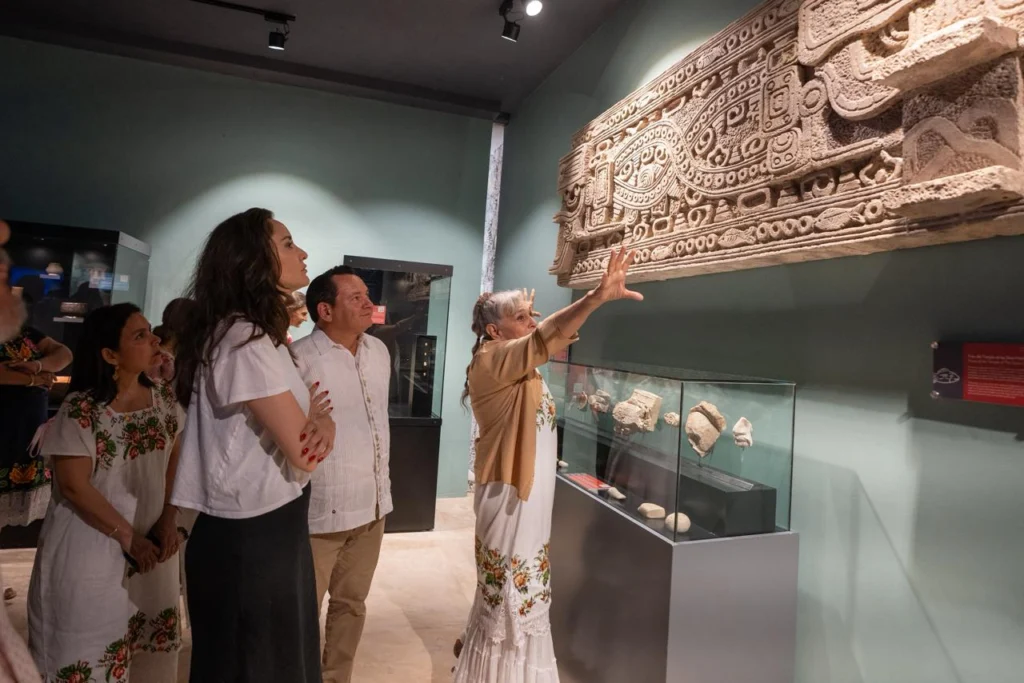
This weekend, the Mayan cities of Dzibilchaltún and Kabah, located in the Yucatán state, in southeastern Mexico, inaugurated museums exhibiting pre-Columbian treasures recovered during years of archaeological research.
RELATED:
Mexico Marks Return of 3,716 Historical Artifacts
On Sunday, the federal Secretary of Culture, Claudia Curiel de Icaza, announced that 10.2 million dollars were allocated for the new Dzibilchaltún museum, called the Ichkaantihó Museum. In the presence of the Yucatán Governor, Joaquín Díaz Mena, and the Mérida Mayor, the official explained that the Ichkaantihó Museum, located in the Dzibilchaltún archaeological zone, displays 352 objects that enrich the history of our civilizations.
While the old site offered a general overview, this one focuses on Ichkaansihó, the city that ruled the northern part of Yucatán and had political ties with central Mexico and Central America.
The collection is the result of decades of work by the National Institute of Anthropology and History (INAH) and includes Stela 19, the burial of a dignitary, the Offering of the Seven Dolls, and vessels from the X’lakah Cenote. Curiel de Icaza pointed out that these findings allow us to understand the political organization, power, and relevance that this Mayan city achieved.
Gobierno de México y Renacimiento Maya impulsan conservación del patrimonio histórico de Yucatán. https://t.co/GgysHxkLj3
Con una inversión de 180 millones de pesos, el nuevo Museo de Ichkaantijoo y Centro de Visitantes de Dzibilchaltún acerca el patrimonio cultural maya… pic.twitter.com/Ds9iTcyD6Z
— STE INFORMA COBRAS (@cobras_santiago) July 20, 2026
The text reads, “The Mexican government and the Maya Renaissance are promoting the conservation of Yucatán’s historical heritage. With an investment of 180 million pesos, the new Ichkaantijoo Museum and Dzibilchaltún Visitor Center bring Mayan cultural heritage closer to the public”
Meanwhile, the Puuc Archaeological Museum opened its doors on Saturday in the pre-Hispanic city of Kabah, with an investment of 227 million pesos, approximately 13 million dollars at the current exchange rate. The museum exhibits 250 pieces that highlight 20 years of research, including Chaac masks, stelae from Uxmal, the regalia of an Itzá warrior, and an offering of Jade.
Kabah, whose name means ‘Lord of the strong or powerful hand,’ is located 100 kilometers from Mérida and is part of the Puuc Route, along with Uxmal, Sayil, Labná, Xlapak, Chalmultún, and the Loltún Caves. A few meters from the museum is the Codz Poop, or ‘rolled-up carpet.’ The inauguration was attended by Maya people from surrounding communities.
Governor Joaquín Díaz Mena highlighted the work of the INAH (National Institute of Anthropology and History) restorers, assuring that “we will continue working hand in hand with the Institute so that archaeological sites, museums, and traditions receive the support they deserve,” and emphasized that “The history of the Maya people is the heart of Yucatecan identity, and we will defend and promote it so that the world may know its greatness.”
Travel agencies Turismo Popular, Taino Tours, and Prelasa Tours signed a collaboration agreement in Mexico City to strengthen multi-destination tourism between Cuba and Mexico.https://t.co/egR2IPd8XD
— teleSUR English (@telesurenglish) July 15, 2026
From teleSUR English via This RSS Feed.