


Dan Ninham
Special to ICT
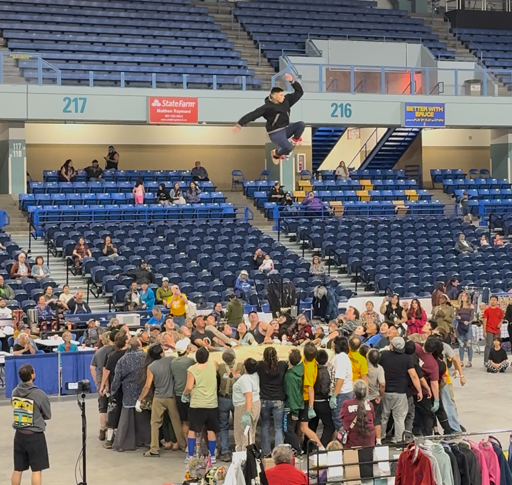
The 65th annual World Eskimo Indian Olympics wrapped up this past Saturday after four days of highly active competition and intercultural sharing. The final day included finals competition in the swing kick, one-foot high kick, walrus pull, ear weight and knuckle hop.
The multi-athletic peak performances in traditional Arctic games revealed a unique blend of traditional survival skills, explosive power, and cultural endurance. Rooted in the seal and other water mammal hunting traditions of Indigenous circumpolar peoples, the high level athletic competitions also served as cultural preservation that was showcased at the annual WEIO event.
Since WEIO started in 1961 there have been a few other national and international competitions that have sprouted to provide opportunities for competition, such as the Arctic Winter Games, the Native Youth Olympics, and the Avannaa Arctic Games.

Daisy VanBlarcom executed the two foot kick at the 2026 World Eskimo Indian Olympics. From left: The WEIO 2026 Officials Marjorie “Kunaq” Tahbone, Candice Adele Parker (sitting), Nicole Johnson and Adele Villa. (Photo courtesy of Adrianna Johnston)
Five people have been featured here to share their story and how they are a part of the WEIO 2026. They talked about what brought them to WEIO, how they trained, what they hope for the future of WEIO and/or how the competitive arena collaborates with each other and makes everyone better.
Nicole “Ikiituk” Johnson
Inupiaq, Gold Medalist and Lead Official
Nicole “Ikiituk” Johnson is Inupiaq from the Fish River Tribe from the Native Village of White Mountain. Johnson is not only a practicing world champion in traditional Arctic sports but is also the head official for the WEIO and Native Youth Olympics and formerly the Arctic Winter Games. Her leadership extended to being the president of AWG Team Alaska and served on the board of governors for WEIO.
“All of our events were created by storytellers, dances, and the traditional garments from our indigenous people,” Nicole Johnson told ICT. “They’re all connected. Our communities would gather to celebrate a successful hunting season. They held contests of strength and endurance, shared stories through storytelling and dance about their experiences of travel, to hunt and survive.”
WEIO champion and up and coming athletes train for their unique, highly specialized disciplines to maximize their game day performance. The traditional Arctic games focused on muscular strength, balance, agility, and extreme pain tolerance. Some athletes specialized in one or two events while others competed in several events and oftentimes during the same day.
“Many of the athletes still train the same as I did, through exercise and practicing the events,” said Johnson. “Many of them now have tailored exercise programs, for strength, agility, coordination, and endurance, based on the events they are competing in.”
WEIO is continuing to grow and reaching toward a broader global audience. Efforts are purposeful to make this happen.
“We would like more athletes to attend from the rural communities, throughout Alaska, Canada, and Greenland,” said Johnson. “We want to educate our audience about our way of life and the rich culture and history of our Indigenous people.”
Bernard Clark
Koyukon Athabaskan, World Record Holder
Bernard Clark, Koyukon Athabaskan, has lineage from the village of Galena, Alaska. He was raised and currently lives in Wasilla, Alaska. He came into WEIO 2026 a world record holder and left tying his own world record, placing second to someone who broke his world record in another event, and also left with three medals.
“I tied the One Hand Reach World Record at 69 inches, and wanted to continue my adventure and experience,” Bernard Clark told ICT. “I joined my wife in coaching the team from the high school we played for. I continued to participate in WEIO every year since, sometimes setting new records for myself.”
Oftentimes personal bests ended up being world bests.
“I do my best to stay going to the gym to maintain fitness,” said Clark. “I practice often in the off season, from stage demonstrations at our state fair to challenging our younger local athletes during the [Native Youth Olympics] spring season.”

Bernard Clark, Koyukon Athabaskan, tied his own world record on 71” in the One Hand Reach. Athletes in the One Hand Reach balance their entire body weight on the palm of one hand while keeping their elbows tucked into their torso. They reach up with their free hand to touch the suspended target and land clearly without letting any other part of their body touch the floor at the 2026 World Eskimo Indian Olympics. (Courtesy of the World Eskimo Indian Olympics)
“I take my diet very seriously, I do not eat fried food, or red meats. Often switching to full vegetarian when getting near a competition, I find the benefits in reducing soreness and increases in stable clean energy,” added Clark.
Competitors are often helping each other and cheering for each other to succeed.
“The difference between these games and others is that you may be competing against one another,” said Clark. “The most supporting role is actually from your opponent kicking, reaching, pulling, and jumping right next to you. Individuals striving for our own personal records, there is nothing like it.”
Leif Richards
Tlingit and Haida, World Record Holder
Leif Richards lives in Juneau and his family is from the village of Igiugig. Richards has been involved with traditional Arctic games for 11 years beginning in the second grade and was well traveled competing in Juneau, Alberta, Matsu Valley, Greenland, and Yellowknife, Canada.
“My favorite memory in this WEIO is unexpectedly beating the greased pole walk world record,” said Richards. “Last year I got negative 2 inches, so I had no idea how I would do. I spent two minutes walking, it felt more like 10 seconds! Since I did it last I have gotten way into rock and ice climbing, along with a little bit of slack-lining, all of which greatly helped.”
“My feet have high arches like an aggressive climbing shoe to get the most amount of surface contact. Once my foot was placed, I made sure it never moved, like I’m ice climbing, and once the foot is placed, it has to stay locked in. If you move your foot even a little the friction is lost, so you have to move around your foot while it stays locked in place. The rest of it is all in the head, like slack-lining,” added Richards.
“By far the best part was holding up my deceased friend Shane Paul’s ashes on the podium,” said Richards. “He went with us to WEIO two years ago, he was a part of team Juneau, and we all miss him greatly.”
Richards is a cheerleader for his competitors and team. His attitude is expressing humility and that is enlightening coming from someone who broke a record recently that stood for 45 years.
“Definitely supporting others in pushing their personal best is more important than trying to win,” said Richards. “As for the environment, I personally don’t think of it as trying to win, and just being here to have fun with the community, and push personal boundaries. If you end up medaling it’s just a cool upside.”
Adele Kuyuk Villa, Iñupiaq, Official and Organizer
Adele Kuyuk Villa is Iñupiaq with her maternal roots in Wales, Alaska, and the Kingikmiut people. She also has Indigenous roots from Mexico through her paternal ancestry. Villa was born and raised in Anchorage, Alaska, and now lives on the Kenai Peninsula.
Leadership capacities in coaching, administration, officials, adds to the sustenance of a growing organization.
“My late sister, Autumn Ridley, was an accomplished Native Games athlete and world record holder, so the games have a deep connection within my family,” Adele Kuyuk Villa told ICT. “That connection continues with my own children, who have grown up with the games and competed over the years and are now part of the Nikiski NYO team, which I coach. I also still compete myself when I have the opportunity, particularly in open events like the strength events, ear pull, grease pole walk, and others.”

Adele Villa at the 2026 World Eskimo Indian Olympics offering the athletes to choose a side of the stick for the Inuit Stick Pull. (Photo courtesy of Krisnan Weston)
From 2013 through 2025, Villa served on the organizing committee for Native Youth Olympics Alaska, and from 2016 through 2025, she was the NYO Coordinator.
“Today, through ‘Mukluks On The Ground,’ my work has broadened to supporting Indigenous games wherever there is a need. That includes helping with events, officiating and official’s development, coaching, mentorship, and connecting communities with resources and opportunities,” added Villa.
Providing opportunities to succeed for others is the driving force of true leadership.
“For me, it has been a progression from being a young athlete myself to helping create and strengthen opportunities for the next generations,” said Villa.
“I think a lot of the way we learn the games is still the same,” said Villa. “You learn by watching others, practicing, asking questions, and having someone show you what works for them. There is a lot of knowledge that gets passed from one athlete to another, and I think that’s something really unique about these games. Your competitor can also be the same person giving you advice or helping you improve.”
Matthew Sidolala Evans
Koyukon Dena (Athabascan), World Record Holder
Matthew Sidolala Evans was known as Sido at the Games. Sidolala is his Koyukon name, and it means “my echo.” Sido is Koyukon Dena (Athabascan). His family comes from the villages of Rampart and Huslia and he lives in Fairbanks.
“I’ve been attending WEIO my whole life and started competing at 12,” Sido told ICT. “I started to place in Inuit stick pull at 18 and placing in four-man carry in my mid-20s. I’m 40 now. I’ve competed in [the] Arctic Winter Games and went to the first Avannaa Arctic Games in Illulissat Greenland in 2025.”
There is no secret to being the best for so long as Sido has been an elite traditional Arctic athlete.
“I focus a lot on leg work and cardio in the gym,” said Sido. “My favorite thing to do these days is jump rope. I’ve done manual labor in different capacities and job titles all my life which I think gives me somewhat of a leg up and high base line for strength. As for mental, I just think about doing best and going as far as my body will let me.”
“I think it’s all about personal achievements and not viewing your competition as a type of foe but a friend trying to do their best,” said Sedo. “Especially in the head to head competition. A common saying people say in the individual events is ‘I’m going for a new PR.’ We’re all good friends on and off the floor.”
Check out the WEIO Facebook page for more results, photos and videos.
WEIO 2026 GOLD MEDALISTS *
KNUCKLE HOP
Kyle Worl | Juneau | 152’6″EAR WEIGHT
Frank M. Lane | Kotzebue | 1,012’4 1/2″MEN’S BLANKET TOSS
Bernard Clark | WasillaWALRUS PULL
Women: Brittany Woods-Orrison | Rampart
Men: Sido Evans | RampartSWING KICK
Women: Anastasha Wilde | Anchorage | 56″ TIED WR
Men: Matthew Chugluak | Anchorage | 68″ NEW WRWOMEN’S BLANKET TOSS
Eden Hopson | UtqiagvikTWO FOOT HIGH KICK
Women: Danica Taylor | Rankin Inlet | 74″
Men: Colton Paul | Kipnuk | 104″EAR PULL
Women: Amanda Ahsogeak | Anchorage
Men: Frank M Lane | Kotzebue
DENE STICK PULL
Women: Nicole Johnson I Nome
Men: Alex Covey | AnchorageGREASED POLE WALK
Women: Avery Reece | North Pole | 31-1/2″
Men: Leif Richards | Juneau | 184 -1/2″ NEW WRALASKAN HIGH KICK
Women: Anastasha Wilde | Anchorage | 78″
Men: Matthew Chagluak | Anchorage | 92″INUIT STICK PULL
Women: Danica Taylor | Nunivut
Men: Sido Evans | RampartDROP THE BOMB
Colton Paul | Kipnuk | 31.22 sTOE KICK
Women: Mila Neely | Juneau | 48″
Men: Don Heflin | Anchorage | 80″RACE OF THE MESSENGER
Women: Alice Johnston | Palmer | 23’55”
Men: Alden Wilbur | Fairbanks | 17′ 30″KNEEL JUMP
Women: Anastasha Wilde | Anchorage | 48-1/4″
Men: Colton Paul | Kipnuk | 65-1/4″ONE HAND REACH
Women: Lilianna Simmonds-Rexford [ Utqiagvik | 57″
Men: Bernard Clark | Wasilla | 71″ TIED WRFOUR MAN CARRY
Sido Evans | Rampart | 211′ 1″FISH CUTTING
Kelly Lincoln | Bethel | 28.78 s* athletic events
The post Having fun with community, breaking records at the 65th World Eskimo Indian Olympics appeared first on ICT.
From ICT via This RSS Feed.