

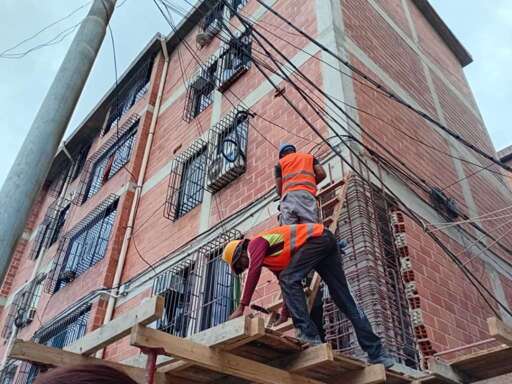
A total of 9,055 homes affected by the double earthquake of June 24 have begun the reconstruction and restoration process across the states impacted by the disaster, reported Jacqueline Faria, head of the Venezuela Renace (Venezuela Reborn) Plan, this Saturday during an inspection of works at the Ana Victoria urban development in La Guaira state.
La Guaira currently has the highest number of properties being intervened under the national plan, with 2,926 homes—including houses and apartments—in the process of rehabilitation. This is followed by Yaracuy (2,700), Caracas (1,690), and Aragua (918), all part of the third phase of the government’s reconstruction program.
Faria explained that all buildings were previously evaluated by the Presidential Commission on Habitability. Studies determined that 49.3% of inspected homes are habitable (green classification), 23.5% require repairs (yellow), and 27.2% need structural interventions (red).
She clarified that a “red” classification does not necessarily imply the demolition of the buildings. Most can be recovered through structural reinforcements designed following rigorous engineering studies and mathematical models. As an example, she mentioned the Ana Victoria urban development, where two of the nine blocks were classified as red but are currently undergoing reinforcement to ensure structural stability, allowing families who remain in nearby temporary camps to return.
“Not all homes marked in red will be demolished,” she reiterated. “Most will be restored through structural recalculation and reinforcement to ensure families can return safely.”
The second phase of recovery is underway
During the inspection, the governor of La Guaira, José Alejandro Terán, presented a summary of the actions carried out within the Venezuela Renace Plan. He reported that the state has provided more than 72,000 medical services since the start of the emergency, supported by the National Public Health System and international field hospitals.
There are currently 28 temporary camps operating, housing approximately 11,000 people, in addition to mobile camps positioned near buildings that are currently undergoing reconstruction. Terán noted that because a significant portion of the affected infrastructure is recoverable, many families will be able to return to their homes in the coming weeks as rehabilitation works conclude.
Public services gradually regaining operational capacity
Governor Terán reported that the state is making significant progress in restoring basic services. The electrical system reached 90% recovery within the first three days following the earthquake, while drinking water services are currently operating at 84% capacity. Telecommunications infrastructure has surpassed 75% connectivity.
Regarding public transportation, 32 routes are currently active with more than 210 units, and fuel supply remains guaranteed at service stations. In the commercial sphere, the governor assured that 95% of businesses in the central parishes have resumed operations, while on a regional scale, approximately 65% of surveyed establishments have reopened.
Debris to be reused for reconstruction
Regarding the management of waste generated by collapsed buildings, Terán announced that the government has activated the Santa Eduvigis landfill for the final disposal of rubble. The site’s capacity exceeds three million tons, well above the 2.1 million tons estimated in the immediate aftermath of the disaster.
He explained that materials are being sorted at six temporary collection centers to recover steel and other reusable elements, which will be reintegrated into the housing reconstruction supply chain.
Single Housing Registry to be extended to all affected areas
As part of the revitalization phase, the governor announced that the Single Housing Registry will begin deployment simultaneously across all temporary camps and, subsequently, throughout the 15 disaster zones identified in La Guaira, with the aim of gathering comprehensive data on affected families.
Starting August 1, registration will also be available at the Ministry of Habitat and Housing offices in states where displaced people have been relocated. The program also includes geological studies and the design of new housing solutions with seismic-resistance criteria for the permanent relocation of families whose original properties cannot be recovered.
(Últimas Noticias) by Doriana León
Translation: Orinoco Tribune
OT/JRE/SH
From Orinoco Tribune via This RSS Feed.