

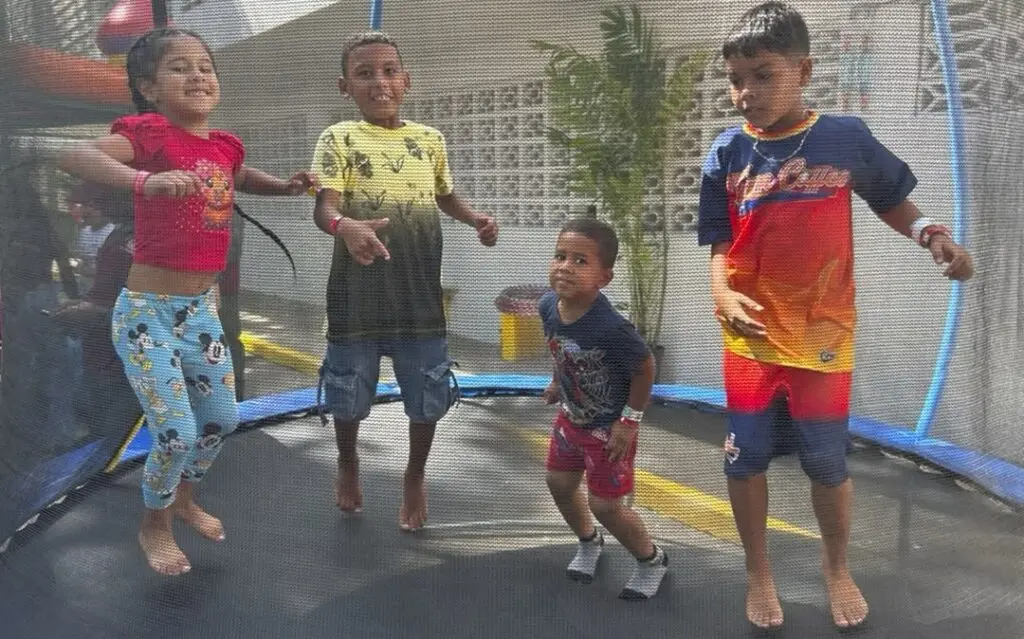
Venezuela child quake support turns Tanaguarena’s main square into a space of play, culture and care for children affected by the La Guaira earthquakes.
Related: UNESCO Venezuela Heritage Protection: 5 Powerful Steps After Devastating Quakes
Venezuela child quake support turns Tanaguarena into a hub of solidarity
Venezuela child quake support has taken on a concrete, community‑driven form in Tanaguarena, a coastal parish in the state of La Guaira that was heavily affected by the recent double earthquake. On Children’s Day, the town’s main square became an epicenter of solidarity, bringing together delegations from several regions of the country to accompany families living through loss, uncertainty and displacement.
Volunteers from states such as Anzoátegui travelled for hours to reach Caraballeda, bringing traditional foods and drinking water to share with local residents. Alongside them, psychosocial support groups, recreational brigades and members of the Bolivarian National Guard organized games, cultural activities and collective dynamics aimed at easing the emotional burden on children. In this way, Venezuela child quake support combines material assistance with emotional care.
These activities are not isolated events. They are part of a broader network of popular power and solidarity brigades that has emerged in the wake of the earthquakes. The guiding idea behind Venezuela child quake support is that play, art and community interaction are essential tools for helping children process trauma and regain a sense of safety, even amid temporary shelters and damaged neighborhoods.
In Tanaguarena’s square, laughter, music and shared meals temporarily displaced images of rubble and emergency tents. For many boys and girls, this space of Venezuela child quake support offered their first opportunity in weeks to run, draw, dance and celebrate their day without constant reminders of the disaster.
Community leadership and targeted assistance for families
The deployment of Venezuela child quake support in La Guaira is being organized directly by the social fabric of the zone, especially female community leaders and communal councils. These structures took on the first tasks of rescue and assistance when infrastructure collapsed and communications were cut off, often acting before external help could arrive.
Lázara, a community leader from Caraballeda, explained that the quakes caused the loss of several neighborhood organizers, leaving important gaps in local coordination. In response, surviving residents reorganized quickly, taking on roles in census‑taking and needs classification for the affected population. This process has become a backbone of Venezuela child quake support, allowing aid to be prioritized by age group and specific vulnerability.
By segmenting information on families, elders and, especially, children and adolescents, community structures have been able to orient medical, social and psychological assistance more effectively. The Venezuela child quake support strategy understands that a child who lost a home, a school and perhaps relatives requires a different type of follow‑up than an adult seeking to rebuild a business or house.
Local management has also facilitated an orderly transition of families from temporary camps to definitive shelters set up by the Venezuelan state. In the Tanaguarena camp, the number of tents has already fallen from 38 to 24, and the site currently hosts 120 people, including 43 children under the age of 12. All of them receive ongoing institutional accompaniment, framed within the Venezuela child quake support approach.
Communal spokespeople stress the importance of keeping internal registries active to ensure the efficient allocation of social protection bonuses and complementary aid for reconstruction. In practice, this means that Venezuela child quake support does not end with one recreational day; it depends on continuous monitoring of needs, rights and access to public programs.
Children’s Day, cultural outreach and a focus on safe spaces
In parallel with local initiatives, the national government has integrated Venezuela child quake support into a broader Children’s Day plan. Acting President Delcy Rodríguez sent a message of congratulations to all Venezuelan boys and girls, highlighting the central role they play in the country’s future and rebirth after the earthquakes.
Through an audiovisual message shared on her official social media accounts, Rodríguez praised the strength of Venezuelan childhood, stating that in children lies the certainty of a better tomorrow. This framing aligns with the spirit of Venezuela child quake support, which seeks to place children at the heart of recovery strategies, not at the margins.
The national government has launched a recreational and cultural care plan across the country to mark Children’s Day 2026. Activities began on the Saturday preceding the official date, with special emphasis on camps and temporary shelters, where many minors are living in precarious conditions. The objective is for Venezuela child quake support to reach every affected community, from La Guaira to other impacted regions.
These community takeovers prioritize comprehensive accompaniment for children and adolescents most affected by recent seismic events. Within the framework of Venezuela child quake support, this means guaranteeing safe spaces for play, expression and rest, where families facing vulnerability can find collective care and institutional presence.
Workshops, sports tournaments, storytelling sessions, music and theatre are some of the tools used to connect children with one another and with supportive adults. The idea is that Venezuela child quake support should help them rebuild routines, rediscover joy and integrate their experiences in a way that reduces the long‑term psychological impact of the tragedy.
For many families, these activities also provide moments of respite in which mothers, fathers and caregivers can share experiences, receive information and access services while their children are safely engaged in supervised dynamics.
Geopolitical and social significance of Venezuela child quake support
Beyond the local scenes in Tanaguarena and La Guaira, Venezuela child quake support carries a broader social and geopolitical meaning. In a country that has long faced economic sanctions, migration pressures and polarized narratives, the focus on children in the aftermath of a natural disaster becomes a powerful symbol of national priorities and social resilience.
Internationally, organizations that monitor children’s rights and disaster response often stress that the way a state and its communities treat minors in emergencies is a key indicator of institutional capacity and commitment to human rights. In this context, Venezuela child quake support can influence how multilateral bodies and cooperation agencies evaluate needs, vulnerabilities and potential partnerships in the country.
Regionally, the experience of popular power structures leading emergency responses—as seen in the communal organization of Venezuela child quake support—may serve as a reference for other Latin American countries facing earthquakes, floods or climate‑related disasters. The role of grassroots networks, women leaders and youth brigades in mapping needs and delivering emotional support resonates with broader debates on bottom‑up disaster governance.
At the same time, the earthquakes have deepened existing social challenges, from housing deficits to access to basic services and educational continuity. The effectiveness and continuity of Venezuela child quake support will influence whether post‑disaster reconstruction reduces or reinforces pre‑existing inequalities, particularly for children in low‑income or historically excluded communities.
Finally, the visibility of Venezuela child quake support in official communications, media coverage and social networks contributes to shaping collective memory of the disaster. By highlighting children’s experiences, voices and needs, the narrative of recovery places care, affection and community organization at the center of what it means for a country to get back on its feet.
From teleSUR English via This RSS Feed.