



Erin In The Morning is a reader-supported publication. To receive new posts and support my work, consider becoming a subscriber.
Earlier this week, Ohio’s Democratic nominee for governor, Amy Acton, made headlines as one of her party’s most prominent political candidates to stake out an anti-trans stance, calling transgender girls “boys” and declaring that she would enforce Ohio’s sports ban, which she cast as a matter of “fairness” and “kids’ health and safety.” The rebuke from her own party was severe. The Ohio Democrats Progressive Caucus, an official advisory group of the state party, issued a blistering page-long statement declaring that its members were now less willing to doorknock for her—before the post puzzlingly vanished shortly thereafter, prompting days of questions about why criticism of Acton’s anti-trans stance had been scrubbed. Now, after prodding by Erin In The Morning, the caucus has revealed the answer: the Ohio Democratic Party itself demanded the criticism be removed, effectively barring those within the party from publicly critiquing a major candidate’s transphobia.
The intra-party firestorm began shortly after the Supreme Court’s ruling in West Virginia v. B.P.J., in which the Court held that Title IX does not protect transgender athletes and that the law’s protections extend only to “biological sex”—breaking with years of lower court precedent. Asked for her reaction by the Toledo Blade, Acton stunned voters in her own party by calling transgender girls boys and vowing to enforce Ohio’s ban, endorsing its premise outright: “I do not support boys playing in girls sports. This is already settled law in Ohio, and as governor I will enforce and uphold the law,” Acton said. “As a doctor, public servant, and a mom, I will always stand up for fairness and protect kids’ health and safety.”
Criticism was swift and severe—and perhaps the most prominent rebuke came from inside her own party infrastructure. The Ohio Democrats Progressive Caucus released a page-long statement declaring that its members would be less likely to knock doors for a candidate who had thrown trans kids under the bus in a state with some of the most severe anti-trans laws in the country. “ZERO Ohioans have become better able to buy groceries by keeping child sport players away from their favorite sport,” the caucus wrote. “Our hearts break for those kids. Those who disagree with that will never vote—let alone doorknock—for Amy Acton.” Its members were less willing to volunteer, the caucus said, “not out of malice, but out of the bad feeling in our chests.” And it noted standing issues with the candidate not inviting LGBTQ+ voices into her campaign room: “Any one of us could have warned her of that natural consequence if any one of us had been in the room with her.”
That post was quickly taken down, with no explanation. After several sources reached out to Erin In The Morning with inside information, we sent the caucus a request for comment. We never received an email back—but shortly after, the caucus posted publicly on Facebook, revealing exactly what had happened: the Ohio Democratic Party had demanded the criticism be removed. The caucus protested, appealed, but then relented. The criticism never went back up. Whatever the rule’s official purpose, its effect in practice was unmistakable: the “progressive” arm of the Ohio Democratic Party is not permitted to publicly call out its own nominee’s transphobia.
“A lot of people have been asking why we removed our statement addressing Amy Acton’s comments regarding transgender athletes. As a new caucus, we are still learning the ropes when it comes to being an internal part of the ODP. While operating outside of the party, we were afforded a bit more freedom with respect to our communications with the public. By posting a statement without going through the official approval process we inadvertently broke the rules we agreed to when we were recognized as an internal caucus,” stated the Progressive Caucus.
“We don’t necessarily agree with this policy and we are still negotiating how we can best comply with the party’s regulations while continuing to advocate for our members. However, despite our protests, ODP insisted that the post be removed and we follow procedure…. After deleting the original statement, we promptly asked about submitting the post for approval through the proper channels so that it could be reposted. At this point, ODP staff informed us that a meeting with Acton was on the table. After thorough discussion, caucus leadership determined this offer aligned with our goal to bring our message directly to her.”
You can see the full post here:
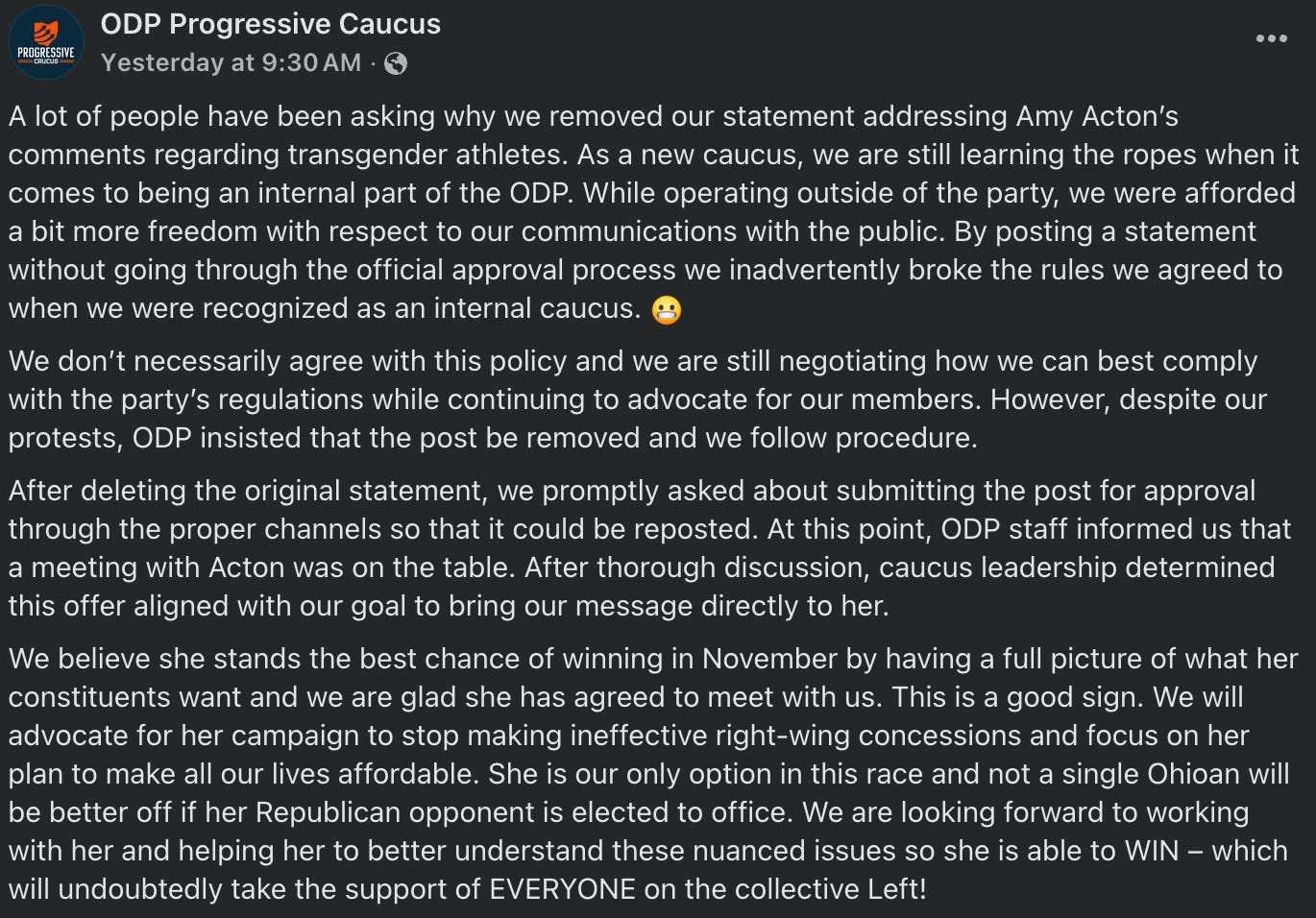
ODP Progressive Caucus explanation of removal
The news threatens to rock the party further, because the scandal is no longer just about the candidate. Acton called transgender girls “boys” and endorsed a sports ban; the party responded by disciplining the people who objected. The Ohio Democratic Party has now applied more pressure on its progressive caucus to quiet its criticism of anti-trans politics than it has applied on its own nominee to stop embracing them. One arm of the party endorsed discrimination and faced no visible consequence. Another arm objected and was forced into silence.
This is a moment worth marking for those who follow anti-transgender politics. Most state Democratic parties, even in deep-red states, have avoided endorsing trans sports bans. When Congress voted on a national ban early last year, just two Democrats supported it—members in swing districts held the line, and when the ban reached the Senate, not a single Democrat broke ranks. But there have been cracks. Gavin Newsom opened his podcast by telling Charlie Kirk that trans athletes in girls’ sports are “deeply unfair.” And in May, eight House Democrats crossed the aisle to pass a national forced outing bill—the largest Democratic defection on any standalone anti-trans bill of the modern panic.
The consequences of this shift could be severe. Some warn that a Ramaswamy victory would be worse for transgender Ohioans. But others see a deeper danger: an Acton victory built on anti-trans capitulation would teach Democrats everywhere a horrific lesson. It would spread the idea, through a party that has so far remained a relatively stalwart opposition, that embracing transphobia is what winning requires. That result could be more disastrous for transgender people than any individual right-wing victory. As long as trans people have an opposition party standing in unity against anti-trans policies, every ban, every restriction, every law remains reversible. But if enough Democrats come to see transphobia as acceptable—necessary, even—then trans rights could be eroded for a generation, with no mechanism left to reverse the losses, similar to what is currently happening with Labour in the UK. That is why, to those who understand the stakes, comments like Acton’s likely read as a cancer on the party. And a candidate willing to throw transgender people under the bus to win has seemingly told every other minority exactly what their protection is worth when the polling gets tight.
In Ohio, this debate is no longer theoretical, but now is part of the political landscape, with a nominee who calls trans girls “boys,” and a party apparatus that decided the real problem was the people who objected. The ODP got what it demanded. The post is gone. But the party has confused deleting dissent with resolving it. The caucus members who wrote “not out of malice, but out of the bad feeling in our chests” will not see that feeling go away just because a post was deleted.
Erin In The Morning is a reader-supported publication. To receive new posts and support my work, consider becoming a subscriber.
From Erin In The Morning via This RSS Feed.