

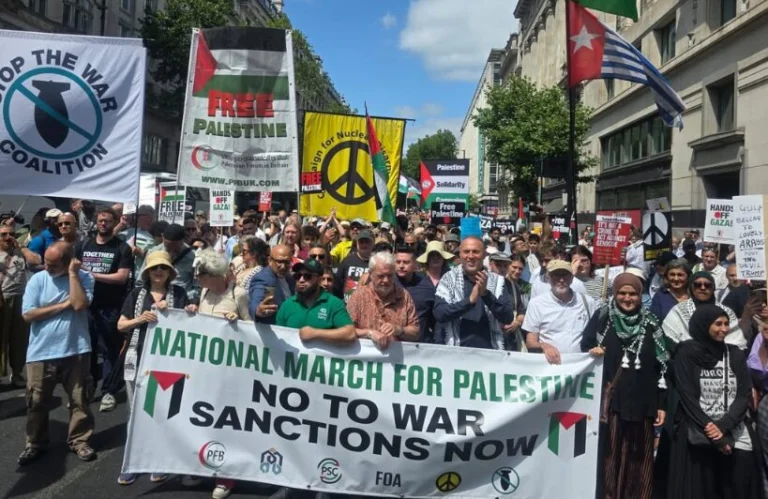
London Gaza protest gathers thousands demanding an immediate UK arms embargo on Israel and an end to Britain’s deadly complicity in Gaza.
Focus Keyword: UN Unveils Seven-Point Climate Roadmap at London Climate Actions Week
London Gaza protest calls out deadly UK complicity in Gaza genocide
London Gaza protest was the rallying cry in the British capital this Saturday, as thousands of people filled central London’s avenues to denounce Israel’s ongoing military assault against the Gaza Strip and to demand concrete action from the new Labour government. The mass protest called for an immediate end to the siege, which organizers say has already claimed more than 73,000 Palestinian lives since October 2023, and urged the United Kingdom to break with policies that enable the violence.
Demonstrators focused their pressure on incoming prime minister Andy Burnham, who is set to assume office on Monday, 20 July. From the streets, banners and speeches delivered a clear message: the London Gaza protest is not satisfied with rhetorical concern. Protesters demanded that the new government adopt a total arms embargo on Israel, insisting that Britain must stop supplying weapons and military components used to bombard a besieged and occupied population.
Social movements and campaign groups accused the UK of “directly funding” human rights violations in the occupied Palestinian territories by maintaining military and security cooperation with Israel. For them, the London Gaza protest is both a moral and political statement: no more public money, licenses or political cover for a state they accuse of carrying out genocide and apartheid.
Chants, placards and speeches linked Gaza’s suffering to the decisions taken in London, highlighting that export licenses, intelligence cooperation and diplomatic backing all contribute to prolonging the war. The London Gaza protest thus framed the new Labour government’s first major international test as a choice between continuity with past complicity or a decisive break in favor of Palestinian rights.
Key demands of the London Gaza protest and growing political pressure
At the heart of the London Gaza protest stood a central, non‑negotiable demand: that the UK impose a comprehensive arms embargo on Israel, covering weapons, components, spare parts, and any form of military or dual‑use equipment. Protesters argued that as long as British arms and technology keep flowing, London remains complicit in war crimes and crimes against humanity committed in Gaza and the rest of occupied Palestine.
Palestinian ambassador to the UK Husam Zomlot played a visible role in the London Gaza protest, emphasizing the global growth of popular movements for justice and international accountability. Marching at the front of the demonstration, he carried placards denouncing impunity, colonialism and Zionist policies, and reiterated that solidarity on the streets is helping to shift global public opinion.
The London Gaza protest also turned its criticism toward the Labour Party’s recent record. Under outgoing prime minister Keir Starmer, Labour leaders were widely condemned by solidarity organizations for what they describe as “active complicity” in Israel’s campaign. Activists pointed out that limited sanctions targeting a few extremist Israeli ministers were cosmetic measures that failed to stop the continuous flow of British weapons to the occupying power.
Speakers stressed that simply condemning far‑right rhetoric in Israel while maintaining trade, arms deals and security cooperation is not enough. In their view, the London Gaza protest reflects a deep frustration with symbolic gestures, and demands binding policy changes that would directly affect Israel’s capacity to wage war on Gaza.
Among those present was veteran left‑wing figure Jeremy Corbyn, who used the London Gaza protest platform to urge the new government to cut military and economic ties that sustain what he described as an apartheid system. Corbyn assured the crowd that British grassroots movements will remain permanently mobilized until Palestine is fully liberated, and underlined that the street will not be silenced by legal persecution or smear campaigns.
Geopolitical context of the London Gaza protest and UK policy
The London Gaza protest unfolded at a time when the UK is experiencing acute internal tensions and mounting international scrutiny. Domestically, the incoming government faces a cost‑of‑living crisis, social discontent and widespread skepticism about the Labour leadership’s will to break with entrenched policies. Externally, Britain’s stance on Gaza has become a litmus test of its commitment to human rights and international law.
For many of those marching, the London Gaza protest is part of a broader wave of global mobilizations in cities across Europe, North America and the Arab world, pressing governments to respect International Court of Justice rulings, support ceasefire efforts and halt arms sales. The UK’s decisions carry particular weight due to its historical role in Palestine, its NATO membership, and its defense industry’s integration into Western supply chains.
The demonstration also reflects growing concern about the criminalization of pro‑Palestinian activism in Britain. Recent prosecutions and harsh sentences against Palestine solidarity activists, coupled with restrictive policing of protests, send a message that raising one’s voice for Gaza can come at a high personal cost. In that sense, the London Gaza protest is not only about foreign policy, but also about civil liberties and democratic space within the UK.
On a wider level, the London Gaza protest signals a shift in public opinion that could reshape Britain’s alliances and diplomatic posture. If pressure from the streets continues and expands, future governments may find it harder to justify unconditional political and military support for Israel, especially in the face of documented mass civilian casualties and devastation of civilian infrastructure in Gaza.
Finally, the protests feed into an ongoing reconfiguration of global alignments around Palestine, where states of the Global South, social movements and parts of Western civil societies increasingly converge in denouncing double standards. The London Gaza protest contributes to that realignment, underscoring that Britain’s choices on Gaza are being closely watched far beyond its borders and will shape its reputation in the Middle East and the wider Global South for years to come.
London, now. The National March for Palestine.
Three years of ongoing genocide — and the movement for justice and accountability, in Britain and worldwide, is growing louder and stronger@PSCupdates pic.twitter.com/QHym1es9vo
— Husam Zomlot (@hzomlot) July 18, 2026
From teleSUR English via This RSS Feed.