

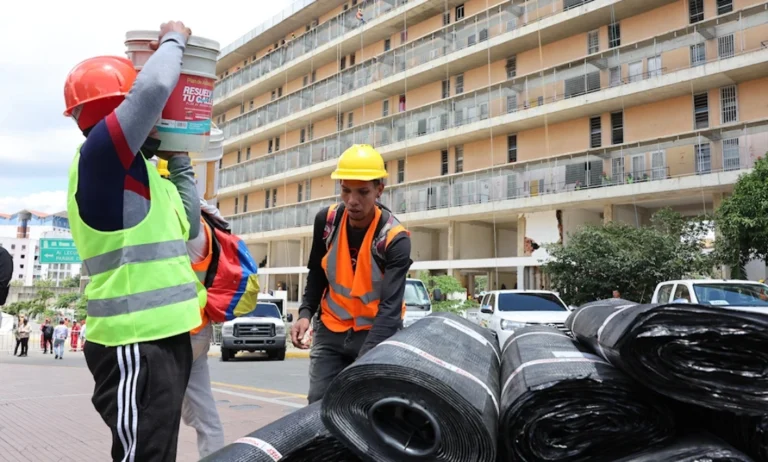
Venezuela Renace housing recovery advances in San Bernardino, where volunteers and brigades clear rubble and repair homes after the deadly June earthquakes.
Related: Venezuela Rises Rebuilds Homes in San Bernardino
Venezuela Renace housing recovery brings families back to San Bernardino
The Venezuela Renace housing recovery plan is beginning to change the landscape of one of Caracas’ hardest‑hit neighborhoods, as residents in San Bernardino slowly return to repaired homes after the devastating double earthquake of 24 June. In this area, damage was so severe that entire residential zones were left buried in rubble, forcing thousands of people to abandon their houses and seek temporary shelter.
Amid this destruction, volunteers, community brigades, members of the Bolivarian National Guard, Red Cross teams and firefighters have worked side by side in some of the most complex terrain in the city. The Venezuela Renace housing recovery effort recognizes these men and women as heroes and heroines of Venezuela, highlighting their sustained work in steep, unstable areas still cluttered with debris.
Acting President Delcy Rodríguez paid tribute to these groups, stressing that they keep working late into the night, supported by portable power plants that allow operations to continue even when electricity is unreliable. For many families in San Bernardino, the presence of these teams is the only guarantee that missing loved ones might still be found amid the ruins.
The Venezuela Renace housing recovery plan, deployed by the Bolivarian Government, is currently enabling the repair of more than 9,000 homes nationwide. In San Bernardino, this has already translated into visible reconstruction work, reinforcing walls, clearing access routes and stabilizing structures that can be safely reclaimed.
Search, rescue and rubble removal in extreme conditions
The Venezuela Renace housing recovery operation depends heavily on front‑line workers who face extremely adverse conditions every day. These are zones of high geological complexity, with irregular terrain, landslide risks and dense piles of rubble that complicate every movement of personnel and machinery.
Many of these volunteers and brigadistas are not professional rescuers, but neighbors, social movement members and young people who stepped forward to support the official response. Under the coordination of the Bolivarian National Guard, Red Cross units and firefighters, they have become a crucial force within the Venezuela Renace housing recovery strategy.
Their tasks range from digging through collapsed structures in search of bodies, to clearing paths so heavy equipment can reach deeper layers of debris. Often, they work in narrow spaces, using basic tools and relying on temporary lighting powered by generators. The goal is twofold: to recover the remains of those who died, giving families a chance to mourn, and to prepare the ground for future rebuilding.
In several sectors of San Bernardino, large machinery has already stopped operating, either because the main piles of debris have been moved or because the area has become too delicate for heavy equipment. Yet the Venezuela Renace housing recovery effort continues through manual labor, stone by stone, to remove rubble and retrieve bodies that have not yet been located.
This slow, painstaking work is part of what gives the plan its deep social meaning. It is not only about bricks and concrete; it is about giving dignity to those who lost their lives and opening the way for survivors to return to something resembling a home.
San Bernardino’s hardest‑hit zones begin to heal
San Bernardino is described as one of the areas of Caracas most severely affected by the 24 June double earthquake. Buildings cracked, retaining walls collapsed and several blocks turned into corridors of rubble and dust, forcing residents to evacuate with little more than what they could carry.
As the Venezuela Renace housing recovery advances, however, some residents have already been able to go back to their homes. These returns are only happening where structural evaluations indicate that repairs have made buildings safe enough to reoccupy, and where the basic services needed for daily life can be gradually restored.
For these families, re‑entering their houses is an emotional and complex experience. On the one hand, they return to spaces scarred by the earthquake, where cracks, makeshift reinforcements and missing furniture tell the story of what happened. On the other, the Venezuela Renace housing recovery gives them a concrete sign that reconstruction is moving forward, that their neighborhood is not being abandoned.
The plan’s approach is prioritized: sectors with less structural damage and faster repair options are rehabilitated first, while the most compromised buildings require full demolition and long‑term rebuilding. This means that in San Bernardino, the visual contrast is striking: some streets show freshly repaired facades, while others still resemble active disaster zones.
The Venezuela Renace housing recovery is therefore both a technical and social process. Engineers and construction crews work on reinforcement and rebuilding, while community organizations help coordinate temporary shelters, emotional support and communication with authorities, especially for families who must still wait before returning.
Geopolitical and national context of the Venezuela Renace housing recovery
Beyond the local dimension, the Venezuela Renace housing recovery unfolds in a national context marked by economic sanctions, financial constraints and recent efforts to regain access to international funds. In recent weeks, Venezuelan authorities have announced steps to recover blocked resources and unlock financing for reconstruction, including partial access to own funds held by multilateral institutions and initiatives to reenter the global financial system.
These moves are directly connected to the Venezuela Renace housing recovery, since rebuilding thousands of homes, repairing infrastructure and maintaining temporary camps requires large volumes of materials, equipment and specialized labor. The more access the country has to external resources and credit, the greater its capacity to sustain recovery over the medium and long term.
Regionally, the plan is also seen as part of Venezuela’s broader effort to demonstrate state response capacity after a major natural disaster. The effectiveness of the Venezuela Renace housing recovery will influence how neighboring countries, regional blocs and international organizations assess Venezuela’s institutional strength and governance in times of crisis.
At the same time, the earthquakes and their aftermath highlight how natural disasters intersect with pre‑existing vulnerabilities, such as housing deficits, informal settlements on unstable slopes and uneven access to basic services. The Venezuela Renace housing recovery is therefore not only about reconstructing what existed, but also about deciding how and where to rebuild, with implications for urban planning, risk management and social policy.
Finally, the visibility of volunteer brigades, community organizations and state institutions working together projects an image of social cohesion and solidarity that the government presents as part of its broader political narrative. How the international community reads this narrative—whether as genuine resilience or as constrained by structural economic factors—will shape future debates on aid, cooperation and sanctions in relation to Venezuela.
Human impact and official balance behind the Venezuela Renace housing recovery
The Venezuela Renace housing recovery is unfolding over a landscape of heavy loss and displacement. According to the latest official balance of the 24 June earthquakes, the disaster has claimed 5,119 lives, a figure that underscores the magnitude of the tragedy and the emotional weight carried by rescue and recovery teams.
The number of injured people stands at 16,740, reflecting the intense pressure placed on the health system, particularly in severely hit regions like La Guaira and parts of Caracas. Hospitals, field clinics and mobile medical units have had to adapt quickly to provide emergency care, trauma treatment and follow‑up for chronic patients whose access to services was disrupted.
Authorities report 6,462 people rescued from collapsed or partially collapsed structures, a number that gives a sense of how many lives were saved through rapid response and community participation. At the same time, thousands of families remain in temporary shelters or improvised accommodations, relying on state support and solidarity networks while the Venezuela Renace housing recovery advances.
The scale of this human impact is what gives urgency to every repaired wall, every cleared street and every home made habitable again in San Bernardino and beyond. For those who have lost relatives or are still waiting for news, the continuity of the Venezuela Renace housing recovery is not an abstract policy, but a daily measure of hope and recognition.
From teleSUR English via This RSS Feed.