

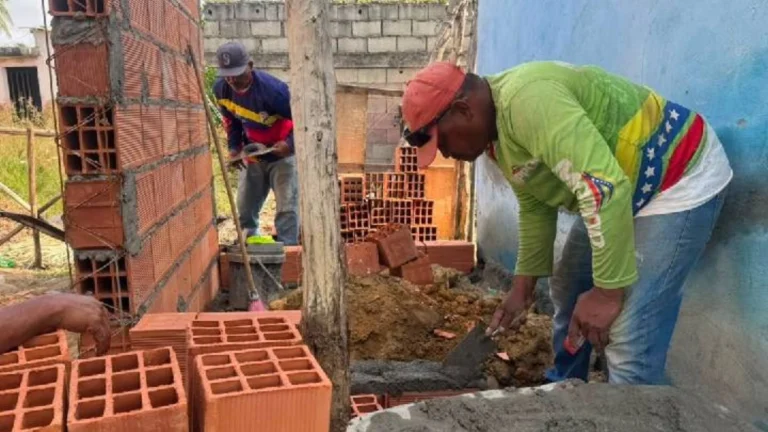
Government expands reconstruction, structural inspections and housing registration for families displaced by the June 24 earthquakes.
The Venezuelan government has entered the third phase of its post-earthquake recovery program, with 9,055 homes under reconstruction following the twin earthquakes that struck the country on June 24. Authorities are simultaneously conducting structural safety assessments, expanding a nationwide digital housing registry and maintaining humanitarian assistance for displaced families.
RELATED: Venezuelan NGO Prepares “Biggest” Cake To Encourage Children Affected by Earthquakes
Reconstruction enters third phase
Under the Venezuela Renace Plan, reconstruction work is underway in the states of La Guaira, Yaracuy and Aragua, as well as the Capital District, where the earthquakes caused extensive damage to housing and public infrastructure.
The housing program is advancing alongside a national census through the Unified Housing Registry Platform. More than 2,800 displaced residents in La Guaira have registered to receive housing allocations and state assistance.
Emergency housing operations and logistics are being coordinated by the General Staff for the Creation of Temporary Camps and Housing Construction Planning.
During an inspection at the Ana Victoria housing complex in La Guaira, Venezuela Renace Plan President Jacqueline Faría said: “We have entered phase three, reconstruction. The reconstruction of La Guaira, Caracas and the remaining seven affected states. To date, we have 9,055 homes under reconstruction that have already begun the process.”
Structural assessments guide recovery
A presidential commission is inspecting buildings along Venezuela’s central coast to determine whether they can be safely reoccupied.
Official assessments show that 49.3% of inspected buildings received a green tag indicating they are habitable, 23.5% received a yellow tag allowing restricted occupancy because of minor damage, and 27.2% were assigned a red tag prohibiting occupancy due to structural risks.
Faría said buildings marked with a red tag will not automatically be demolished.
“Structural engineers, engineers, male and female, as well as structural pathology specialists, have to recalculate the structure and carry out the necessary work to make it habitable. That means not every red-tagged building will be demolished,” she said while describing reinforcement work underway at two apartment blocks in the Ana Victoria housing complex.
The reconstruction program currently covers 2,926 homes in La Guaira, 2,700 in Yaracuy, 1,690 buildings in Caracas and 918 residences in Aragua.
Faría added: “This is the step that the president has been demanding from us as quickly as possible: the third phase of reconstruction so that the people who moved to temporary camps, or who remain outside their homes, can return as soon as possible in complete safety.”
Digital housing registry expands
The Ministry of Housing and Habitat continues to register families who lost their homes in the earthquakes.
Registration teams are working in temporary camps and communities, including the La Lucha neighborhood in Maiquetía.
“We are moving as the territory is being assessed. At first we worked in the camps, and now we are in the neighborhoods, registering people whose homes collapsed there,” Housing and Habitat Minister Laura Posani said.
Authorities said the only requirement for registration is a national identity card because the digital platform is integrated with the Patria system and the National Electoral Council’s civil registry database.
The automated process links household information and material losses to an email address that generates a permanent QR verification code. Registration began in the communities of Suma and La Llovizna and has since expanded to the Los Caracas temporary camp.
Official emergency update
Jorge Rodríguez, president of the General Staff for Temporary Camps, presented an updated official assessment of the emergency response on Saturday.
Authorities reported 5,119 deaths linked to the disaster, 16,740 injured people and 6,462 rescues.
The official figures also include 856 damaged buildings, 190 collapsed buildings, 17,907 people left without housing and a cumulative total of 1,350 aftershocks.
The government said 107 temporary camps remain in operation, sheltering 21,470 people, while institutional assistance has reached a cumulative total of 128,324 families.
Authorities also reported the distribution of 32,854,150 liters of drinking water, 10,063 metric tons of food and medical care for 38,292 patients. The response effort includes 30,989 institutional personnel, 31,745 volunteers and 2,278 international rescue workers.
From teleSUR English via This RSS Feed.