

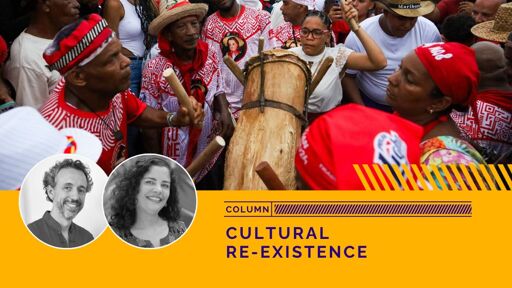
In defense of Venezuelan culture
On the day of San Juan (June 24), Venezuela was rocked by the strongest earthquake ever recorded in our history. An extremist, elitist discourse immediately arose, attempting to blame these seismic events on Afro-Venezuelan cultural and devotional practices. This reveals deep sociological and historical dynamics and deserves rigorous critical analysis. This diatribe is a clear symptom of the persistence of the coloniality of power, through which Eurocentric epistemologies continue to marginalize, stigmatize, and criminalize cosmogonies that escape their control. (click for more)
This condemnation of devotion to San Juan transcends mere religious intolerance; it constitutes an act of epistemic violence rooted in structural racism. By demonizing the festival, this conservative discourse acts as an ideological mechanism that reproduces the hegemony of the Global North. Historically, the Western “civilizing” project labeled African-rooted spiritualities as “barbaric” or “demonic” to justify dispossession, slavery, and domination. Today, that same framework is being recycled amid a crisis in an effort to invalidate the Caribbean-Venezuelan musical heritage, fully aware that these celebrations are spaces for cultural resistance and the affirmation of life.
Those who echo these condemnations reveal a profound alienation from their own identity. By internalizing and defending the values of the former colonizer, this group seeks to distance itself from its own roots in order to assimilate into an aspirational and illusory “whiteness.” Instead of recognizing and embracing the ethos that defines Latin America’s complex and tense reality, they adopt an imported and punitive morality. They directly attack traditional community-based folk music, disparaging a historical tradition that has been, and continues to be, the fundamental for family and community cohesion.
Ultimately, to claim that the beating of drums and the siren-like chants in honor of San Juan cause the material destruction of our cities and the deaths of our compatriots is a desperate and deeply irrational mechanism for sustaining a decadent racial and cultural hierarchy. We defend and assert the right of peoples to exist, to celebrate their diversity, and to express their ways of understanding the world in the face of a colonial mindset that insists on punishing and blaming everything it cannot tame.
San Juan arrives at the Cruz de Mayo Wake
For this second installment of our work on Venezuela’s life cycle festivities (click here for part I), we present an in-depth conversation with the renowned Venezuelan musician, cultural practitioner, and percussionist Rolando Canónico. Together, we reflect on the immense responsibility of preserving Venezuelan traditions, specifically during festivals such as Cruz de Mayo and San Juan. From his dual role as a professional musician and cultural worker, Canónico addresses the tension between the commodification of music or competitive virtuosity and absolute respect for ancestral rhythmic and melodic patterns, defending the playing of the drum as an act of genuine devotion rather than a spectacle. He further delves into the powerful spiritual and syncretic connection he experiences when “dialoguing” with the instrument, underscoring his firm commitment to protecting and passing on this invaluable family and cultural heritage to new generations in Caracas.
A percussionist, drummer, and cultural creator, Canónico has participated in Fundación Bigott and renowned musical groups such as Caracas Sincrónica and Francisco Pacheco y su Pueblo. His trajectory is intertwined with a more discrete, yet vital, task: safeguarding Venezuelan musical memory. What began as a conversation between friends turned into a deep discussion about ethics, spirituality, and the responsibility of honoring the legacy of our ancestors in the twenty-first century.
Family and heritage: the weaving of a music lineage
To understand Rolando Canónico, one must look back at his ancestry. “My paternal grandparents passed away many years ago: Luisa Amelia Aponte de Canónico and Benito Canónico,” he recounts. Benito Canónico was the author of “El Totumo de Guarenas,” an important folk music composition. A musical heritage that flows through Rolando’s veins. However, as we delve into his role as a “host” of these festivities, Rolando turned his gaze toward his maternal lineage –to the women who, through the energy of daily life, kept the flame of devotion alive.
His story takes us to the Afinque Marín in the densely populated Afro-Venezuelan community of San Agustín, Caracas, where his maternal great-grandmother became a cultural bridge. “When that wave of people from Barlovento arrived –that migration boom from Barlovento to Caracas –she had the opportunity to be there when all these cultural expressions arrived,” he explained. It was there that, without any artistic pretensions, driven solely by faith, his great-grandmother began to adorn the Cruz de Mayo.
This responsibility passed to his grandmother, Rosa Emilia Pérez Sanz. “She embraced it as such,” Rolando told us, describing a pedagogical-community learning process where knowledge wasn’t taught in classrooms, but rather through observation and habits shared with neighbors. Music, for its part, was naturally incorporated through his mother, the founder of local band Los Tucusitos, blending Christmas carols with the fervor of the Cruz de Mayo vigil. For Rolando, that early exposure to music, combined with the discipline of his musical training, allowed him to turn a family passion into a profession.
A double celebration: a rite of transition and coming together
The celebration that Rolando Canónico holds at his home in La Pastora is not a one-off event, but rather part of a 43-year tradition that has been formally recognized by the Culture Ministry’s Institute of Cultural Heritage for the past 15 years. Every last Saturday in May, the house becomes the setting for a symbolic transition: the farewell to May, dedicated to Cruz de Mayo (May Cross), and welcoming June, the month of San Juan.
The logistical effort is monumental. “It’s not just a matter of sitting there, shouting some stuff, and that’s it,” Rolando emphasized. The process begins days in advance, with the presentation of newborn children and spiritual cleansings. Rather than merely attending as spectators, the community becomes an active participant: “People already know when it is; they don’t even ask anymore –they just show up with a small bouquet of flowers, a candle, fruit, or even a kilo of vegetables for the soup.”
The masterfully designed altar serves both festivities. “We make one, but it also serves as decoration for both,” explained Rolando, describing a symbolic overlap where the Cross is moved aside to make way for San Juan. This is the moment when devotion becomes tangible.
One of the most tense and beautiful moments of the night is the ritual procession. When San Juan arrives, the Cross, guarded by its devotees, seems to resist the change. “That encounter there, that clash, there comes a moment when San Juan announces that he’s going to come out, and the Cross doesn’t want him to,” Rolando tells us with the intensity of someone who has deeply witnessed that “struggle.”
To manage this tension, Rolando delegates to a decimista [poet], who acts as a mediator. He not only sings but also has the authority to say “He said it right!” at the precise moment when the euphoria outside the house reaches its climax. It’s a necessary exercise in control: “I have to do it this way because otherwise the whole thing turns into a conflict.” As the sirens* and golpes de tambor** intertwine, the cross at the altar gives way to the triumphal entry of San Juan, closing one portal to open another.
Rolando Canónico narrates the intensity of this coming together:
That encounter there, that clash, there comes a moment when San Juan announces that he’s coming out, and the Cross doesn’t want him to. So the devotees of the Cross hold their ground. It’s something beautiful, truly beautiful. Right there in that moment, with San Juan already coming down the stairs and the fulía [traditional rhythm] playing at the altar, the devotees form a circle so the fulía doesn’t stop. In the end it’s not a struggle but a meeting. The meeting where San Juan rises as he descends the stairs, already looking toward the Cross, and he’s trying to leave the house to welcome those who are coming. It’s as if he’s saying, “I’m letting you know that I’m on my way here.”
Regarding the energy that is unleashed when the festival reaches its peak with the arrival of the San Juan statues, Canónico adds: “That’s the moment when the altar of the Cross begins to be dismantled, when all the crosses are removed to make way for San Juan.” “That clash there between the Cross and San Juan gives you a powerful feeling,” he continued. “And when the three San Juan statues meet in front of the house, I can’t even describe it…”
Responsibility toward our ancestors and their legacy
If there is something Rolando Canónico is known for, it is his intransigence toward shoddy work. In a world where the commodification of traditional music threatens to sever it from its roots, he stands as a bulwark.
“In my house, I don’t accept things done poorly.” For him, the drum is not an instrument for competition or for displaying empty virtuosity. “I’m not putting on a show. I’m fulfilling a family promise,” he emphatically clarifies. His authority within the festival doesn’t stem from arrogance, but from a deep understanding of and respect for the musical codes, styles, discipline, and rigor that his teachers instilled in him.
This rigor extends to his training of new generations. Rolando is fully aware of his role as a guide and seeks to prepare his nephew and other young people so that the tradition is not diluted by stage “improvisations.” It is a pedagogy by example: he inaugurates each drum, ensuring that the rhythmic foundation is consistent with what has been passed down for centuries.
Finally, the conversation heads into more intimate territory: the relationship between the musician-artist and the divine. When asked if he experiences an altered state of consciousness while playing, Rolando responds with overwhelming sincerity. “I am a devotee of San Juan the Baptist; I am a santero… my spirituality is deeply connected to the drum.”
For Canónico, there is no separation between the musician who reads the score and the practitioner who offers his prayer through the drum’s vibrations. “That’s the best spiritual cleansing there can be here –playing the drum the right way,” he affirms. “I say ‘the right way’ because with the drum, you have to communicate with it.”
This dialogue, this meeting between the sacred and the profane, is what makes the festival in La Pastora, in Rolando’s own words, a “formidable experience.” By the end of our interview, it’s clear that his work is not merely a tribute to the past, but a strategy for cultural re-existence. As our interviewee aptly summarized at the end of our meeting, the true responsibility of a cultural artist is to ensure that, when San Juan arrives at his doorstep, the drum sounds exactly as it should: with the truth of the ancestors and the strength of a future that, thanks to people like him, is guaranteed a place in Venezuela’s collective memory.
Notes
*Sirenas are a cappella songs with an octosyllabic quatrain meter used to express devotion to both the Cross and San Juan.
**Golpes de tambor refers to multiple rhythms where drums, usually in sets of three, are the main protagonists. From a melody standpoint, singers take turns between solos and choruses.
See below for more details on the festivities and the surrounding music.
Fabiola José is a Venezuelan singer. She has performed in countries across South America, Africa, Europe, and Asia. Her singles and albums are available on all digital platforms. She hosted and produced “Cantante y Sonante” for Radio Nacional de Venezuela. In 2018–2019, she created a series of videos for social media, published on her YouTube channel #HechoEnCasa. She holds a bachelor’s degree in Music from IUDEM, Caracas (2005); specialized under Maestro Tom Krause in Spain (2007); and an M.A. in Arts and Cultures of the South from UNEARTE, Venezuela (2020).
Fidel Barbarito is a Venezuelan musician and researcher, with a bachelor’s and master’s degrees in music and history, respectively. He teaches in the undergraduate and graduate programs at the National Experimental University of the Arts (UNEARTE). Together with Fabiola José, he promotes several musical projects aimed at disseminating traditional folk repertoires, integrating them with contemporary compositions inspired by these sounds.Joropo llanero. Parranda de reexistenciais one of his published essays.
The views expressed in this article are the authors’ own and do not necessarily reflect those of the Venezuelanalysis editorial staff.
The Sounds of Celebration
To gain a deeper understanding of the rich soundscape that defines the festivities at the Canónico family home, we break down how the musical universe of these celebrations is organized. It is not merely a decorative sideshow, but rather the ritual language through which faith is expressed.
The music in the Cruz de Mayo wake: a devotional geography (drop-downs with more info)
The Cruz de Mayo ceremony, which precedes the arrival of San Juan, features a structure that honors various regions of Venezuela. Canónico explains that this part of the festival requires specific discipline and respect for the different genres according to their geographic origin.
The order of the genres
Devotional music follows a set pattern that begins with the “Salve Llanera.” Afterward, songs representative of various regions are performed: Lara, Oriente, Falcón, and finally Zulia.
The poet and the sirenas
The mediator plays a crucial role. He recites poetry (“décimas”) and also has the authority to sing sirenas. This person is responsible for maintaining the choir and the performance during the most intense moment, when the altar of the Cruz is being prepared for the transition.
Interpretive rigor
There is a strict hierarchy. Although the community is invited to participate, the singers are committed to specific roles. For example, those responsible for the salve must perform it with the rigor that tradition demands, avoiding any “improvisation” or inappropriate mixing with other genres.
Music for San Juan Bautista: the strength of the drum (drop-downs with more info)
Once the ritual procession takes place and San Juan enters the house, the soundscape changes radically. Canónico explains that, unlike the Cruz, San Juan marks the beginning of a sequence in which the drum takes center stage.
Performance spaces
There is a geographical distinction within the house. The genres permitted to be performed inside the home, directly in front of the altar, are limited and sacred: sirenas, culo e’ puya, quitiplás, and San Juan de Guatire. All other musical performances take place outside the house.
The main reference
Rolando Canónico, as the host and a cultural leader, inaugurates each drum. He performs the Afro-Venezuelan section—specifically the Miranda fulía—alongside his nephew and his godson, ensuring that the rhythmic pattern remains true to tradition and does not veer toward competitive or show-oriented styles.
Ethical guidelines
At the Canónico household, a clear policy has been upheld: to play not for the sake of competition or virtuosity, but out of devotion, tradition, and beauty.
Talking to the instruments
For Canónico, playing the drum is not a technical performance, but a dialogue. He asserts that, in this context, the saint dwells within the drum and that playing it is a form of spiritual cleansing. When the instruments sound, the performer seeks to “detach” himself from rigid patterns in order to let a powerful energy flow, especially when several San Juan statues gather in front of the house.
This musical framework is, in Canónico’s words, a “system” in which every drumbeat and every décima has a specific place and time to ensure that the legacy of the ancestors remains alive without being corrupted by trends or commodification.
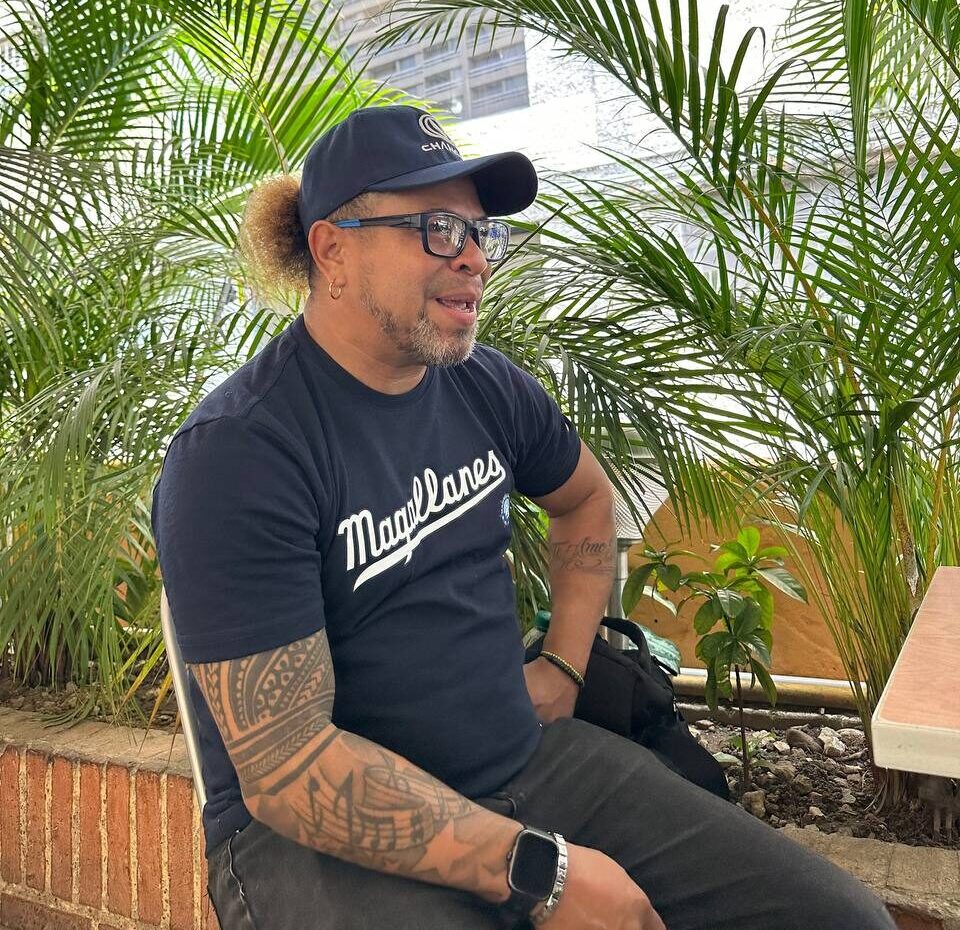
Rolando Canónico. (Photo by Simón Barbarito)
Rolando Canónico is a prominent Venezuelan percussionist, educator, and cultural practitioner, recognized as a key figure in the preservation of traditional community music and Afro-Venezuelan percussion. Initially trained at the Bigott Foundation’s Popular Culture Workshops, he has built a prolific musical career by joining iconic groups such as Francisco Pacheco y su Pueblo, Pomarrosa, and Caracas Sincrónica, as well as accompanying important Venezuelan artists, including Cecilia Todd, Cheo Hurtado, Betsayda Machado, Fabiola José, and Luisana Pérez, on recordings and on stage.
Beyond his virtuosity as a session musician, Canónico stands as an active guardian of Venezuela’s musical tradition, demonstrating a deep ethical and spiritual commitment to organizing community festivals, ensuring that historical accuracy and the identity of the ancestors remain alive for future generations.
The post The Life Cycle Festivities in Venezuela (II): a Conversation with Rolando Canónico appeared first on Venezuelanalysis.
From Venezuelanalysis via This RSS Feed.