

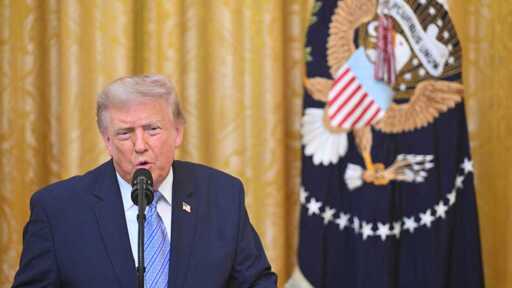
In a sometimes rambling and contentious speech on Thursday night, which several networks refused to air in its entirety, Donald Trump once again claimed that the 2020 elections were rigged and unleashed a tirade of abuse against immigrants and trans people.
Amid the strain caused by the war with Iran, persistent economic uncertainty, and with the November midterm elections just months away, the speech sought to shift the focus of the political debate to terrain more favorable to Trump and his base: the integrity of the nation’s elections and the need to restrict voting.
Although the White House had announced that the message would focus on “electoral integrity,” the president dedicated a good part of his speech to endorsing practically the entire agenda of the Republican Far-Right, including attacks against trans people, criminalization of migration, praise for his draconian border policy, new threats against the media, defense of greater powers for the security apparatus, and an offensive to further restrict the right to vote.
From the outset of his speech, Trump asserted that “no country can be great without fair elections,” claiming that the U.S. electoral system falls “catastrophically short” of that standard. Based on this premise, he announced the release of previously classified documents that, according to him, would demonstrate a vast conspiracy involving government agencies, foreign governments, and officials from previous administrations.
However, even the documents released by his administration do not present evidence of any manipulation of the votes or that the results of the 2020 election were fraudulent in any way. Several previously published intelligence reports had concluded that alleged espionage attempts and influence campaigns by powers such as China would not have affected the voting process or the vote count.
From Conspiracy Theory to State Policy
Trump insisted that China had obtained data on millions of American voters and claimed that this information had jeopardized the election. But Trump failed to mention that a large portion of those voter registration records are already publicly available. Even Republican election officials immediately pointed out after the speech that access to these records does not imply voter manipulation or constitute proof of fraud.
He also blamed the so-called “deep state,” Barack Obama, the FBI, the CIA, and other agencies for allegedly hiding information for years, essentially repeating the same discourse that fueled election conspiracies after the 2020 elections and which eventually led to the take-over of the Capital building by right-wing election deniers on January 6. Far from being a “historic” revelation, as he claimed, the message sought to give a new institutional framework to an ongoing campaign to delegitimize any election result that does not favor Trump or his supporters. It is a preemptive attempt to construct a new narrative of fraud before an election in which the Republican Party could face significant setbacks. It is also an attempt to shift attention away from the government’s political decline, the mobilizations against ICE raids, the “No Kings” protests, and the movement against the genocide in Palestine.
Rather than attempting to rewrite the 2020 election, Trump appears to be laying the groundwork for the November 2026 midterm elections. If the Republicans win, Trump will be able to say that his reforms “protected” the elections. And of course, if they suffer major defeats, he will be able to claim that they were the result of irregularities or the resistance of state authorities to implementing his policies. In this sense, the narrative of fraud ceases to be merely an explanation of the past and becomes a political tool to manipulate or contest future elections.
The Real Objective: Restrict the Right to Vote
Beyond the unsubstantiated accusations, the political objective of the message was clear. Trump used the speech to once again pressure Congress to pass the so-called SAVE America Act, a Republican-backed initiative that would require photo identification and proof of citizenship to register to vote in federal elections.
Although the president argues that the measure would prevent foreign nationals from voting, it is already illegal for non-U.S. citizens to participate in federal elections, and documented cases are extraordinarily rare.
In fact, civil rights organizations have warned for years that these types of initiatives primarily affect poor workers, racialized people, naturalized migrants, young people, and older adults who face greater obstacles in obtaining official documentation.
These are mechanisms widely used by the Republican Party to restrict the electoral participation of popular sectors of the electorate while maintaining the enormous influence of corporate money over the American political system.
But the goal is not limited to restricting the right to vote. The initiative also aims to strengthen federal executive intervention in processes that have historically been administered by the states. Through new powers for federal agencies, Justice Department investigations, and greater interference in the electoral process, Trump is attempting to advance a doctrine according to which the presidency can intervene preemptively in states’ administration of elections to guarantee so-called “electoral integrity.”
You may be interested in: Trump’s Summit Against the Left: the “Terrorism” They Fear Is the Mobilized People
Attacks Against Trans People and Migrants
As usual, Trump also used the opportunity to reinforce his ideological offensive against historically oppressed groups. He again celebrated his administration’s measures to prevent transgender people from participating in sports and presented this policy as part of a supposed “recovery” of the country.
He also reiterated his support for his immigration policy, asserting that virtually no irregular migrants have entered the country in recent months and presenting the strengthening of the border as one of his government’s main achievements.
These statements are part of a well-known political strategy: to make migrants, trans people and other vulnerable groups into scapegoats while deepening social inequalities and keeping the privileges of large corporations intact.
An Offensive Against the Press
The speech also included new threats against the media. After networks such as ABC, NBC, and CNN decided not to broadcast the entire message on network television, Trump accused them of being part of an alleged plot to hide the truth and even suggested they should lose their broadcast licenses.
The confrontation with the mainstream media also serves a precise political function: to discredit in advance any independent verification of presidential claims and to portray all journalistic criticism as part of an alleged conspiracy against his administration. In this way, the White House seeks to simultaneously become the source, interpreter, and judge of the information it produces.
This is not the first time the president has used his office to attack journalists and media outlets that have been critical of his administration, but the episode confirms an increasingly worrying trend: the use of the presidential apparatus to discredit any institution that contradicts the official narrative.
You may be interested in: The Washington Summit and Marco Rubio’s Fear
Dispute Between Two Wings of the Regime
Democratic leaders responded by denouncing the speech as yet another dissemination of conspiracy theories and again rejected the electoral initiatives promoted by Trump. However, the Democratic Party’s opposition can hardly be considered a consistent defense of democratic rights.
For decades, both Democrats and Republicans have administered a profoundly undemocratic regime sustained by the Electoral College, the multi-billion dollar influence of big business, the restriction of voting rights for millions of people, including millions of immigrants, and the permanent strengthening of the repressive apparatus of the State.
The political crisis that began after the 2020 elections and deepened during Trump’s second term actually reflects the internal tensions of U.S. imperialism in the face of growing social polarization, the deterioration of its international hegemony, and the increase in class struggle.
Thus, Trump’s speech was a perfect expression of how he and his supporters intend to contest power in November 2026. Faced with the difficulty of demonstrating a strategic victory in the Middle East and the erosion caused by the war and the economic situation, the administration is attempting to regain political initiative by reinforcing presidential powers in the electoral arena and mobilizing its base around a new narrative of fraud. The question remains to what extent it will seek to translate this rhetorical strategy into concrete executive measures that will alter the course of the upcoming elections.
As we have pointed out before, the advance of the extreme right cannot be confronted by relying on the Democratic Party that also maintains an imperialist and reactionary agenda (including reactionary immigration policies) and governs for Wall Street and large corporations, but rather through the independent organization of the working class, youth, women, migrants, and the oppressed to defend democratic freedoms and confront the reactionary advance from an anti-capitalist, anti-imperialist and internationalist perspective.
This article was originally published in Spanish on July 17 in La Izquierda Diario.
The post Trump’s Election Tirade Signals Shift Toward Greater Repression Ahead of Midterms appeared first on Left Voice.
From Left Voice via This RSS Feed.