

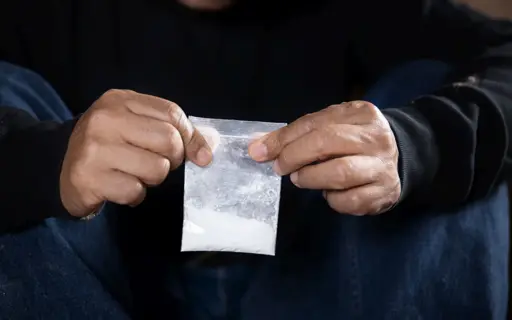

“I’ve heard of students at intermediate turning up to school with meth to sell, as parents normalise its use,” writes Kingi Snelgar about the P health crisis. (Image: RNZ)
The insidious disease that we’re ignoring will cost the next generation, writes Kingi Snelgar.
In the ngahere of Te Tai Tokerau, our kauri trees stand as tūpuna. They are among the oldest living things on this whenua, forming a broad canopy and carrying the mana of the forest, much as an elder holds a family together.
In recent years, kauri have been dying from the roots up, hollowed out by a disease known as kauri dieback. This has forced many of us to stay away to try to stop the spread of the disease, which can be carried on shoe soles.
Some of our most promising responses come from traditional Māori medicine. Rongoā practitioners like Tohe Ashby and others have gone into the ngahere, using traditional medicine and knowledge, including whale and seaweed extracts, companion planting, and karakia, to draw the sickness out of trees. They treat the tree as a living relative in distress, not merely a specimen to be sprayed and treated.
There’s a better word, I think, than “dieback” for the disease affecting the kauri. It’s been described as a ngāngara or ngārara, which are words for small, creeping, devouring things — insects, reptiles, or creatures that get in close and eat away at whatever they find. Ngāngara is also used for disease, for an illness that consumes a person’s vitality bit by bit, from the inside out.
I’ve also heard people describe methamphetamine as a ngāngara, and I think it’s an apt description. Meth addiction creeps in. It doesn’t overpower you in one strike. It only needs you to keep feeding it, a little at a time, until one day you look up and realise it’s taken almost everything.
That’s exactly how I’ve come to think of P and its impact on those I’ve worked with and on some of my whānau. It arrives as something small and manageable, a way to get through a bad patch in life, invited in by someone who just wants the noise in their head to stop for a while. But then it grows in the dark corners of life until it runs the whole show.
Meth is a health crisis that’s affecting the wairua, tinana and hinengaro — the spirit, body and mind — of this generation, whose behaviour shapes the next. Like a snowball rolling down a hill, the problems caused by meth continue to grow and gather momentum as it moves through the whakapapa.
In my 14 years as a lawyer, I’ve not come across anything that does more damage than methamphetamine. P sits above all the other agents of pain and destruction as the single biggest driver of harm. And it’s probably the most difficult to overcome. Meth is very often the thread running beneath criminal offending, and beneath the Oranga Tamariki and family violence files.
This drug touches every walk of life in Aotearoa. It’s in boardrooms and on building sites. But it finds its greatest traction among those seeking to numb or quiet the effects of unresolved trauma, poverty, isolation, and pain.
The harm from P addiction doesn’t stop with the person using. It trickles down the generations. Tamariki grow up around it, absorb its use as a normal part of life, and the cycle starts again. For me, the real cost of methamphetamine isn’t just what it takes from one life, but what it teaches the next generation. I’ve heard of students at intermediate turning up to school with meth to sell, as parents normalise its use and seek to fund their next fix.
P is a sickness that has moved into our whānau, and it needs to be drawn out the way our tohunga draw sickness from a kauri — with patience and the right knowledge. And operating from a real belief that what’s underneath is worth saving.
P is now cheaper than cannabis and easier to get hold of. A New Zealand Drugs Trends Survey found a gram of meth sold for $563 in 2017, while last year it cost $334. Weekly or more frequent use has more than doubled since 2018, from roughly a quarter of users to well over half. It has burrowed further into daily life than ever before.
For a dealer, meth is close to the perfect product. It has high margins and is light enough to move easily from manufacturers to suppliers and into communities like mine in Whangārei. It’s addictive almost from the first use, and it creates its own repeat customers. Nobody sets out to become dependent. But P is built to make sure that’s what happens, and fast. Research has found that meth floods the brain with up to 1000 times more dopamine than other things we do for joy, like eating, exercising or socialising.
Because of the rapid release of massive levels of dopamine, the drug produces a strong urge in the user to keep taking more, so they can continue to stimulate their brain’s reward centre.
What follows for whānau is a kind of erosion, one many of us watch unfold in slow motion. You see someone start to disappear, little by little. There are unanswered calls, missed whānau events, eyes that aren’t quite present anymore, and excuses that no longer make sense but are accepted because the alternative is too hard to face.
Whānau often see it long before they can name it. And too often we don’t look hard enough either, because looking means admitting something we don’t want to be true. By the time we act, the ngāngara already has its hooks in deep.
The statistics support what many people are seeing. Police wastewater testing for the first quarter of 2026 shows the country consumed an estimated 36.6 kilograms of methamphetamine each week, up 15 percent on the previous year’s average and the highest figure on record.
When testing first began here in Whangārei in 2016, the levels detected were roughly double those in Auckland’s wastewater, and three to four times those in Christchurch.
Almost a decade on, Te Tai Tokerau is still the highest-use district in the country on a per-capita basis — 2,282mg a day for every 1,000 people, up from around 1,488mg just two years ago. Wastewater can’t tell you exactly how many people those measurements represent, or how many whānau are using it, but the increase lines up with what we are seeing. Walk around this community, and you cannot miss how widespread the addiction is. The pain is carried so clearly on the faces of those under its grip.
The estimated weekly social harm cost is $38.4 million. That’s close to $2 billion a year — a figure that doesn’t even account for what it costs a household to watch someone they love disappear in front of them.
But when whānau reach the point of asking for help, too often there’s nowhere for them to go. There simply aren’t enough residential drug rehabilitation beds to meet the demand this epidemic has created, and there isn’t enough support reaching whānau early enough to stop it taking hold in the first place.
People wait weeks for a detox bed while addiction tightens its grip. Families call providers, only to be told they’re already full. We’re asking whānau to fight this ngāngara alone, with almost nothing to fight it with.
Here in Te Tai Tokerau, Te Ara Oranga — a meth addiction service funded by the proceeds of crime — has walked hundreds of whānau towards recovery. But it can only do so much when funding doesn’t flow their way.
There’s also the National Telehealth line, 0800 787 797. It’s free, and it has staff who can talk anyone through that first step, before things reach crisis point.
But the size and depth of the meth crisis can’t be met by the aroha of these people alone. We’re in desperate need of wrap-around services to address what might be driving the addiction, things like housing, stress from not being able to pay the bills, childhood trauma, or a lack of connection to identity.
New Zealand has three alcohol and other drug treatment courts, in Auckland, Waitākere and Hamilton. Each costs around $3.3 million a year to run. Compare that to Corrections’ annual budget of $2.9 billion, where it costs $200,000 a year to keep a single sentenced person in prison.
The Drug Court is so successful because it’s an intensively hauora or health-focused approach. The process seeks to understand what has contributed to the addiction, to address the mamae underneath, rather than treating the person as a criminal who needs to be locked up.
Getting someone out the other side of meth addiction takes that deeper kind of work.
Like the ngāngara that attacks the kauri, meth addiction requires a deeper examination of the root cause of addiction. We need more support for whānau seeking help — such as residential drug treatment that’s grounded in kaupapa Māori and rongoā, in spaces that are built around whakapapa and wairua as much as clinical care.
I’ve seen it work with clients and whānau. It’s a hard and unglamorous process, and it doesn’t always succeed. But when it does, it doesn’t just save the person in front of you. It stops that mamae travelling any further down the whakapapa.
Other countries have already shown what happens when you treat addiction as a health crisis instead of a crime. Norway moved in this direction, shifting its national strategy to frame addiction primarily as a health issue and investing accordingly, even though a full decriminalisation law didn’t make it through parliament.
And Iceland offers a different approach by focusing on the next generation. Through a prevention model, communities invest heavily in sport, music, family time and after-school connection for young people, rather than policing. Over a decade, Iceland has seen youth substance use and intoxication rates fall by close to half.
Our kauri tūpuna are still standing because people are willing to set boundaries to protect them from the ngāngara. Others are willing to draw out the sickness, using knowledge built for exactly that purpose. A similar approach is needed to draw the ngāngara of meth out of our community.
Our tamariki deserve a life where meth no longer affects their whānau. Meth will only loosen its grip when we start treating and funding it like a health crisis. Like the ngāngara affecting our kauri tūpuna, the ngāngara afflicting our whānau needs to be recognised for what it is: a sickness.
He oranga ngākau, he pikinga waiora. When the heart is well, the spirit rises.
Kingi Snelgar (Ngāpuhi, Te Whakatōhea, Ngāti Whakaue, Ngāi Tahu) is a barrister and Rongoā practitioner based in Whangārei. He has also completed a Master of Laws at Harvard Law School as a Fulbright Scholar.
The post Agent of pain and destruction appeared first on E-Tangata.
From E-Tangata via This RSS Feed.