

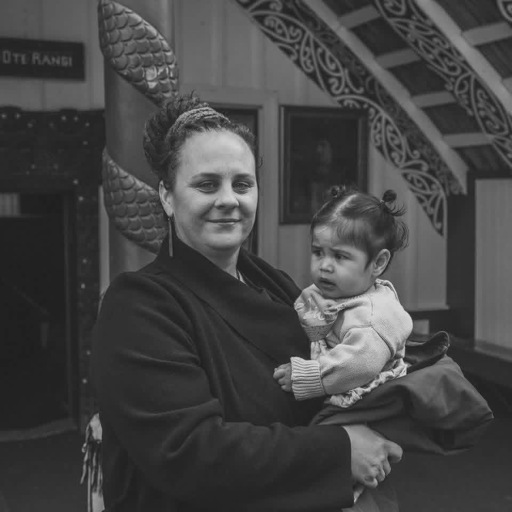

“Death is the only certainty in our lives. Yet there are many of us who are still really scared to have those conversations, who find the whole subject really confronting,” says Whanganui writer Julie Herewini.
Planning what needs to happen after you die isn’t morbid, says Julie Herewini — it’s an assertion of mana motuhake and an act of manaakitanga.
Here she tells Atakohu Middleton about her new book, He Aroha Te Aroha*, which helps whānau Māori to have early conversations about end-of-life wishes.*
Have you thought about whether you’ll be cremated or buried when you die? Do you want a kahu whakatere, a woven flax casket, rather than a coffin? And who’s going to look after your beloved pets when you’re no longer around?
It’s not morbid to ask yourself these sorts of questions and discuss them with your whānau, says Julie Herewini (Ngāti Rangi, Te Āti Haunui-ā-Pāpārangi), a writer and Whanganui District Council Māori ward councillor.
Yet far too many of us avoid the topic until it’s too late, which is why Julie has launched a practical guide, He Aroha Te Aroha, to help people plan for their death.
“Death is the only certainty in our lives,” says Julie. “Yet there are many of us who are still really scared to have those conversations, who find the whole subject really confronting.”
But those conversations are essential. Making your wishes known saves your whānau from the stress and potential conflict of trying to figure out what you wanted. It means that “when your whānau is faced with having to make decisions in a state of grief, they will know what you wanted, particularly if you have a larger whānau who may have different ideas about things,” she says. “They don’t have to guess what you would want.”
Julie says that planning ahead is an assertion of mana motuhake and manaakitanga. “For me, having life insurance and writing a will is an assertion of mana motuhake within the system, an ultimate act of manaakitanga, ensuring that your uri (descendants) are provided for after you’ve gone.”
Even when people have written their will, they may not have told their whānau what it contains. Or they may have discussed their wishes with their partners but not with their children.
“I know lots of my reanga (generation) in particular have been trying to have these conversations with their parents, but then have realised that they haven’t got themselves sorted either,” says Julie.
This was also true for Julie, 44, and her husband Karney, 45, who “took far too long” to do their first wills.
They started that exercise in 2012, when they had four dependent tamariki and had just bought their first house. But they didn’t know how to start conversations with wider whānau about potential guardians for their tamariki in the event that both of them died at the same time, so they kept putting it off. For 12 years.
“Instead of having the conversations with our whānau, we just didn’t do anything about it. So if something had happened, our whānau would have been in a really yucky predicament, not knowing what we had wanted to happen.”
Julie and Karney finally completed their wills two years ago, when their eldest children, Trinity, 21, and Jordan, 20, had reached the age when they would be legally able to care for Taonga, 16, and Karney Jr, 14.
This experience has fed into He Aroha Te Aroha, as have the lessons from her parents’ deaths and from assisting at tangihanga in her rohe over the years.
A decade ago, not long before her father, Gary, died of cancer at 69, Julie became the enduring power of attorney for his health needs. She remembers feeling highly stressed when she signed the paperwork. “There are probably some questions that I would have asked him if I hadn’t been in this haze.”
In 2021, Julie’s mum, Gail, 72, died suddenly from a pulmonary embolism while on a waka on her beloved Whanganui awa. It was a “tragically beautiful” death, says Julie. “She was where she wanted to be, doing what she wanted to do.”
Gail had already told the whānau that she wanted to be cremated. But the whereabouts of her will was a mystery until two weeks after her tangihanga, when Julie found it among papers she was cleaning out.

“Māori do grieving and supporting whānau and death better than any other culture that I know. But we don’t, as whānau, engage in the planning side of things to make the rest of it easier.” Julie pictured with mokopuna Te Kāhui.
Having helped out at so many tangihanga, Julie has seen the multitude of decisions that need to be made.
“Māori do grieving and supporting whānau and death better than any other culture that I know,” she says. “But we don’t, as whānau, engage in the planning side of things to make the rest of it easier. When you consider how much of our time and energy goes into supporting tangihanga, it really does surprise me that we don’t have some of these conversations.”
It was the culmination of her experience with tangihanga and conversations with her own whānau that led Julie to think that “there was something in putting things down, having conversations early, making it as easy as possible for those who are left behind to do what needs to be done.”
So how do you talk to your whānau about what you want to happen after your death? The key, Julie says, is to broach conversations with aroha and frame them positively. She suggests starting like this: “This isn’t something to be afraid of. I want to help us work through this because I love you, because it’s important.”
The book itself is a way in. Designed to be attractive and eye-catching, He Aroha Te Aroha offers questions for reflection and also provides space to record the answers. It covers legal necessities, offering straightforward guides to legal instruments such as enduring powers of attorney, wills, guardianship of children, trusts, life insurance, whenua Māori succession and the like. It advises buying a fireproof “dead box” to store important documents.
It’s a thoughtful and practical book, helping its owner to make considered decisions and anticipating the questions that whānau pani may have. For example, in the section where the book’s owner can list executors, guardians, or trustees, there’s a checklist of skills these people would need, and a space to record names and reasons why these people would be good executors.
The book also prompts questions about culturally-based decisions: Do you have any specific people you’d like to support the paepae at your tangihanga? Are there particular waiata you’d like sung? Do you have any tikanga around photography, videography or livestreaming that you want your whānau to know?
There’s also a page titled Te haumaringi | Hidden kōrero (haumaringi means mist). It asks: Is there kōrero that you need to have with your whānau that you don’t feel able to have with them before you pass, or anything you may have told some whānau members but want to ensure everybody knows?
“It’s an opportunity to reflect on whether you’re holding on to something that needs to be released, either for you or others to have clarity,” says Julie.
And if you can’t bring yourself to have that conversation in person before you die, Julie suggests writing what you need to say in the book. “By writing it down, you can share it, even if you feel you can’t talk to your whānau about it.”

Julie Herewini’s book was a whānau affair written to help other whānau. Back, from left: Julie’s brother Anaru Imhoff, his partner Laura, Trinity Herewini, Jordan Herewini, Karney Herewini and Julie Herewini. Front: Taonga Herewini, Gail Imhoff, Gary Imhoff and Karney Jr Herewini. This photo was taken in 2013, before Gary and Gail died.
He Aroha Te Aroha was a whānau effort. Julie led the research, writing and graphic design, while 14-year-old Karney Herewini Jr developed the book’s artwork alongside his mum. The team also included Karney Herewini, who works in Māori health for Te Whatu Ora, lawyer Paranihia Walker, chartered accountant Missy Te Kanawa, Ngāti Rangi chief executive Helen Leahy, Māori researcher, educator, and cultural practitioner Matariki Cribb-Fox, and friend Renee Tamehana, an executive assistant.
The book was launched on July 10 at Te Ao Hou Marae in Whanganui. Julie says she’s grateful for financial support for the book from Ngāti Rangi’s Whiria Ngā Hua fund, which supports whānau-centred wellbeing initiatives. The funding will enable free copies to be distributed to kaumātua.
Julie is pleased that He Aroha Te Aroha has attracted media attention, as that alone may prompt useful conversations in households across the motu.
“Hopefully, people are going: ‘Oh, yeah, we haven’t actually talked about that. Maybe we should.’”
- He Aroha Te Aroha is available as a hard-copy book ($45) here, along with free information sheets covering practical end-of-life topics.
Dr Atakohu Middleton (Waikato, Pākehā) isE-Tangata’sarts editor. She is a journalist whose lengthy career has included outlets as diverse asRadio Waatea*, theGuardian(UK), theNew Zealand Listener, theSunday Star-Times, and theNew Zealand Herald. She lives in Tāmaki Makaurau. Her book*Kia Hiwa Rā!, on Māori journalism in Aotearoa, was published in 2024.
The post Having the end-of-life kōrero before it’s too late appeared first on E-Tangata.
From E-Tangata via This RSS Feed.