


Deborah Savage, the American author of The Flight of the Albatross. Her book, later adapted into a film on Aotea/Great Barrier Island, inspired teacher Will Flavell to pursue his dreams. (Image supplied)
Reconnecting with an American author has made Will Flavell determined to pass on his love of reading to a new generation of Māori boys.
As a Māori boy raised in the north, books were my world. My mum would often take our whānau to the Whangārei public library, where I would get lost in mystery books in the corner. And because of her job as a teacher, our house was always filled with boxes of books.
Every young reader has that one book that gets them hooked. I was 12 when I stumbled across mine, pulling it from a dusty box in our garage.
It was Flight of the Albatross, by Deborah Savage, published in 1989.
The story immediately felt local, set along the untamed coastline of the imaginary Great Kauri Island. The pages were sprinkled with Māori kupu. Wrapped in a compelling mystery involving an injured albatross and a valley guarded by ancient forces, the story follows Sarah, an overseas teenager arriving on the isolated island, and Mako, a talented but troubled Māori carver who feels rejected by the world around him. Their relationship brings two worlds together.
As a young boy, I was drawn to the raw and emotional connections, which kept me turning the pages late into the night. It was the first time I had opened a novel and found a Māori character at the centre of the story. The landscapes described in the book felt familiar, and at times, I saw my own world reflected back at me.
For more than 20 years, I assumed its author was a New Zealander because the characters felt so real to me. It wasn’t until a casual Sunday night Google search that I learned Deborah Savage wasn’t from Aotearoa at all. She was American.
At that time, I was preparing to head to the US on a scholarship to the University of Massachusetts, where I would study the schooling experiences of Native American youth, focusing specifically on how language, culture, and identity shape their education.
I managed to find Deborah’s contact details online and sent her an email. To my surprise, she replied the very next morning:
“Hello, Will! What an unexpected and wonderful surprise to get such an email! Wow. That is so special, to have someone who read my book as a child actually contact me as an adult! Thank you. And yes, I would love to meet you when you come to Amherst. I live only half an hour north, in Greenfield. UMass is my old university — in fact, I wrote Flight of the Albatross for my Senior Thesis back in the 1980s! That book has always brought me magic in one way or another, and your email reminds me that the magic is still there.”
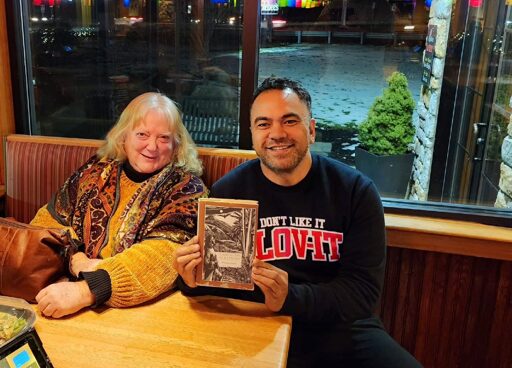
A few months later, Deborah picked me up from the university campus. We drove through a winter blizzard to a diner. Looking out at the snow blanketing the windows, I couldn’t quite believe I was a Fulbright scholar from West Auckland, sitting in an American diner across from the person who had captured my imagination decades earlier.
We fell right into conversation, and I soon learned that the circumstances which led to Flight of the Albatross were every bit as dramatic as the pages she wrote.

Will Flavell and Deborah Savage meeting for the first time in Massachusetts. (Image supplied)
In 1975, as a 19-year-old student at Amherst, Deborah’s passion for stories led her to study mythology. But by 1980, feeling overwhelmed, having left home at a young age, and struggling to pay her bills after government cuts to her education support, she walked into the administration office intending to drop out. Her plan was to take the plunge into the unpredictable life of a creative artist.
On her way to the office, she bumped into her professor, Robert Dyer, who was at the same time carrying his own letter of resignation. Robert, a New Zealander, had uncovered a painful secret in the pages of his late father’s personal diary. Humphrey Goring Dyer was the last Pākehā commander of the 28th Māori Battalion and had returned from the Second World War haunted by a tragedy in a minefield on Crete. He was convinced that a curse had followed him home.
According to Robert’s father, Major Dyer, the Māori Battalion was retreating through a minefield when a young Māori soldier was grievously injured by a mine. Not wanting to be captured by the Germans, the soldier begged Major Dyer to shoot him. When Major Dyer returned home, he travelled to Northland to find the boy’s whānau near Whangārei. The whānau didn’t take the news of the shooting well and placed a mākutu, or curse, on Major Dyer, which seemed to affect the family for generations.
Robert had decided to abandon his academic career and return to Aotearoa to seek answers. Deborah was captivated by the mystery and ended up going with him. They married in 1981, and this young American woman soon found herself living in a tiny, isolated cabin with no electricity on Aotea Great Barrier, milking goats and absorbing the intricacies of life on the whenua.
After finishing at the diner, we moved our kōrero to her warm home nearby, where we were surrounded by old manuscripts from her life as a fiction writer. It was a peaceful space that she had to herself these days. She and Robert divorced after a few years and went their separate ways.
The conversation flowed easily, occasionally interrupted by her demanding elderly cat, Oliver, and her dog, Dolly, who seemed to recognise my New Zealand accent. Deborah looked at me intently, her expression a mix of sharp focus and genuine warmth.
“You’re very focused . . . always on a mission,” she observed, describing herself as the exact opposite: “I’m much more in my head.”

Will Flavell as a Fulbright Scholar at the University of Massachusetts. (Image supplied)
We tackled the heavy question of cultural appropriation and whether you should write about a world that isn’t your own. Deborah said nobody had been debating that when she wrote Flight of the Albatross, but she completely understood the modern concerns. She said her approach back then was guided by simple human decency — she had arrived with an open heart, ready to soak everything up. She spent a lot of time listening to kaumātua, observing her new community, and pitching in with work. She learned about the deep grief of people fighting to reclaim a language that had been systematically stripped away.
She initially spent three years in Aotearoa.
Storytelling had been her passion since childhood, when she first began writing and illustrating her own tales. Catching buses around Auckland, she delivered the manuscript of her first book, A Rumour of Otters, to various publishers. Over the course of her career, she published seven books.
Deborah earned a living sharing her gifts directly with the community. She secured writer and artist residencies at schools, worked in a children’s museum, and helped kids paint community murals. A significant chapter in her life story ended five years ago when her former husband, Robert, passed away.
She still holds fast to the idea that it’s our stories that bind us together as human beings.
“We don’t own stories. The stories are us. They are our meaning. The reason they last is because they still speak. They speak, and we hear them, because it’s human.”
Before we parted ways, I asked her the question that had been lingering in my mind. Would she ever return to Aotearoa?
“Oh, it would be a dream to go back,” she replied. She hasn’t been back for more than 30 years, due in part to a disability, combined with the modest income of a life spent teaching art to children.
Her physical challenges date back to the mid-1990s, when she developed Graves’ disease, a hereditary condition that causes a hyperactive thyroid and severely restricts her mobility. A decade ago, her resilience was tested further when a devastating fire destroyed her home and her beloved art and writing studio, leaving her temporarily homeless. Yet despite these setbacks, Deborah remains cheerful and determined.
Years after pulling her book from a weathered box, I now work as a high school principal. I read recently that over half of the boys in Aotearoa don’t read for pleasure. That’s something I’m really trying to turn around in my job. Writing about Deborah has reminded me just how special it is to develop a love for reading at a young age.
Forty years ago, on the shores of Aotearoa, a lonely American woman, who had married very young and was consequently unhappy in her marriage, used her creativity to carve a story that became the taonga, Flight of the Albatross.
Seeing a Māori character take centre-stage in this book was genuinely inspiring. For me, that moment changed everything. It was a profound realisation that our faces and our stories belong in all spaces, including literature. That moment has fundamentally shaped my own journey and career, driving a lifelong passion to keep pushing for Māori to be represented in community leadership and governance, where our voices deserve to be heard.
Deborah had no idea her words would spend years waiting in a garage before pushing a young Māori boy to see what was possible, ultimately starting a journey that carried him straight to her doorstep.

Deborah Savage, at home with her dogs. (Image supplied)
Dr Will Flavell (Ngāpuhi, Ngāti Whātua, and Ngāti Maniapoto) is a Fulbright scholar, elected member of the Henderson-Massey Local Board, and the principal of Te Kāpehu Whetū Tāmaki, a new senior high school in Auckland Central.
The post Flight of the albatross appeared first on E-Tangata.
From E-Tangata via This RSS Feed.