

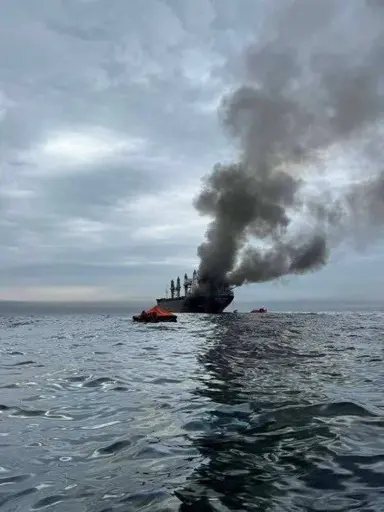
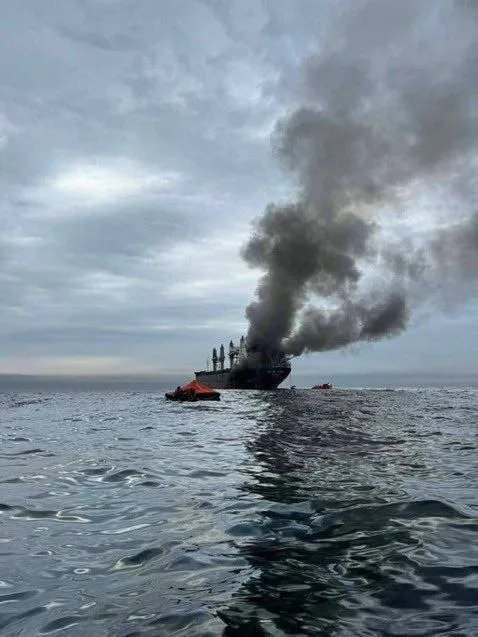
Strait of Hormuz tankers explode in mined waters as Iran closes the route and warns of offensive action amid dangerous U.S. military escalation.
Related: Iranian Supreme Leader Will Be Sheltered Until the US Threat Ends
Strait of Hormuz tankers incident sparks new escalation
Strait of Hormuz tankers have become the latest flashpoint in the escalating confrontation between Iran and the United States, after the Islamic Revolutionary Guard Corps (IRGC) reported the explosion and fire aboard two oil tankers south of the strategic waterway. According to Iranian military authorities, the vessels attempted to sail through mined waters, triggering the blasts and forcing emergency response operations in the area.
In its statement, the IRGC specified that the tankers tried to proceed along a passage that had been previously mined, and issued a warning to all ships navigating in the region about the extreme danger present in that maritime corridor. The force emphasized that the Strait of Hormuz tankers incident was directly linked to what it described as destabilizing U.S. military actions in the surrounding waters.
Iran’s military leadership declared that, due to the current conditions, the strait is effectively closed and unsafe for oil and gas shipments. This announcement immediately raised concerns among energy markets, as any disruption affecting Strait of Hormuz tankers can have direct consequences for global oil and gas supply routes.
Tehran holds Washington responsible for creating an environment of high risk in one of the world’s most sensitive maritime chokepoints. For Iranian authorities, the Strait of Hormuz tankers explosions are not an isolated event but the result of a broader military escalation fueled by recent U.S. operations in the region.
Iran’s stance on Strait of Hormuz tankers and energy flows
- International Maritime Organization – Safety and navigation
- U.S. Energy Information Administration – Strait of Hormuz
The Iranian command has warned that no oil or natural gas exports will transit through the strait as long as U.S. attacks continue, effectively tying the reopening of the route to a de‑escalation of hostilities. This decision turns the Strait of Hormuz tankers route into a central pressure point in the current confrontation.
Iranian officials stressed that the ongoing armed confrontation has buried the most recent diplomatic efforts between Washington and Tehran. Just one month earlier, on June 18, both countries had signed a memorandum of understanding aimed at curbing military operations and opening formal negotiations. That fragile framework has now collapsed.
The shift became evident when U.S. President Donald Trump canceled the agreement on July 8, following attacks against three vessels in the region. After scrapping the memorandum, Washington resumed airstrikes on Iranian territory, further intensifying tensions and placing additional Strait of Hormuz tankers at risk.
In response, Tehran launched retaliatory actions against U.S. military positions across the region, in what it frames as defensive operations. While Washington demands guarantees for freedom of navigation and insists on securing maritime traffic for its allies, Iran argues for establishing a regional mechanism under its own participation to regulate the transit of ships.
The dispute over who controls and secures sea lanes has turned the Strait of Hormuz tankers corridor into a symbol of the broader struggle for influence, sovereignty and security arrangements in the Persian Gulf.
Military warnings linked to Strait of Hormuz tankers crisis
- UN News – Security Council coverage on Middle East and Gulf
- International Crisis Group – Gulf and Iran analysis
As U.S. bombings continue, hitting not only military targets but also Iranian civilian infrastructure such as residential neighborhoods, airports, train stations and bridges, senior Iranian figures are sharpening their rhetoric. Major General Mohsen Rezai, former commander‑in‑chief of the IRGC, warned that Iran could soon abandon a purely retaliatory posture.
Rezai stated in a televised interview that, if the United States keeps the war going in the coming days, Iran will move from a phase of reprisals to an offensive phase. In his words, this shift would mark the end of a scenario combining negotiation and war and open a period defined primarily by offensive military operations.
The general cautioned that another miscalculation by the United States could “take the flames of war to an extraregional level”, suggesting that the conflict could extend beyond West Asia and involve broader international actors. In this sense, the fate of Strait of Hormuz tankers is directly linked to the risk of a wider, less controllable confrontation.
Rezai has called on Muslim populations across West Asia to oppose the expansion of the conflict through their resistance to U.S. and Israeli policies. For him and other Iranian officials, mobilization at the societal level is essential to counter external pressure and to support the country’s stance on the Strait of Hormuz tankers shutdown.
These declarations add a political and ideological layer to a crisis already marked by military incidents, economic pressure and naval maneuvers, placing the Strait of Hormuz tankers issue at the center of both strategic calculations and regional narratives.
Irán declara cerrado el estrecho de Ormuz
La Armada de la Guardia Revolucionaria afirmó que la vía marítima “está completamente cerrada” y minada. Advirtió que no se exportará “ni una gota de petróleo o gas” hasta que cese la agresión de EE. UU. Por Ormuz transita el 20 % del… pic.twitter.com/fiHt5bgaqa
— teleSUR TV (@teleSURtv) July 17, 2026
Geopolitical context: Strait of Hormuz tankers and global stakes
The Strait of Hormuz tankers route is one of the world’s most critical maritime arteries, through which a significant share of global oil and liquefied natural gas exports passes. Any prolonged disruption in this corridor can drive up energy prices, unsettle financial markets and alter supply chains worldwide.
The closure announced by Iran, even if partial or temporary, has immediate implications for energy‑dependent economies in Asia, Europe and beyond, especially those that rely heavily on Gulf producers for crude and gas imports. The vulnerability of Strait of Hormuz tankers underscores how regional conflicts can quickly translate into global economic shocks.
At the same time, the crisis deepens existing fault lines between the United States and Iran, both of which see control over the strait as a matter of national security and strategic influence. For Washington, ensuring freedom of navigation is presented as a central principle; for Tehran, the presence of foreign fleets is framed as a threat to its sovereignty and regional stability.
Other regional actors, including Gulf monarchies and major importers such as China and India, are closely following how the Strait of Hormuz tankers crisis evolves. They must balance their security partnerships, economic interests and domestic political considerations while seeking to avoid a scenario in which a localized naval clash escalates into a larger regional war.
In multilateral arenas, the situation will likely fuel debates on maritime security regimes, sanctions policy and conflict‑prevention mechanisms. The way the international community reacts to the Strait of Hormuz tankers explosions and subsequent closure may shape future norms on how strategic chokepoints are managed during periods of tension.
Ultimately, the incident highlights how a single maritime episode—two damaged Strait of Hormuz tankers in mined waters—can become the trigger for diplomatic breakdowns, military escalation and global economic uncertainty, confirming the strait’s status as one of the most sensitive geopolitical points on the planet.
— teleSUR TV (@teleSURtv) July 17, 2026
From teleSUR English via This RSS Feed.