


By DANIEL ADAM
On Monday, July 6, the town council of Windsor, Conn., voted against bringing back Automatic License Plate Recognition (ALPR) cameras owned by Flock Group Inc. The vote represents a small but meaningful advance for the movement against surveillance and state repression, which includes similar victories in some 90 towns and cities across the U.S. Community leaders are now organizing to make the most of this advance by continuing and expanding campaigns against surveillance in Windsor and Connecticut.
A council vote of 8-1 first turned off the Windsor ALPR cameras in February, pending a discussion on whether to revise the town’s contract with Flock or to let the contract expire in September. The 5-4 vote in July against turning the cameras back on suggests the town government will likely let its contract with Flock expire in September, although councilors still show interest in finding a less controversial company to host a similar surveillance system in the town.
Months of organizing and agitation by community members went into winning the vote, including an organizing meeting of 80 and a petition drive to pass an ordinance to remove the cameras. The advance comes as a backlash against Flock and ALPRs grows nationally, and as residents of other cities and towns across Connecticut are getting organized to expose and expel ALPR cameras and the warrantless state surveillance that they help to expand.
What are ALPRs?
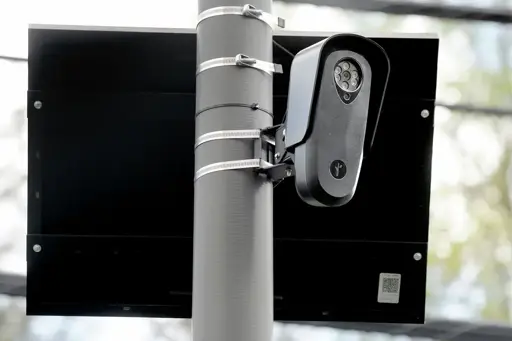
Automatic License Plate Recognition (ALPR) cameras take pictures of cars and license plates, process them with “AI” algorithms that turn the pictures into key words, and upload those words into a national database owned by Flock that police and federal agents can search without a warrant. The database can track vehicles, establish patterns of movement, and identify relationships. It is hard to find an end to the use of such surveillance infrastructure. The cameras can, for instance, track every vehicle that visits an abortion clinic, immigration court, place of worship, or union hall. Flock is just one of several companies that maintain such cameras.
The Windsor campaign
Flock cameras were first installed in Windsor five years ago with the approval of a police lieutenant, and without public discussion or debate. Concerns about the cameras were raised in 2025 with the start of a somewhat informal group called “Get Flock Out of Windsor.”
One resident filed a FOIA request on recent searches made on the data collected by Windsor’s cameras. The FOIA revealed that police and federal agents around the country had logged searches in Windsor data related to immigrants, women seeking abortions, people seeking gender-affirming care, and people attending peaceful protests like the “No Kings” actions.
The FOIA made the cameras’ larger significance perfectly clear. At a time when mass lawless repression is openly employed throughout the country by federal agencies against political dissidents and a variety of oppressed groups, it is already much harder than in other periods to claim that this kind of mass warrantless surveillance could be employed only with the best of intentions. The FOIA, however, was a smoking gun: It emphasized that the contract with Flock is an act of open collaboration between the local government and the rise of authoritarian rule led by Trump.
And in Windsor, the Democratic Party majority on the council is not merely solid. Without laws reserving space on the town council for a minority party, Republicans would likely not have a single seat.
Around the time of the FOIA, local members of the Connecticut Civil Liberties Defense Committee (CLDC) joined the effort to get the cameras out of Windsor, and opposition in town hearings and meetings grew.
At the same time, state legislators indicated that they could soon pass regulations in Connecticut that could save local officials from having to end their contract with Flock. So, in February, the town council voted to turn off the cameras, pending a later discussion.
In May, the state legislature did indeed pass SB397, appearing to impose various restrictions on the use of ALPR cameras, such as prohibiting their use to “monitor or investigate someone based on race, ethnicity, sexual orientation, gender identity or expression, sex, pregnancy status, disability, citizenship, nationality or income level, or perceived criminal history” and restricting data sharing to law enforcement in Connecticut, Massachusetts, Rhode Island, and New York.
The regulation, however, is next to useless. Even on its own terms, the data-sharing provision contains its own loopholes a mile wide for “authorized multi-jurisdictional task forces under specific conditions” and “agencies operating under a warrant or other limited statutory authorization.” This language allows ICE and other federal agencies right back into the database.
But more fundamentally, the federal government already openly violates Connecticut law without consequence (as it does when ICE agents raid courthouses with masks on). Flock is a private, multi-billion-dollar company with far more knowledge and control over its own data centers than any official in Windsor or Connecticut, and every provision of the regulation can be violated without public knowledge a hundred different ways. What matters is not a regulation on the books, but whether the cameras are running and filling Flock’s servers.
So, when town councilors on the Health and Safety Committee recommended turning the cameras back on, opponents redoubled their efforts, organizing to petition for an ordinance to end the contract and remove the cameras. The campaign (called “Surveillance off Our Streets” or “SOS”) kicked off with an 80-person meeting on July 1, where residents from several other cities and towns joined to discuss and begin new campaigns. In attendance were representatives from New London, Stamford, Norwalk, West Hartford, and Hamden.
In the following five days leading up to the council vote (three of which hit 100 degrees and on one of which, it rained), activists collected about 300 signatures and circulated a short brochure on the cameras (a little over 1000 signatures are needed to call a special town meeting to pass the ordinance). The short effort brought a new layer of residents into the town hall for the vote, several of whom spoke out against the cameras for the first time.
In the vote’s aftermath, activists decided to continue the petition drive. The cameras are supposed to be off, but they are still set up in the streets, and the contract hasn’t been cancelled or expired. Meanwhile, some of the councilors who voted against turning on the cameras openly discussed finding another company with a better name to conduct surveillance in town. And local media (like the Hartford Courant) have either run opinion pieces defending mass surveillance via ALPR cameras or news stories that paint the cameras in a positive light.
The petition drive is serving as an important vehicle to clarify the stakes with residents through numerous discussions. It has also proved to be an essential means of meeting and training new activists. With more than 500 signatures now submitted (as of this article’s writing) it is also a means to keep the pressure on the council to finalize the cancelation of Flock’s contract and ensure the cameras are finally taken down.
Meanwhile, the town of Killingworth, Conn., is also in the process of removing its Flock cameras. Similar efforts in other towns are starting up, and the planning of new educational and organizing meetings is underway.
Photo: A Flock camera on a street pole. (Arnold Gold / Hearst Connecticut Media)
The post Activists build on victory for anti-surveillance movement in Windsor, Conn. first appeared on Workers’ Voice/La Voz de los Trabajadores.
From Workers’ Voice/La Voz de los Trabajadores via This RSS Feed.