

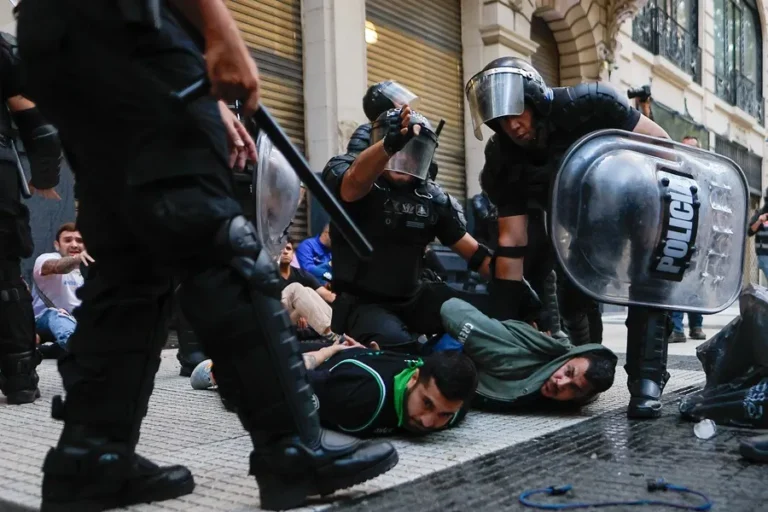
Argentina police repression under scrutiny as federal forces hide key records on the 2025 crackdown that gravely injured photojournalist Pablo Grillo.
Related: Argentina and Spain Clash for First World Cup Champion Rings
Argentina police repression and the hidden records in the Grillo case
Argentina police repression is once again at the center of public debate after the Argentine Federal Police delivered a heavily redacted report to the courts on the March 12, 2025 crackdown that left photographer Pablo Grillo gravely injured in front of Congress. Key records covering the exact time of the attack were omitted, deepening concerns over institutional opacity and possible cover‑up.
On Saturday, July 18, the Federal Police submitted a 600‑page report to Judge María Servini, but left out all radio communications between 17:00 and 18:00, precisely when Grillo was attacked during a demonstration of retirees. This deliberate time gap has become a central element in the discussion on Argentina police repression and accountability.
The missing recordings correspond to the period when security forces enforced the anti‑picket protocol promoted at the time by then Security Minister Patricia Bullrich, during a protest that ended with dozens of injured protesters and 114 people detained. The decision to withhold those communications raises serious questions about the chain of command and operational orders during the operation.
Relatives of Pablo Grillo have publicly denounced the concealment of Federal Police records, arguing that the partial report obstructs efforts to clarify how and why the brutal attack took place. Their complaint places Argentina police repression under renewed scrutiny, particularly in cases involving journalists and demonstrators.
How Argentina police repression targeted photojournalist Pablo Grillo
- United Nations – Special Rapporteur on the promotion and protection of the right to freedom of opinion and expression
- Inter-American Commission on Human Rights – Freedom of Expression
According to the complaint filed in court, the legal team representing Grillo showed that Gendarmerie corporal Héctor Guerrero fired a tear gas grenade horizontally at the photographer’s head, rather than using the arcing trajectory required by safety protocols. This direct, horizontal shot is cited as evidence of disproportionate and unlawful use of force, a hallmark pattern in broader Argentina police repression.
At the time of the attack, the security operation was coordinated by Commissioner Gerardo Perillo Scampini, identified as the officer in charge of the joint deployment of federal forces. The omission of radio communications from that crucial hour hinders the reconstruction of who gave which orders and how the operation was executed.
During the same mobilization, other demonstrators were also wounded, including Jonathan Navarro and retiree Beatriz Blanco, who remains hospitalized as a result of the injuries sustained. These additional victims reinforce the perception that Argentina police repression during that operation was not an isolated incident but part of a broader pattern of aggressive crowd control.
Corporal Guerrero is currently facing an oral criminal trial for causing extremely serious injuries before Federal Oral Court No. 6. Human rights organizations stress that the outcome of this trial will be an important indicator of whether Argentina police repression will be met with real judicial consequences or continue in a context of impunity.
In response to the state’s opacity, lawyers from the Center for Legal and Social Studies (CELS) and the Argentine League for Human Rights have demanded that the court compel the Federal Police to deliver the complete audio recordings. They argue that full access to those files is essential to clarify responsibilities at every level of the command chain and to determine whether orders or omissions enabled the attack on Grillo and other protesters.
The controversy over the missing material coincides with earlier reports of censorship against Pablo Grillo himself, including attempts to block or limit exhibitions of his photographs related to police violence, which have become symbolic in documenting Argentina police repression against social movements and the press.
Argentina police repression under Milei: data, trends and alarming percentages
The Coordinadora contra la Represión Policial e Institucional (Correpi) has provided stark figures that place Argentina police repression during the government of President Javier Milei in a broader, deeply worrying context. In its annual report presented in March at the headquarters of the Buenos Aires Press Union (Sipreba), the organization revealed that the first two years of Milei’s administration account for around 10% of all killings committed by state security forces since the return to democracy in 1983.
According to Correpi’s updated database (as of January 20, 2026), 10,181 people have been killed by security forces in Argentina since December 10, 1983, when democratic rule was restored. Of those cases, 1,056 deaths occurred after December 10, 2023, the date on which the La Libertad Avanza government took office. These figures underscore the intensity and speed of lethal incidents associated with Argentina police repression in the current period.
Activist, lawyer and Correpi founder María del Carmen Verdú stressed that the updated 2025 Archive shows that the current administration is the one that has repressed and killed the most in 42 years of democracy, when measuring deaths in proportion to time in office. For human rights defenders, this confirms a qualitative and quantitative leap in state violence linked to Argentina police repression.
Verdú further specified that more than 10% of the total recorded deaths at the hands of security forces have occurred in just two years of Milei’s government, surpassing previous administrations in relative lethality over the same time frame. This statistic places Argentina police repression under this government at the top of the democratic era in terms of intensity of deadly incidents.
Correpi’s report also categorizes cases by security force, type of event and context, identifying patterns such as trigger‑happy shootings, deaths in custody, and fatalities during protest repression. These categories suggest that Argentina police repression is not confined to street protests but extends to everyday policing and prison conditions, amplifying concern over structural problems within the security apparatus.
Geopolitical context: Argentina police repression and regional human rights concerns
The escalation of Argentina police repression underlines growing alarm among regional and international human rights bodies. In Latin America, where several countries have faced controversies over the militarization of public security and the criminalization of protest, developments in Argentina are closely watched as a potential benchmark for future responses.
Argentina has historically presented itself as a reference point in transitional justice and human rights, with landmark trials on dictatorship‑era crimes. The recent surge in Argentina police repression, however, risks undermining that legacy and reshaping the country’s image within multilateral forums and regional organizations.
International observers warn that high levels of state violence during protests and ordinary policing may affect Argentina’s standing in bodies such as the UN Human Rights Council or the Organization of American States, particularly if allegations of systematic abuses persist without effective corrective measures. In this context, the Grillo case and Correpi’s statistics become emblematic indicators of a wider trend.
At the same time, regional social movements and press freedom organizations see in Argentina police repression a reflection of broader tensions around austerity policies, labor reforms and social cuts, all of which have prompted mass mobilizations. How the Argentine state responds to dissent will likely influence regional debates on security protocols, crowd control and the right to protest.
The combination of concealed police records, serious injuries to journalists, and rising fatality numbers strengthens calls for international monitoring, independent investigations and structural reform of security forces. For many analysts, the direction taken by Argentina in dealing with Argentina police repression will signal whether the region moves toward greater respect for rights or deeper normalization of harsh police tactics.
From teleSUR English via This RSS Feed.