

“Yet again, the Trump administration has sold out our endangered wildlife to the highest bidder,” said one biodiversity advocate after the US Department of Interior, in a Friday news dump, issued two new policy changes that would weaken the Endangered Species Act and make it easier for corporate polluters to prioritize their own bottom lines over habitat protection.
The US Fish and Wildlife Service (FWS) rescinded a policy that has been known as the “blanket rule” since 1975, which has given threatened species the same protections from illegal killing, trapping, harassment, and other forms of “take” under the ESA, as species that are officially designated as endangered.
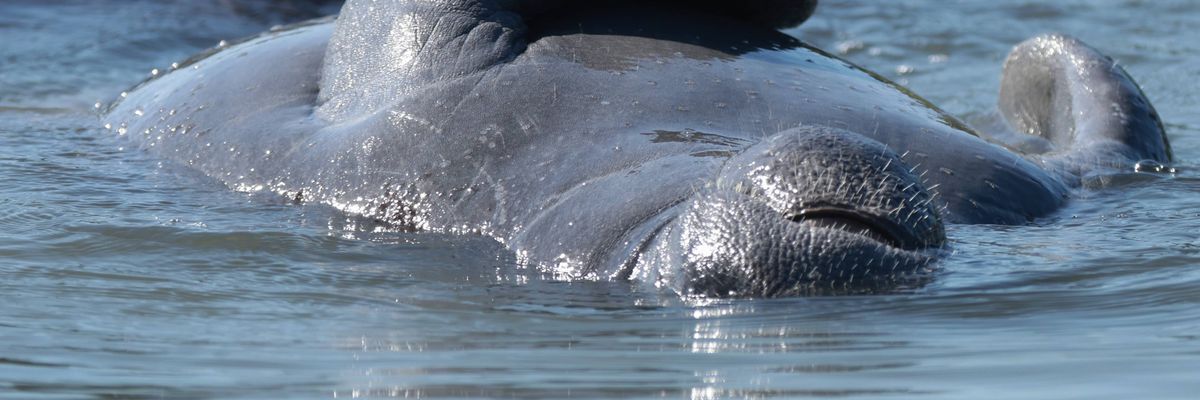
The rollback would apply to species that have been newly declared as threatened, including the Florida manatee, the Pygmy rabbit, the Aztec Gilia, and Clover’s Cactus—which could now go for years without protections despite their habitat loss and declining populations.
“Today’s decision represents a profound failure by Interior Secretary [Doug] Burgum and his department, and it amounts to an utter abdication of the federal government’s responsibility to protect America’s wildlife," said Sara Amundson, president of the Humane World Action Fund. "The department’s role is to faithfully implement—and certainly not to dismantle—the Endangered Species Act.”
The other policy change will require the FWS to consider the economic impact on various industries of designating areas as “critical” habitats in order to protect threatened and endangered species. The agency has previously had discretion over whether to consider economics when making habitat protection decisions.
Under President Donald Trump’s new rule, said the Center for Biological Diversity, the FWS will be forced “to accept at face value claims by corporations and landowners of economic impacts from designating critical habitat, which could greatly limit the amount and quality of habitat protected for imperiled wildlife.”
“Trump is bending over backward for corporate polluters by ripping away the blanket that protects so many struggling wildlife species as well as the air we breathe, the water we drink, and the natural places where we seek peace of mind."
"The way this is written, a landowner could falsely claim they planned to build the next Disneyland on their property, so designating critical habitat would supposedly cost them tens of millions of dollars,” said Noah Greenwald, CBD’s endangered species co-director. “This rule is clearly intended to prevent the protection of the wild places that endangered animals and plants need to survive. It’s a despicable move that cheapens the value of our most imperiled wildlife so corporations can make more money. Anyone can make outrageous claims about how much their property is worth, but that shouldn’t be taken as gospel.”
Advocacy groups said both policy changes amounted to giveaways to the logging, mining, drilling, and cattle ranching industries. The latter industry has long lobbied against land being designated as a critical habitat for the ‘I‘iwi bird in Hawaii, Clay Samford, an attorney with the environmental legal group Earthjustice, told The Washington Post.
“It’s part of this administration’s push to reduce protections for public lands and wildlife that are enjoyed by all Americans, in favor of narrow business interests,” Samford told the newspaper.
A senior attorney for the group, Elizabeth Forsyth, said in a statement that “the Trump administration is turning the law on its head by letting extractive industries dictate where critical habitat can be destroyed.”
“This prioritization of industry interests over science is fundamentally at odds with the clear purpose of the Endangered Species Act,” said Forsyth. "We won’t let this dangerous giveaway go unchallenged.”
There is currently a backlog of more than 500 species awaiting consideration for listing as threatened or endangered, and the rule changes, along with the Trump administration’s 18% reduction in the FWS workforce, are expected to leave imperiled species waiting even longer for protections.
“In the midst of an extinction crisis, with hundreds of species like the Florida manatee and the wolverine desperately needing stronger protections for their habitats, the Trump administration is gutting protections to benefit industry interests," said Ryan Shannon, a senior attorney at Defenders of Wildlife. "Where we see our nation’s irreplaceable wildlife, they see dollar signs. But our federal lands and waters, and the species they support, belong to all Americans, not to the logging, drilling, and mining industries that oppose all limits on maximizing their private profits.”
In a statement, Interior Secretary Doug Burgum asserted that the ESA has long been "weaponized to stop almost any new project in America, driving up costs for families, weakening our competitiveness, and undermining our national security,” continued Secretary Burgum.
He added that the endangered species list has “fallen short,” with 97% of listed species remaining designated as endangered, and called for “species recovery and delisting.”
But Defenders of Wildlife noted that the ESA “has succeeded in preventing extinction for 99% of listed species.”
“Public support for protecting our native wildlife remains overwhelmingly high, with 84% of voters supporting the ESA, according to nationwide polling conducted by Defenders of Wildlife,” said the group.
The rules announced on Friday came days after the Interior Department proposed a new rule under which management of threatened grizzly bears would be transferred from the federal government to the states, where Republican leaders have pushed to end protections for the species.
The administration also exempted oil and gas companies from having to protect endangered species in the Gulf of Mexico, and earlier this month changed the regulatory interpretation of the word “harm” in the ESA.
“These rules are a one-way ticket to extinction for our most imperiled animals and plants, from monarch butterflies to giraffes to alligator snapping turtles,” said Greenwald. “Trump is bending over backward for corporate polluters by ripping away the blanket that protects so many struggling wildlife species as well as the air we breathe, the water we drink, and the natural places where we seek peace of mind. This is the last thing we need in the middle of an extinction crisis, and we’ll fight it with everything we’ve got.”
From Common Dreams via This RSS Feed.