

Record July rainfall, an intense atmospheric river and winds of up to 160 km/h have left three dead and more than 400,000 households without electricity.
A historic storm system has battered Chile, leaving three people dead, destroying or severely damaging around 100 homes and cutting electricity to more than 400,000 households, as authorities carry out urgent evacuations in informal settlements built along riverbeds threatened by rising waters.
RELATED:
Record rainfall and exceptional weather conditions
The frontal system is affecting 10 of Chile’s 16 regions, bringing flooded streets, widespread power outages, heavy coastal swells, grounded vessels and swollen rivers. Wind gusts of up to 160 km/h have toppled power lines, trees and a large construction crane in the northern city of Coquimbo.
Gastón Torres, director of Chile’s Meteorological Directorate (DMC), described the event as exceptional.
“We are under the influence of a train of frontal systems accompanied by an intense atmospheric river with exceptional characteristics. Its intensity and geographic extent place it among the most significant weather events recorded in recent years.”
#ALARMA AAA5/2026
PRECIPITACIONES INTENSAS
Provincia de Huasco (Costa a precordillera) Regiones de Atacama
Validez: Desde la madrugada del sábado 18 al lunes 20 de julio.
Sigue las recomendaciones de las autoridades @Senapred y el pronóstico y Alertas oficiales… pic.twitter.com/UhdNLG9SGt
— MeteoChile (@meteochile_dmc) July 16, 2026
Text Reads: #ALERT AAA5/2026
HEAVY PRECIPITATION
Huasco Province (Coast to foothills) Atacama Region
Validity: From the early morning of Saturday 18 to Monday 20 July.
Follow the recommendations from the authorities
@Senapred and the official forecast and Alerts for  on #Meteochile
Torres warned that the system could become the most intense July rainfall event since meteorological records began.
According to the DMC, the coastal region of Valparaíso has recorded the highest rainfall totals, with 142 millimeters between Thursday morning and midday Friday. The Santiago Metropolitan Region follows with 132.6 millimeters, while the O’Higgins Region has received 101.6 millimeters.
More than 400,000 households without electricity
The latest official report estimates that around 100 homes have been destroyed or suffered severe damage, while more than 400,000 households remain without electricity. The largest concentration of outages is in the southern region of La Araucanía, about 750 kilometers south of Santiago.
Authorities have maintained emergency alerts and warned that the figures could rise as the storm continues affecting the country.
Emergency evacuations along riverbanks
In the municipality of Talagante, on the outskirts of Santiago, emergency crews are racing to evacuate residents from the Ribera del Río settlement, an informal community built within the Mapocho River basin.
The town’s mayor led a convoy of military personnel, police officers and firefighters using loudspeakers to urge residents to leave immediately.
“There is an imminent risk, and I do not want anyone to die.” He also warned: “The river always returns to its natural course. The last major flood here was 23 years ago.”
Authorities have also carried out precautionary evacuations in settlements near the Maipo River in Puente Alto, south of the capital, underscoring the persistent housing vulnerability affecting low-income communities.
Penco hit by a second disaster
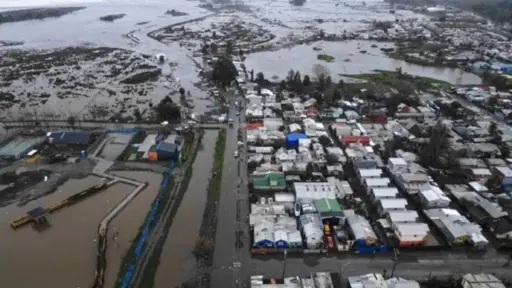
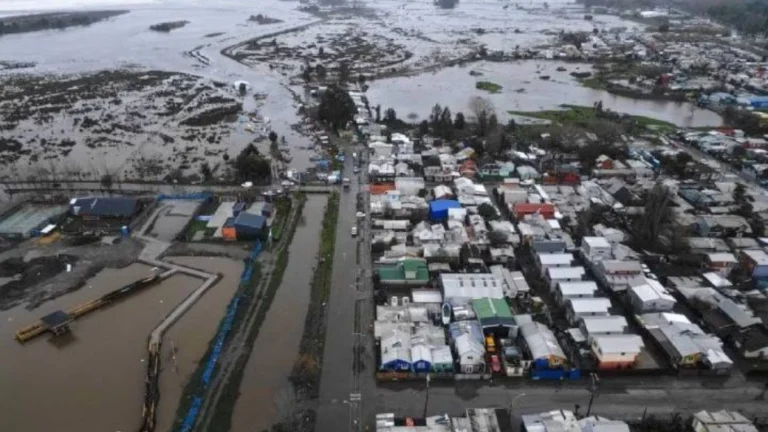
Penco, in the Biobío Region, is among the hardest-hit municipalities after storm surges flooded dozens of homes near the coast. President José Antonio Kast was scheduled to visit the area on Friday.
The municipality had been recovering from the devastating wildfires that struck southern Chile in January and left around 20 people dead. Less than six months later, it is facing severe flooding.
The succession of frontal systems is expected to continue until Sunday night while advancing northward. Authorities are preparing for heavy rainfall in Atacama, about 800 kilometers north of Santiago and the site of the deadly 2015 floods, as well as in Coquimbo, where regional authorities have acknowledged that the region “is not prepared” for a weather event of this scale.
Government response
President José Antonio Kast, facing his first major emergency since taking office in March, traveled to the Biobío Region, one of the areas most affected by the storm.
“We have to learn lessons: there are places that are not habitable.”
He also thanked regional authorities for their cooperation, adding:
“There are no political differences when Chileans are affected by disasters or severe weather events that we can only mitigate, not stop.”
The government suspended classes on Friday across most of the regions affected by the storm, which authorities linked to the El Niño phenomenon following an unusually warm and dry autumn across much of the country.
Authorities remain on alert as the historic storm system continues to move across Chile.
From teleSUR English via This RSS Feed.