

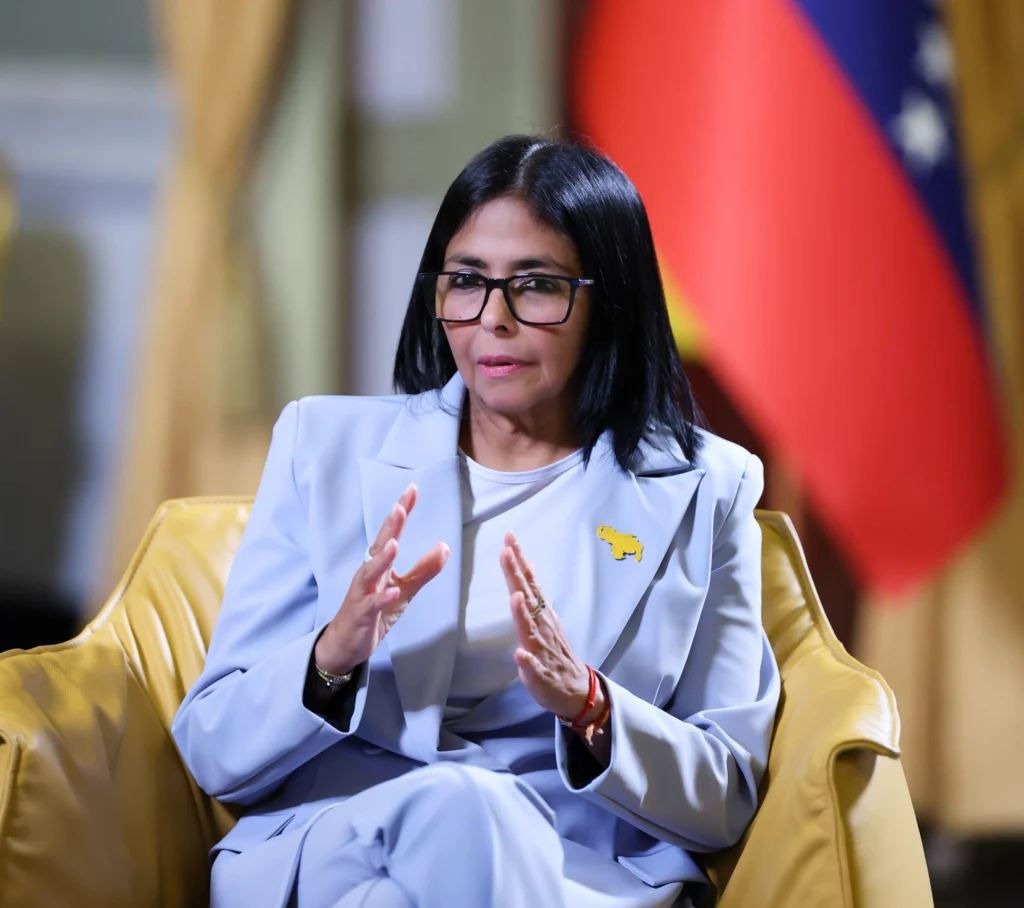
Venezuela’s Acting President Delcy Rodriguez confirmed the funds will aid housing, infrastructure and public services reconstruction as the death toll from the June 24 double earthquake.
Venezuelan Acting President Delcy Rodriguez announced on July 17 that the disbursement -drawn from Venezuela’s own contribution reserves within the multilateral institution— will be allocated to support affected families in housing reconstruction, infrastructure rehabilitation, essential public services, and other urgent post-disaster needs.
RELATED: Venezuela Signs Agreements for Electrical Recovery with Russia and U.S. Energy Firms
“This initial disbursement will allow us to begin the urgent task of rebuilding homes, restoring water and electricity networks, and providing shelter for thousands of families who lost everything,” Rodriguez stated in an official communiqué released this Friday evening.
#Venezuela | Acting President Delcy Rodríguez announced that Venezuela has accessed US$346 million from its own IMF resources to finance reconstruction efforts following the June 24 earthquakes.
The funds will support housing, infrastructure, and essential public services in the… pic.twitter.com/y6LU3GW4rj
— teleSUR English (@telesurenglish) July 18, 2026
The Acting President thanked IMF Managing Director Kristalina Georgieva for “her support and commitment, as well as all the institutions that made this important step possible.“
Venezuelan Acting President Rodriguez had previously spoken with Georgieva on July 8 regarding the release of blocked national resources at the Fund. During that conversation, the Acting President reiterated her demand for the lifting of international sanctions against Venezuela and the full unblocking of the country’s financial assets abroad.
On July 9, IMF Spokesperson Julie Kozack clarified during a press briefing that Georgieva and Rodriguez discussed “the use of Venezuela’s reserve tranche at the IMF, which constitutes an important and easily accessible source of liquidity that can be mobilized quickly.” Kozack distinguished the reserve tranche -funds that countries contribute as part of their IMF membership- from the Special Drawing Rights (SDR) retained by the institution, which amount to approximately US$4.5 billion. Combined, Venezuela’s total assets held at the IMF approach US$5 billion.
Kozack confirmed that the reserve tranche assets have “immediate availability to help address urgent humanitarian needs arising from the disaster” and constitute the resource Venezuela “has indicated it wishes to use.”
The development marks a significant milestone in the gradual normalization of relations between Venezuela and the IMF, which resumed formal contacts in April 2026 after being suspended since 2019. Since then, technical dialogues between the Fund and the Bolivarian government have been regular, with the aim of completing the procedural steps that could eventually allow Venezuela to access additional IMF financial instruments.
Sanctions Still Ongoing
The IMF disbursement represents a rare instance of financial fluidity for Venezuela, which has faced severe economic sanctions and restricted access to multilateral credit since 2017.
In a related diplomatic move, Acting President Rodríguez recently confirmed the dispatch of a formal letter to King Charles III of the United Kingdom requesting the release of Venezuelan gold reserves currently retained at the Bank of England. The gold -valued at approximately US$2 billion- has been frozen since 2018 amid the international dispute over recognition of Venezuela’s legitimate government.
“Allow me to reiterate once again the call for the definitive cessation of all coercive and unilateral measures that, in violation of international law, continue to harm our people,” Rodríguez stated. “We will continue working tirelessly to protect our people and advance the country’s recovery,” she affirmed.
Devastating Earthquakes
The twin earthquakes struck northwestern Venezuela on the afternoon of June 24, with epicenters located in the Veroes Municipality, west of San Felipe, in Yaracuy state.
According to the United States Geological Survey (USGS), the first tremor -a magnitude 7.2 foreshock- struck at 6:05 P.M. local time at a depth of 20.3 kilometers, followed just 39 seconds later by the magnitude 7.5 mainshock at a depth of 10 kilometers, making it the strongest earthquake to hit Venezuela since the 1900 San Narciso earthquake.
Official report released by the Venezuelan government place the death toll at 5,069, with 16,740 injured and 17,907 people rendered homeless. Infrastructure damage has been catastrophic: 856 buildings were affected, of which 190 collapsed completely. The hardest-hit region was the coastal state of La Guaira, adjacent to Caracas, where approximately 80% of buildings collapsed under the force of the quakes.
From teleSUR English via This RSS Feed.