

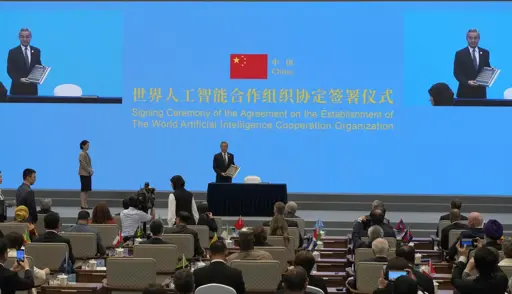
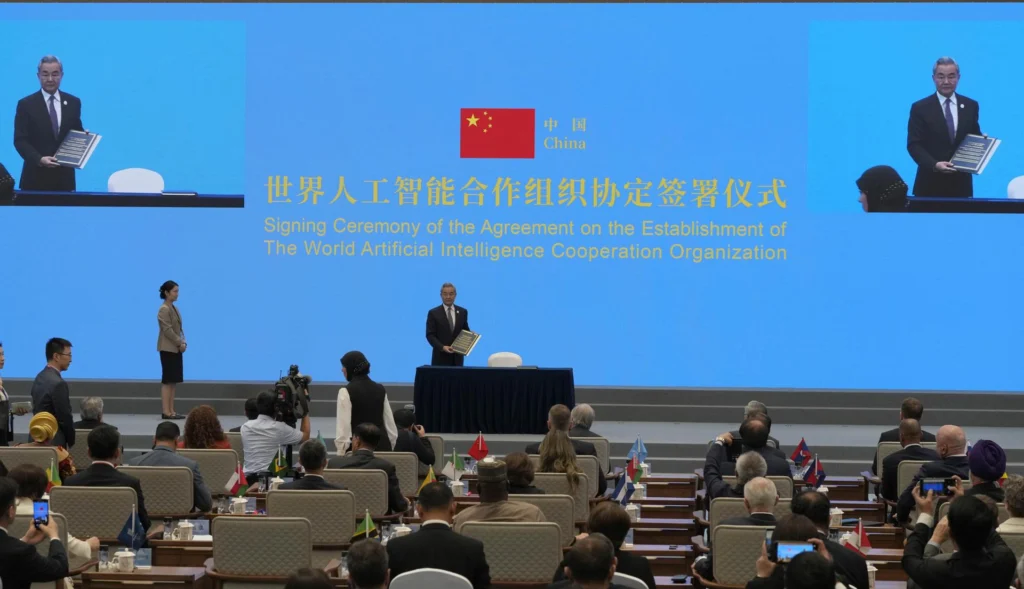
China launched the World AI Cooperation Organization (WAIC) as President Xi Jinping declared the new body responds to Global South demands and marks a milestone for artificial intelligence governance worldwide.
Chinese President Xi Jinping highlighted that the creation of the World AI Cooperation Organization (WAIC) materializes a proposal presented by China the previous year, affirming that it constitutes a direct response to the demands of the Global South.
The new international body represents a strategic move by Beijing to shape the global governance framework for artificial intelligence technology.
RELATED: OpenAI Launches GPT-5.6 AI Model Family
The the World AI Cooperation Organization (WAIC) serves as a platform to strengthen international cooperation on AI development and governance. This positioning aligns with China’s broader diplomatic strategy of positioning itself as a representative of developing nations in global technology debates.
The Chinese leader further stated that the launch of WAIC will mark an important milestone in the history of AI development. This declaration underscores Beijing’s ambition to play a leading role in defining the rules and standards that will govern the future of artificial intelligence worldwide.
#WAIC 2026 will bring global experts, leading institutions and young innovators together in #Shanghai to advance #AI research and cooperation. The program features WAIC Academic, the SAIL Award and the OPC Challenge, spotlighting frontier ideas, breakthrough projects and… https://t.co/4XUDmkwSXM pic.twitter.com/u6rt455vDY
— Chinese Embassy in US (@ChineseEmbinUS) July 16, 2026
Global South AI Platform
According to the foundational agreement, WAIC will be governed by the principles of the United Nations Charter. The organization will promote broad consultation among member states, joint contribution to AI development, and shared benefit from technological advances. This framework seeks to differentiate WAIC from existing AI governance initiatives led primarily by Western nations.
The organization will maintain a people-centered approach to AI governance. This principle prioritizes human welfare and social development over purely commercial or military applications of the technology. The focus on human-centered AI aligns with China’s stated position on technology ethics and governance.
WAIC’s creation comes at a time of intense global competition over AI standards and regulations. The United States and the European Union have advanced their own frameworks for AI governance. China’s initiative provides an alternative platform that directly addresses the concerns of developing nations.
The Global South framing is particularly significant. Many developing countries lack the technical infrastructure and regulatory capacity to participate in AI governance discussions led by wealthier nations. WAIC offers these countries a seat at the table and a voice in shaping the future of the technology.
UN Principles Guiding AI
The foundational agreement of WAIC emphasizes several key operational principles. The organization will promote broad consultation, ensuring that all member states have input into decision-making processes. Joint contribution encourages nations to share technical knowledge, data, and resources for mutual benefit.
Shared benefit represents a fundamental departure from current AI development models. Currently, AI advancements concentrate overwhelmingly in a small number of countries and corporations. WAIC seeks to distribute the benefits of AI technology more equitably across the global community.
President Xi underscored that WAIC will serve as a platform to strengthen international cooperation. The organization will facilitate technology transfers, joint research initiatives, and capacity-building programs for developing countries, aiming to reduce the digital divide between advanced economies and the Global South.
The launch of WAIC positions China as a leader in the governance of emerging technologies. Beijing has invested heavily in AI research and development, becoming a global leader in the field alongside the United States. By creating an international organization for AI governance, China seeks to translate its technical capabilities into normative influence.
The organization’s headquarters location and membership structure remain to be determined. The founding agreement leaves room for expansion as more countries join the initiative.
As AI technology continues to advance rapidly, the need for international coordination becomes increasingly urgent. In this sense, WAIC offers a platform for this coordination, particularly for nations that have been excluded from existing governance frameworks.
Xi concluded that WAIC will contribute to building a community with a shared future for humanity in the digital age. The organization embodies China’s vision of technology governance that prioritizes development, equity, and human welfare over profit and strategic advantage. Whether WAIC achieves these ambitious goals will depend on its ability to attract broad international participation and translate principles into practice.
From teleSUR English via This RSS Feed.