

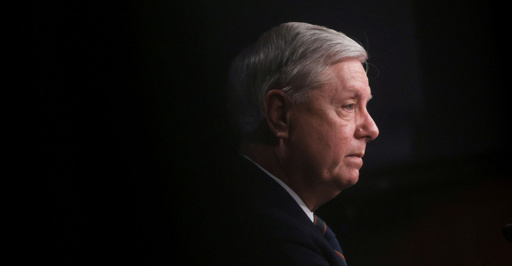
When Republican South Carolina Sen. Lindsey Graham died suddenly on Saturday night, July 11, corporate media’s elegiac coverage didn’t just whitewash his record—it illustrated the affinity and symbiosis between the press corps and the politician they were meant to hold to account.
Like corporate journalists, Graham played a key role in cheerleading imperial wars and promoting domestic inequality. And Graham and the media both prioritized the appearance of bipartisanship while normalizing Trump and his politics.
‘Steadfast’ hawk
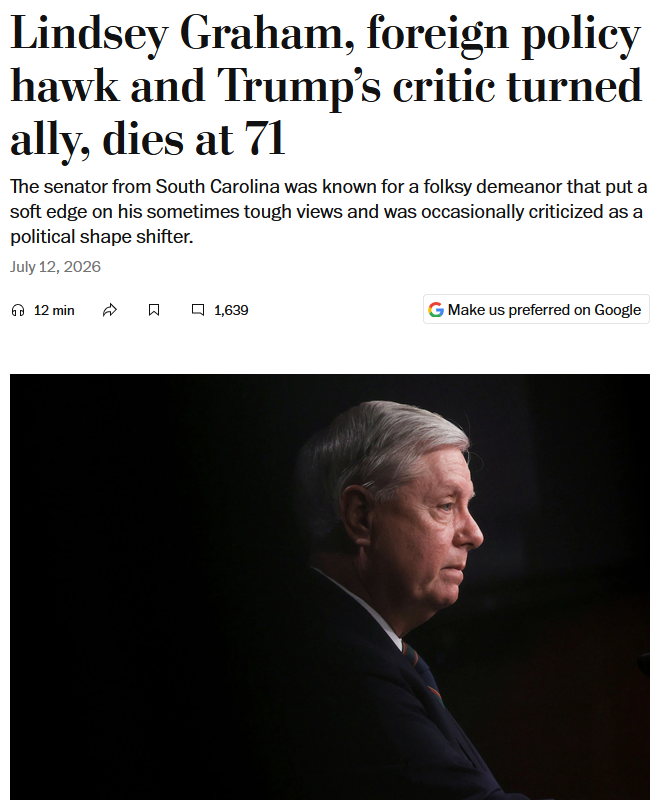
Karen Tumulty (Washington Post, 7/12/26): “Mr. Graham became nationally known because of a near-constant presence in the news media, where his folksy manner and talent for a good quote put a soft edge on his sometimes hard-line views.”
As most of the tributes pointed out, Graham was a “steadfast” hawk (Washington Post, 7/12/26). Like his good friends in the Senate, John McCain and Joe Lieberman, Graham believed in projecting US power militarily across the globe, no matter the human toll, and fiercely backed the Iraq and Afghanistan wars.
Many outlets credited him as the key player in overpowering the isolationist faction of the GOP—and Trump’s own vacillations—in launching the current Iran War and continuing US support for Ukraine. And Graham was a key Israel supporter, with far-right Israeli Prime Minister Benjamin Netanyahu remembering him as “one of Israel’s greatest friends.” Virtually none in corporate media offered criticism of any of this—unsurprising, given their own cheerleading for these wars.
Graham was a key figure in the political transformation of the Supreme Court, first in helping Senate leader Mitch McConnell block Barack Obama’s nomination of Merrick Garland to fill Antonin Scalia’s seat, then two years later in providing critical support to bolster Brett Kavanaugh’s nomination, faltering after credible accusations of sexual assault from Christine Blasey Ford.
The New York Times’ Carl Hulse (7/13/26) told readers that Graham’s
bipartisanship extended to his handling of federal judicial nominations on the Judiciary Committee, where he regularly pointed out that he had backed President Barack Obama’s Supreme Court nominees at a political cost to himself while Democrats dug in against Mr. Trump’s court picks—a stance that infuriated him.
While it’s true that Graham voted for Obama nominees Sonia Sotomayor and Elena Kagan, his taking the unprecedented step of preventing a sitting president from filling a Supreme Court vacancy was one of his most consequential “handlings,” in that it changed the course of the country’s history. Giving Trump the chance to fill that seat instead of Obama meant the balance of the court was shifted, ultimately giving the GOP the current 6–3 advantage that has paved the way for Trump’s rapid expansion of executive power. But Hulse failed to find that worth mentioning in painting his portrait of “bipartisanship.”
‘Change of heart’ on Trump
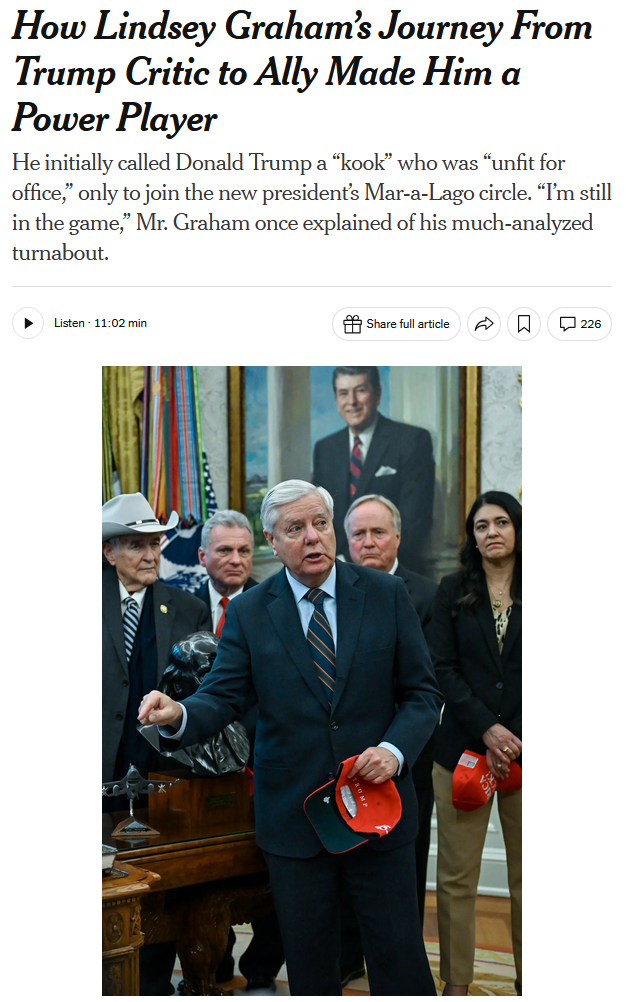
The New York Times‘ Peter Baker (7/13/26) invited us to admire Graham’s cynical transformation into Trump’s “most important ally in the Senate”: “He was never dull, and he was always at the table playing the cards the best way he knew how.”
When Donald Trump emerged onto the political scene, Graham came out swinging against him (Atlantic, 5/23/16): “He’s a race-baiting, xenophobic, religious bigot. He doesn’t represent my party. He doesn’t represent the values that the men and women who wear the uniform are fighting for.”
But once Trump took power, Graham became, as PBS (7/13/26) explained, “one of his closest allies and golf buddies.” (For the New York Times—7/12/26—Graham “softened his tone” on Trump.) He had a moment of hesitation after January 6, saying: “Count me out. Enough is enough.” But apparently it wasn’t actually enough, because he soon was back in Trump’s corner.
Graham’s “change of heart” on Trump (NPR, 7/13/26) was reflected in policy reversals. For instance, Graham was once a proponent of “comprehensive immigration reform” and the DREAM Act, which gave some undocumented youth a path to citizenship. But this year, as Senate Budget Committee chair, Graham was instrumental in passing the highly controversial $70 billion ICE funding package through Congress via the reconciliation process, jamming it through over unified Democratic opposition after the ICE killings in Minneapolis. He was similarly crucial in the passage of Trump’s “One Big Beautiful Bill”—which slashed Medicaid and SNAP benefits and gave massive tax cuts to the rich—through reconciliation in 2025.
While the media love to pounce on some politicians’ policy or ideological changes as a sign of hypocrisy or untrustworthiness, they made clear that now was not the proper time for such critiques. Many articles were limited to pointing out Graham’s “reversal”—or, as the Times’ Peter Baker (7/13/26) called it, a “much-analyzed turnabout”—regarding Trump. PBS (7/13/26) turned to Coastal Carolina University’s Gibbs Knotts to analyze Graham’s flip flops:
I think Lindsey Graham had some of his famous shifts in part to…continue to be relevant. I mean, he wanted to be an effective senator when there was a Democratic president and also when there was a Republican president.
A rare few commentators did criticize Graham. Sunny Hostin of ABC’s The View (7/13/26), for instance, said:
When you’re talking about a complicated legacy and someone who may have betrayed his country for power, that seems to be, in my view, what his legacy became.
But such critical scrutiny was hard to find in coverage of Graham’s death.
‘Revered for his passion’
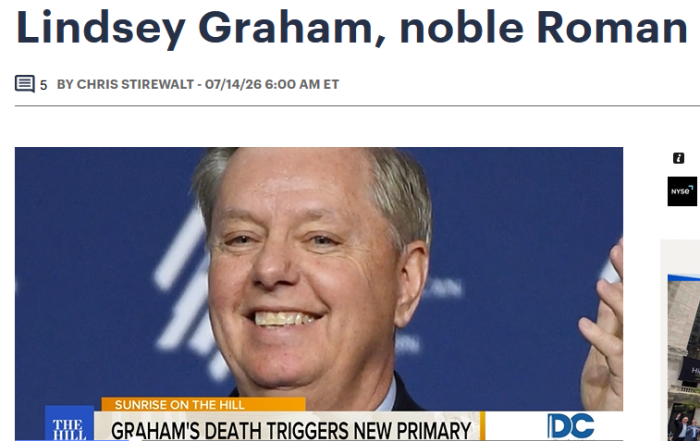
The Hill‘s Chris Stirewalt (7/14/26) called Graham a “noble Roman” because “I never once saw or heard him act like he was above his work or contemptuous of the institution in which he served.”
Across major centrist media, the man who must share responsibility for the deaths and immiseration of countless people in the US and around the globe as a result of US-backed wars, ICE raids, Medicaid cuts and contorted decisions by the right-wing Supreme Court was remembered with widespread fondness and admiration.
Chris Stirewalt, The Hill’s political editor (7/14/26), waxed poetic about Graham under the headline “Lindsey Graham, Noble Roman”:
You may love or hate America’s involvement in the Russo-Ukrainian war or our war-not-a-war with Iran. You may think we have the greatest Supreme Court since Charles Evans Hughes or believe that we have a bunch of Roger Taneys. But whatever you think of those things, they wouldn’t be the way that they are without Graham. And he wouldn’t have been where he was if he didn’t truly love his work.
Politico’s Jonathan Martin (7/13/26) remembered him under the headline “Lindsey O. Graham, a Politician in Full”:
I’m not sure there was a more deft, pure politician in the Senate in this era than Graham…. In a Congress that has become filled with play-it-safe types scared of their own shadow and performance artists, Graham was both a character and workhorse.
While “he could confound his colleagues with his tempestuousness,” wrote the New York Times’ Hulse, “he was also revered for his passion, wit, willingness to deal and dedication to the institution.”
Hulse’s piece concluded:
In the contemporary Senate, where the characters often do not seem to measure up to the figures of the past, Mr. Graham was a major presence, and his loss will be felt in many more ways than his vote.
“Lindsey was a giant in the Senate,” said Sen. Sheldon Whitehouse, the Rhode Island Democrat who jousted with him on the Judiciary Committee. “No one loved being a senator more, or was more energetic. The Senate will be a lesser place without him.”
‘Never confused good and evil’
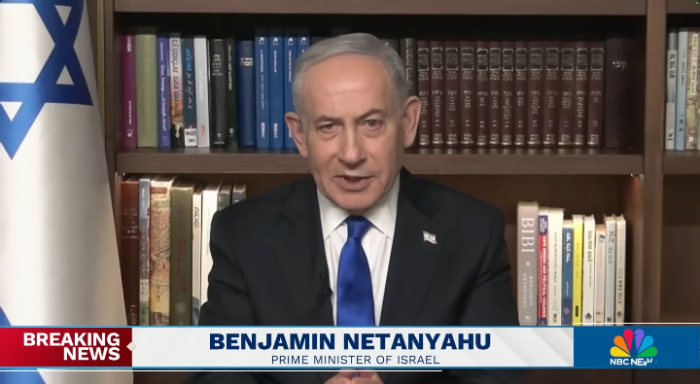
Benjamin Netanyahu, wanted for war crimes, told Meet the Press (7/12/26) that Graham “never confused good and evil.”
While major outlets around the country failed to muster nearly any kind of even-handed appraisal of Graham’s legacy, the Sunday political shows, where Graham was a frequent guest, perfected the art of veneration. All received the news of Graham’s death early the morning of their broadcasts, and quickly rearranged schedules to invite special guests to speak about him.
At NBC’s Meet the Press (7/12/26), Graham himself was slated to appear—for, as host Kristen Welker pointed out, the 64th time. Instead, the network saw fit to invite Donald Trump, Netanyahu and fellow GOP senator from South Carolina Tim Scott to offer their unvarnished thoughts.
Welker asked Trump such piercing questions as: “He loved his work, Mr. President. He was tireless. But it brought him such joy, didn’t it?” (Trump responded, “Man, he was—there was nobody like him.”)
She then turned to Netanyahu, who called Graham “a great patriot” who “never confused good and evil.” (Welker: “How did he process the fact that he was quite outspoken and not afraid to engage in tough debates?” Netanyahu: “Well, he was absolutely fearless, you know?”)
As Discourse Blog’s Jack Mirkinson (BlueSky, 7/13/26) observed:
If a serial killer died, Meet the Press wouldn’t bring on two other serial killers to talk about their fond memories of serial killing together. But if you’re a genocidal fascist politician, you get to have fellow genocidal fascists remember the good times.
And it wasn’t just genocidal fascists remembering the good times. In the journalist panel at the end of the show, Politico’s Jonathan Martin recounted:
I was texting with somebody this morning. I said, “Did anybody love being in the Senate and have more fun in the Senate in the history of the body? I’m not sure anybody did.”
**‘**One of the edgiest guys’
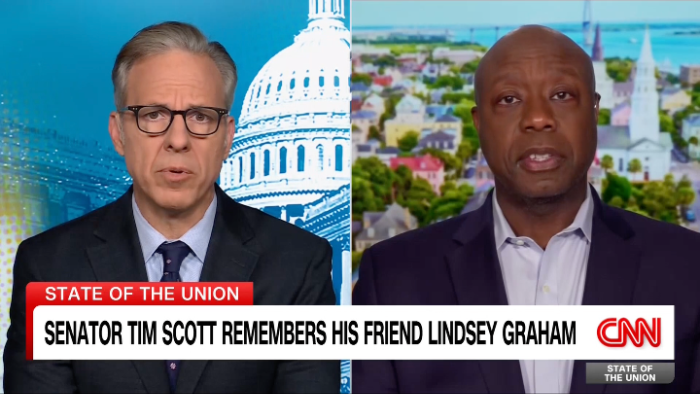
Sen. Tim Scott (right) tells Jake Tapper on CNN‘s State of the Union (7/12/26): “The one thing we have to realize about [Graham] is that that ‘peace through strength’ motto is exactly what he tried to lift.”
Trump also appeared on CNN’s State of the Union (7/12/26), as did Scott—who managed to make an appearance on every single major Sunday show. Host Jake Tapper asked Scott to “talk about the role [Graham] played in contributing to America’s national security and the way that the US is seen around the world.” Scott replied:
He was literally one of the most—one of the edgiest guys as it relates to foreign policy you would ever meet. But it was never because he was a warmonger. It was because he wanted to see peace in every place possible. And, if necessary, peace becomes a part of what happens if you need to use our kinetic response tools.
Tapper didn’t even raise an eyebrow at that grotesque sequence of words. No Sunday hosts were in the mood to do anything but nod at Scott’s pronouncements, such as “he’s just a good person” (ABC This Week, 7/12/26) or “Lindsey was just a powerful force for good” (Fox News Sunday, 7/12/26).
But then it’s par for the course in an environment where journalists appear to see themselves less as representatives of the public, holding politicians to account, and more as partners and even buddies who run in the same Beltway circles; Fox News Sunday’s host, Gillian Turner, described Graham as “a great friend to us on the show, at this channel.”
On CBS’s Face the Nation (7/12/26), Scott said, “You’re seeing world leaders come out across the world for Lindsey Graham. And why? Because he put others first.” Host Margaret Brennan’s response: “Yes.” (She didn’t see fit to mention that Iran was understandably celebrating Graham’s death.)
“Shocking tragedy” was how Martha Raddatz introduced the news of Graham’s death on ABC This Week (7/12/26), not even trying to tone down what the show’s approach would be: “We’ll have a remembrance.”
In This Week’s journalist panel, New Yorker writer Susan Glasser explained her understanding of how Graham flipped from a harsh critic of Trump to his right hand man in the Senate: “He said, you know, OK, Donald Trump, he doesn’t always tell the truth, but he’s so much fun to be with.” Glasser continued, echoing Politico’s Martin: “And I think Lindsey Graham actually still saw the fun in politics at a time when many people do not.”
For the countless people at the noxious receiving end of many of Graham’s crowning achievements, “fun” is hardly his defining legacy. But it’s a perfect window on the yawning distance between corporate media and the public they’re meant to serve.
From FAIR via This RSS Feed.