

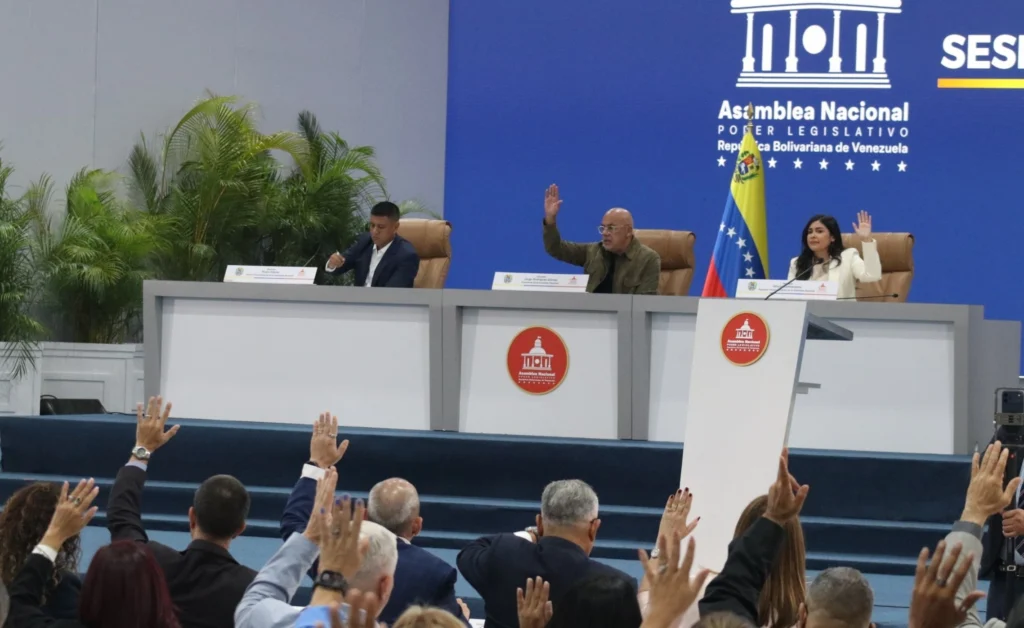
Venezuela’s National Assembly began public consultations on housing law reforms this Friday to protect more than 17,000 families affected by the double earthquake that struck the country on June 24.
The Special Commission of the National Assembly of Venezuela launched a comprehensive public consultation process on two key legislative projects.
The first initiative proposes a partial reform of the Law against Real Estate Fraud, meanwhile the second project modifies the Special Regime Law for Residential Property Leasing. Both legal instruments aim to strengthen the housing legal framework in response to the devastating double earthquake that displaced thousands of families across the nation.
RELATED: [Venezuelan Acting President Boosts Economic Recovery and Demands End of Sanctions](https://telesurenglish.net/venezuela-economic-recovery-end-sanction/)
The central objective of the legislative effort focuses on addressing the urgent needs of more than 17,000 families who lost their homes or suffered severe structural damage during the seismic event of June 24, which left 5,069 people dead and 16,740 injured.
The reforms seek to dynamize the rental market and stimulate the construction of new homes under a balanced legal framework.
Ver esta publicación en Instagram
Una publicación compartida de Asamblea Nacional
(@asamblea_ven)
Text reads: “The National Assembly approved this Tuesday, in first discussion and unanimously, the Bill of Partial Reform of the Law against Real Estate Fraud, whose objective is to promote the construction of new housing adapted to the new times. The first vice-president of the National Parliament, deputy Pedro Infante, presented the reform project that aims to resolve and guarantee better economic conditions for those affected by the double earthquake of June 24, to access the real estate sector.”
Post-earthquake Legal Response
The legislative package introduces transformative operational changes to the housing sector. The reforms implement indexed economic incentives, bank and insurance guarantees and rapid conflict resolution mechanisms, which explicitly prohibits leasing properties located in high-risk zones or precarious structures.
The reform against real estate fraud focuses on creating more flexible financial conditions, aiming to help the earthquake-affected population access dignified housing solutions. The proposal modifies key components of the construction sector to incorporate private capital in the building of new homes.
The Venezuelan State positions itself as a facilitator of rights rather than a direct executor of all housing projects and it represents a significant change in housing policy.
Protecting Vulnerable Families
Regarding the rental housing reform, Deputy Rigel Sergent indicated that the primary purpose is to encourage property owners to place vacant homes into the rental market. The law establishes a special differentiated framework to generate confidence among property owners who currently keep their units empty.
Sergent clarified that current tenants will maintain the absolute protection of existing legislation. In this sense, the new contracts, however, will operate under updated parameters designed to create greater trust and balance between parties.
The public consultation received proposals from the private real estate sector. Industry representatives suggested implementing indexed credits, digital registration technology to prevent fraud, and efficient anti-seismic construction models.
Deputy Sergent highlighted that state institutions are deployed in three fundamental stages that operate simultaneously, including rescue operations, structural inspection of buildings, and determination of habitability conditions. According to this, authorities are using the traffic light method to categorize structural resistance levels, particularly for buildings constructed before 1967.
After completing this phase of popular consultation with communities and productive sectors, both legislative projects will proceed to the second discussion. The plenary session of the National Assembly will debate the final version for definitive approval. Subsequently, Acting President Delcy Rodriguez will promulgate the laws.
The housing law reforms represent a comprehensive response to the humanitarian crisis triggered by the double earthquake in Venezuela. The legislative initiative combines immediate relief measures with long-term structural changes.
The National Assembly of Venezuela positions this legislative effort as a priority for national recovery. The public consultations ensure that affected communities have a direct voice in shaping the legal tools designed to protect them.
From teleSUR English via This RSS Feed.