


Janine Jackson interviewed the Institute for Policy Studies’ Phyllis Bennis about the costs of the Iran War for the July 10, 2026, episode of CounterSpin*. This is a lightly edited transcript.*
https://media.blubrry.com/counterspin/content.blubrry.com/counterspin/CounterSpin260710Bennis.mp3
ABC (7/8/26)
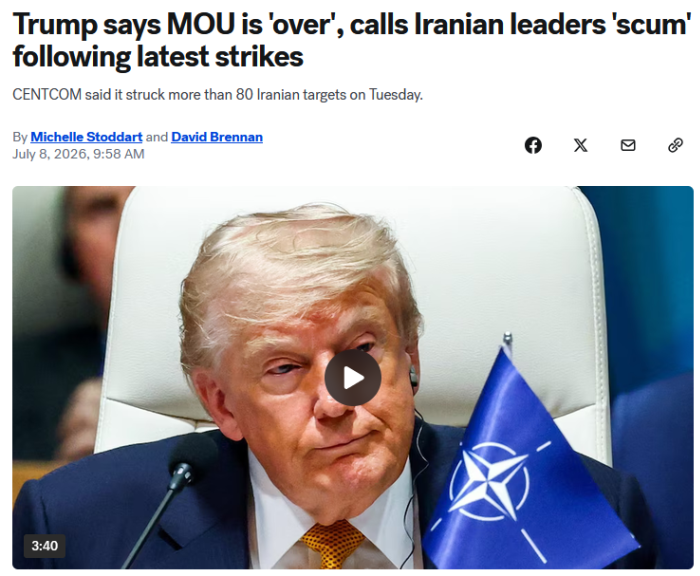
Janine Jackson: As we record on the afternoon of July 8, the news is that Donald Trump has said he thinks the Memorandum of Understanding with Iran is over. Trump told ABC News, “I don’t want to deal with them anymore. They’re scum. You know what scum is? They’re scum. They’re sick people. They’re led by sick people.”
OK, as a press corps, you have lots of ways to address that. The New York Times went with, “Speaking at the NATO summit in Ankara, Turkey, Mr. Trump struck a belligerent tone amid the seemingly unyielding cycle of attacks and counterattacks.”
You and I might think this is not a person who should be in charge of international diplomacy affecting billions of human lives, but ABC News just followed that up with, “The president did, however, suggest that US/Iranian negotiations over a final peace deal could continue.”
So here’s where we’re at: There are real things really happening, with tremendous import. And yet there’s a cartoonish feeling to it, that this can’t be how leaders should speak, or how disputes should go, in a world where we know that wars kill people who aren’t the ones that make the decisions.
Are we just naive? Is this the way things just are? Or is there another way forward? And how might news reporting shape, or inform, that new way forward?
We’re joined now by Phyllis Bennis. She’s a fellow at the Institute for Policy Studies. She’s an international advisor for Jewish Voice for Peace, and author of many books, including, recently, Understanding Palestine and Israel, from Olive Branch Press. She joins us now by phone. Welcome back to CounterSpin, Phyllis Bennis.
Phyllis Bennis: Great to be with you, Janine.
JJ: Let me just stick with today, July 8, for a minute, and ABC News’ rendering for a second. I think it’s not especially bad or good; I think it’s just reflective. So they say:
The 14-point MOU committed the signatories to the reopening of the Strait of Hormuz for commercial traffic, with the US lifting its naval blockade of Iranian ports. Iran also committed not to pursue nuclear weapons—a commitment Tehran has previously made—while the US agreed to allow Iranian oil sales and to begin work on a $300 million reconstruction fund for the country.
So there’s numerous things that you might pick up on there, but where would you start? If you were talking to someone about this statement—and again, I’m not saying it’s inaccurate—but if you were to come along with folks reading news media coverage, what would you add or annotate?
NPR (6/18/26)
PB: Well, there’s a lot, not surprisingly.
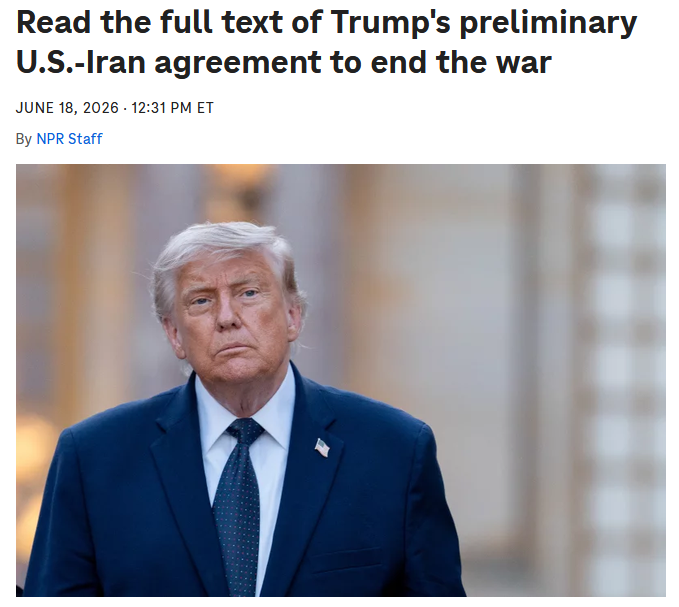
The MOU, the Memorandum of Understanding, is very short. It’s like a page and a half long. And it’s one of the reasons, one of many reasons, why there were so many questions about: Can you tell us the difference between this MOU and what was known as the JCPOA (because it was an actual agreement) that was negotiated during the Obama period?
And the first part of answering that question is that that, one, the Obama period JCPOA, was a nuclear deal. The MOU is a memorandum to talk about what we should talk about. It was an agreement about what we should talk about. So you can’t really compare them. It’s not just like apples and oranges; it’s kind of apples and rosebushes, or something. So let’s start with that reality.
Now, there are some things about the MOU that were pretty clear. Ironically enough, from the US vantage point, what was clear was what Iran is supposed to get out of this ‘agreement to go forward.’ One of which was the part you just referred to, Janine, about that they were going to allow free traffic through the strait of Hormuz, without charging anything, for 60 days. After that, the implication was, they could charge fees or service charges or other things; it wasn’t spelled out, but that was the implication. But that they were obligated to arrange for the safe passage.
Axios (7/10/26)
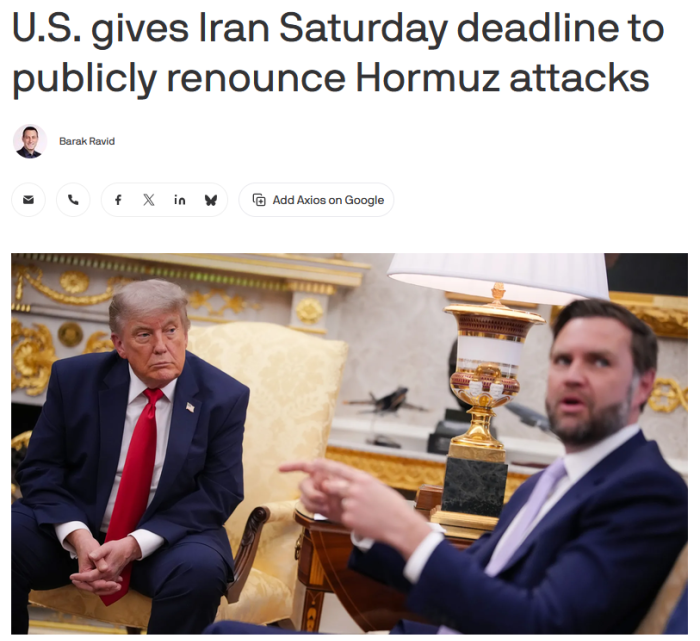
The US decided that that clearly meant—because they say it with that kind of outrage—that clearly meant that Iran had to simply not do anything, and let any ships go through, without any power. Without acknowledging that part of this was the understanding that Iran has something to say about what ships in what order, at what time, and how many, traverse the Strait, which is both part of international waters and within Iran’s territorial waters. The same is true for Oman on the other side of the Strait, but that seemed to not be part of the MOU.
So the significance of that, it’s not just some technical, legal thing. It’s that the Iranian understanding of what the MOU said was that it had to arrange for ships to traverse safely through the Strait of Hormuz. And their position is, “That’s what we’re doing. We’re telling every ship they have to coordinate with us. If they want to coordinate with somebody else, that’s up to them, but they have to coordinate with us for this 60 days, and we will not charge them anything.”
The US says, “That’s not good enough.” They can’t require ships to coordinate with them. They have to just allow ships to go through, without checking in with anybody, without caring how many, are they going to crash into each other? What kind of naval restrictions are underway? Nothing.
War on the Rocks (7/14/26)
And that’s what has led to this most recent occasion. For Iran, the ability to control the Strait of Hormuz has been the one strategic victory they have won through this horrific war that has been waged. And in that context, the notion that you might expect them to simply stand back and say, “Oh, the Strait of Hormuz? Yeah, we’re going back to what it was before the war. Before you destroyed almost 4,000 lives in our country, before you destroyed 170 school girls on your first day, before you assassinated our leader, before all of that—that’s the position we’ll go back to.” It’s kind of, what planet do they think they’re living on? So there’s those kinds of things in the MOU that the US is claiming should be the interpretation, but clearly is not.
JJ: I’ll bring it back, but it feels like this “Great Man” understanding of politics. It’s “Trump”; it’s “the US” versus “Iran.” And we’re talking about people, yeah? We’re talking about international law. It’s the way that it’s conveyed as though it’s like Rock ’Em Sock ’Em Robots, as I say.
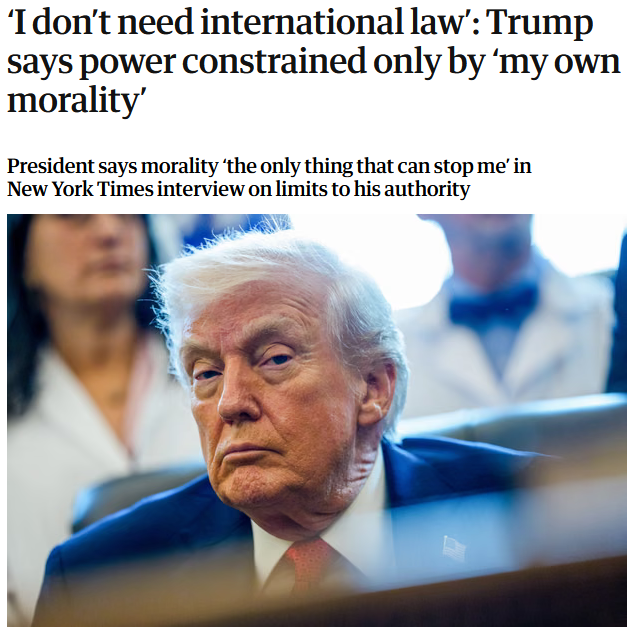
Guardian (1/8/26)
PB: That’s a very good way to describe them. I mean, what we’re talking about is a president who has said that international law does not matter. That, in his words, “the only constraint on my power”—those were his words—”the only constraint on my power is my own moral judgment.” My God, talk about a frightening statement.
So what we’re looking at when he starts talking about the Iranian negotiators as “scum,” and calling them “cuckoo,” and then later, on the same day, he says in a press conference: “I don’t know what the problem is. They’re dealing with really good guys.”
And he talks about his son-in-law, Jared Kushner, and his favorite real estate agent, who are his envoys, who know nothing about diplomacy, nothing about Iranian history, certainly nothing about nuclear weapons, nuclear power, nuclear anything. All they have going for them is the trust of the president. They don’t need to know anything. They don’t need to know how you negotiate. They simply can say, “We speak for the president.” And that’s supposed to be enough.
So when they say that, when these are the kinds of negotiations that are going on, it’s a very serious problem. And this is what we’re seeing at this NATO summit, where the question of Greenland has come up again; Trump is again demanding that the US must be in control of Greenland. He’s berating all of the NATO forces for not having supported this horrific war that the US and Israel launched against Iran, as if the NATO charter requires every member of NATO to join every crazy illegal war that any member might start. What it actually calls for, Article 5, the famous Article 5 that says an attack on one is an attack on all, starts with “an attack on one of us.” It doesn’t start with “any war that any member of NATO might choose to start, whether it was legal or not, whether it was moral or not, no matter how many civilians it killed.”
So that’s what we’re dealing with. We’re taking this out of the reality of international law. We’re taking it out of the history, and we’re looking at, for example, where does the question of Gaza fit into all this? How does Lebanon fit into all this? It makes it much more complicated.
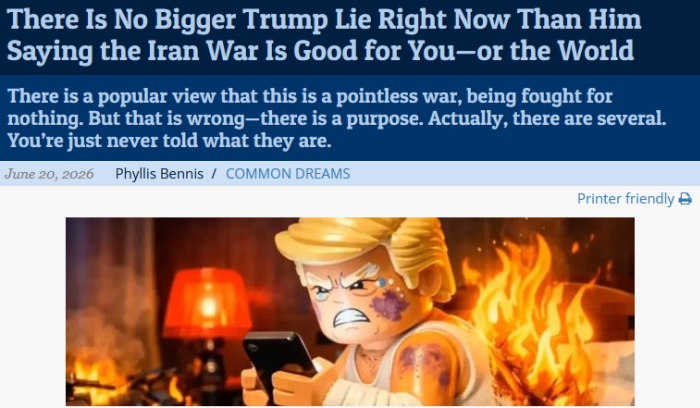
Portside (6/20/26)
JJ: And I just want to continue on that, because you wrote a piece a few weeks back that I saw headlined on Portside: “There Is No Bigger Trump Lie Right Now Than Him Saying the Iran War Is Good for You—or the World.” And in that piece, you’re connecting realities that sometimes get divorced in media, where not just Iran, Gaza, Lebanon get segregated into different stories, but where foreign policy and domestic policy are on different pages, even as common sense tells us that they are tied up together, and we could benefit from understanding how.
PB: Absolutely.
JJ: And so I want to push you, as a particular point, to explain the problem with the idea that this war with Iran was a pointless war. Like Trump woke up in the middle of the night and started this war. In fact, it helps us to understand the connections here.
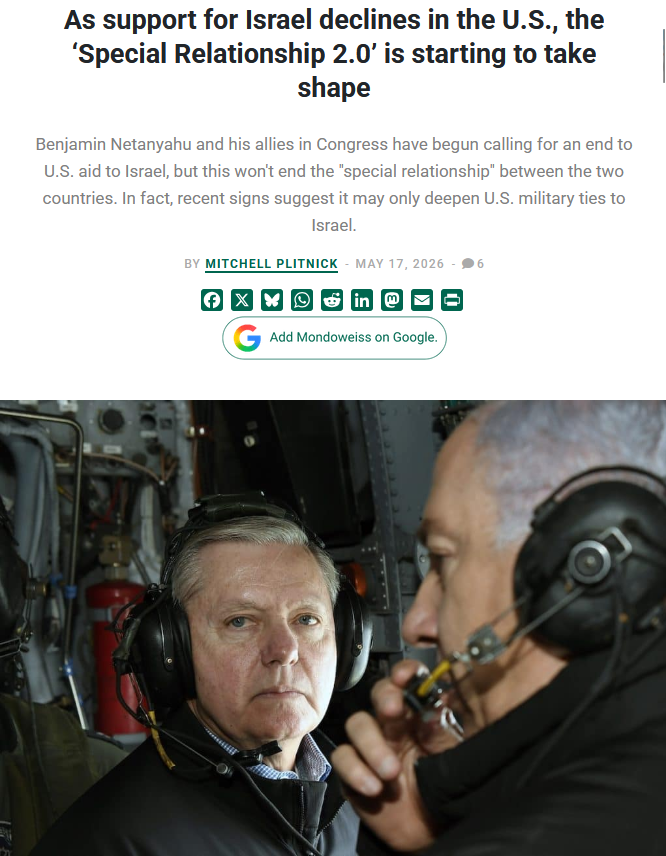
Mondoweiss (5/17/26)
PB: Right. That’s a really important point, Janine. I’m glad you asked it, because I think there has been this sense, including among a lot of people who are strongly against the war, understand that it’s illegal, but are describing it and thinking about it as being a pointless war; there was no reason for it.
There were reasons for it. They weren’t good reasons. They weren’t legal reasons. But as you say, it didn’t ‘just happen.’
And one of those most important reasons is the question of hegemony, both for the US and Israel, and this is why they were so closely aligned on this one. The US and Israel have a longstanding “special relationship,” but there are times when they disagree. This wasn’t one of them, at the beginning. At the beginning of this, when they went to war hand in hand, shoulder to shoulder, no daylight—all those lovely phrases we like to hear—it was because each of them had the goal of using this war to both demonstrate, and to strengthen or consolidate, its role as a hegemonic power.
For Israel, that meant being the hegemonic power across the Middle East and West Asia. Iran was the major stumbling block preventing Israel from claiming that as an unchallenged reality. There’s no question it has the most powerful military in the region. There’s no question that it has the only nuclear weapons in the region.
The nukes in the region, the nukes in the neighborhood, do not belong to Iran. They belong to Israel. Nobody likes to talk about that, but that’s part of the reality of their strength. They want to be the unchallenged hegemonic power.

Phyllis Bennis: “Trump wants to be the hegemonic leader of the world—on his own terms, whatever those terms may be, as they change hour to hour.”
The US wants that at the global level. Trump wants to be the hegemonic leader of the world—on his own terms, whatever those terms may be, as they change hour to hour.
So they agreed with that, and that’s what made that alliance so tight.
Now, of course, they disagree. We don’t have to go through the whole history of this war, but we do know that one of the things that’s happened is that the question of what they want to get out of it now has differed.
The US, like Iran, ironically enough, for different reasons, both want this war to end. Israel does not. Israel wants this war to continue. Bibi Netanyahu wants this war to continue, because it’s the basis of his political legitimacy. He’s the only one, he has told the people of Israel for 30 years now, who can both manage the relationship with the US—I would say he’s not doing such a good job on that one—and who could stand up to Iran, which means who’s willing to go to war against Iran. (As it turns out, there’s a lot of people in Israel that are willing to go to war against Iran, and eager to.)
But for the moment, that’s the basis of the disagreement. It didn’t start as a disagreement, but it is a disagreement now. It’s also a disagreement in the question between the US and Iran certainly, not so much between the US and Israel, on the question of: How does this relate to Lebanon? The MOU says explicitly that the ceasefire component—which is basically what this is; it’s a ceasefire agreement, supposedly—that ceasefire explicitly is supposed to include the region, including Lebanon.
What it doesn’t say is, “including Lebanon, where Israel has now killed over 4,000 civilians in the south, has driven more than a million people out of their homes and is occupying much of South Lebanon, but also Palestine, particularly Gaza in the context of the genocide.” It does not say that “the region” has to include Gaza.
And, unfortunately, the other side, the Iranian side, did not demand that, did not call for that. They did demand it for Lebanon, and they got it. They did not demand it for Palestine. And, as a result, the genocide in Gaza is continuing. There have been people killed every day. Just in the period since last October’s so-called ceasefire in Gaza, there have been over 1,200 people killed, 260 of them children. And that’s continuing on a daily basis.
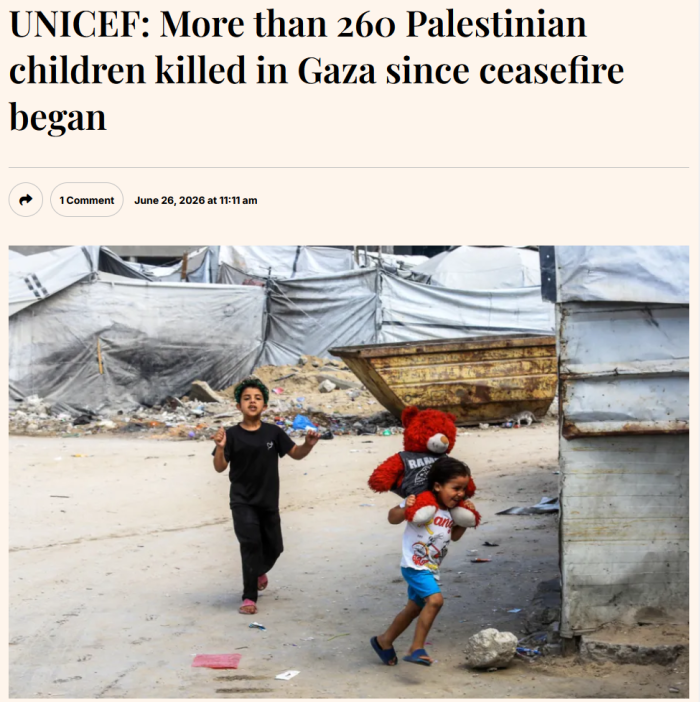
Middle East Monitor (6/26/26)
So this has to be looked at in that context. Part of the reason that the US and Israel went to war right when they did—not the only reason of why they did, but when they did—had to do with Gaza.
And that is on the question of accountability and impunity. They were looking at the two years at that point, it’s now almost three, it’s coming on to three years. More than two years of genocide in Gaza, and Israel had really not paid a serious price. In legitimacy, yes. But strategically, economically, at the human level, no. And from that, they drew the lesson: We could do it too, and not pay a price. And unfortunately, they’ve been right.
JJ: That’s where we are.
PB: They launched an illegal war. They’ve killed thousands of people, driven millions out of their homes—3.2 million people in Iran have lost their homes—and they have not paid a price.
JJ: I’m going to ask you about media in a second. But before that, we’ve talked before about international agencies, the folks that are supposed to be meta, and reviewing this in terms of international law. What’s happening in that space? Why can you and I say this is illegal, and somehow it’s not stopped?
Observer Research Foundation (3/16/26)
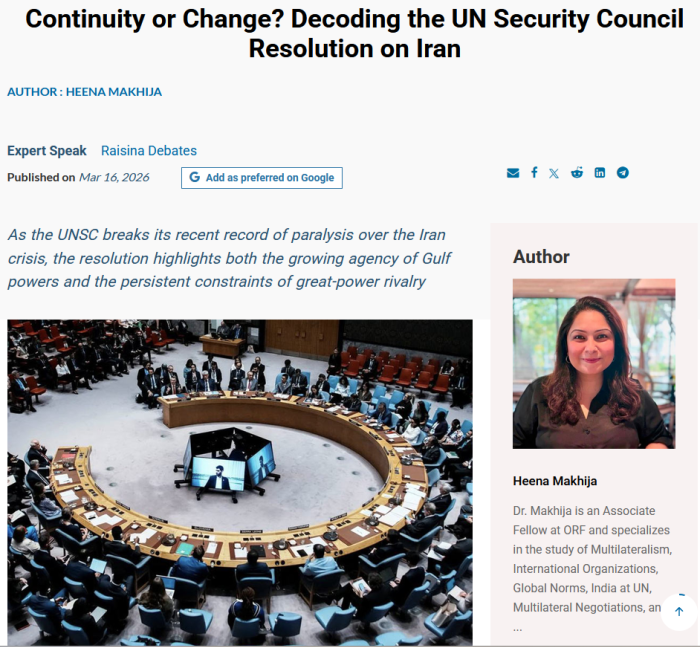
PB: Yeah. Well, how is it illegal is the easy part. The UN Charter, which is the foundation of modern international law, is very clear. It says that no country can go to war against another country, with only two exceptions. One is immediate self-defense, if an armed attack occurs. And only until the Security Council can meet to decide what should be done in the context of this apparently new threat to international peace and security. The second is if it’s approved by the Security Council.
Neither of those things happened this time. There was no move to support this in the Security Council. The Security Council certainly didn’t support it—until after, when it congratulated parts of it; it’s quite horrific in that sense. But it did not approve it.
And there was no attack against Israel or the United States from Iran. The exception in Article 51 of the charter that talks about self-defense does not include, “We think they’re creating materials that someday could become a weapon that might be used against us.” That doesn’t count. That’s not self-defense. That’s not self-defense.
So this war was illegal, period, full stop. It’s not a question. The reason that it doesn’t get talked about is because Trump has made clear that, unlike other, earlier horrific wars waged by the United States, such as the Iraq War of 2003 led by George Bush, who has since gotten a pass because he’s painting pictures of puppies…
JJ: For real.
PB: But when he was trying to get international support of the United Nations to go to war against Iraq, he was unable to do so. For eight months, he and his counterpart in the UK, Tony Blair, tried to get the Security Council to vote to endorse a war, and they failed. They could not get the resolution to pass. Ultimately, they made the decision to go to war in violation of that requirement. But they at least acknowledged that there was such a requirement.
Trump has taken it 10 steps further, and said, “There is no international law that I’m bound by.” So he doesn’t care. He never tried to get the UN to approve. Not that they would have, but he never tried to do that, because he doesn’t believe that he is bound by any kind of laws that everyone else in the world is bound by.
JJ: And the media shape our public understanding to such a great extent, because many folks don’t have a historical understanding, or a political understanding, of what’s going on. And why should they? Why would they? So they read the paper, and that’s where they get their ideas, yeah?
PB: Right. I mean, that’s one of the effects of these wars, is the economic impact on every country, including the United States, that makes the question—the word of the day—of affordability, it makes that such a crisis. It means people are working harder than ever to put food on the table. Who has time to follow the news in a serious and level-headed way? It’s asking too much.
JJ: It’s asking a lot. And that’s why, in particular, I appreciated in your piece, your connection of foreign policy and domestic policy, because they are often segregated.
So I was trying to keep it cute, but I can’t find a way: Media coverage says, “You got to say you’re team USA. And other countries are team anti-USA!” And it doesn’t land, because all of us know people from every country on the planet. We’re married to them. They’re our friends. They’re every second person we meet on the street.
AP (4/3/26)
PB: Exactly. They’re in our communities, they’re our neighbors. They’re in ICE jails today. And that’s why we’re seeing this incredible resistance in this country, the resistance against ICE atrocities that are grabbing children out of their parents’ arms and arresting our neighbors.
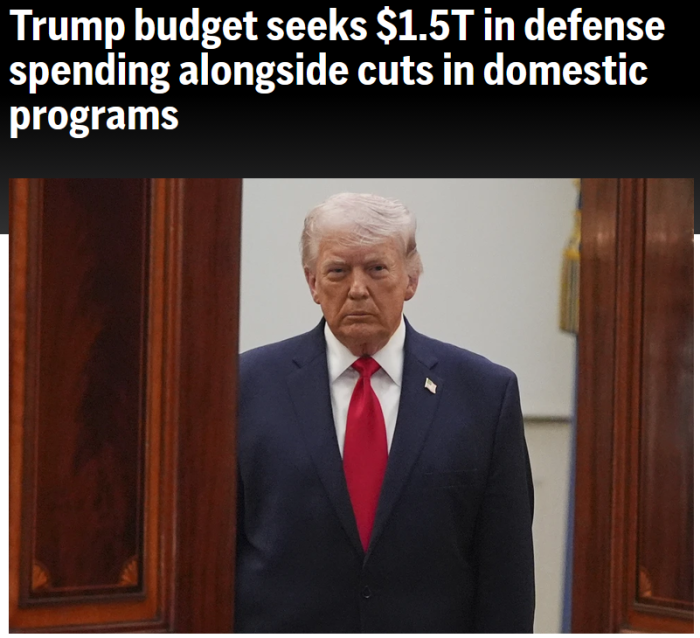
All of that is linked to what the US is doing with our tax money, where it’s spending—the current military budget, Janine, this year is over a trillion dollars. That’s one of those figures that it’s not even possible to understand what a trillion means. A million is such a big number that when you think about a million millions, it’s impossible to comprehend that.
But what we’re talking about for next year is $1.5 trillion. And that gives the answer to, why are we constantly told that there’s not enough money for healthcare, there’s not enough money for education, there’s not enough money for jobs. We heard it out of the mouth of Donald Trump when he said, “Of course we can’t afford childcare. We’re at war.”
Those were his words, and for once he was telling the truth. That is why we can’t afford those things. Because there’s plenty of money; that’s not the problem. The problem is, where does the money go? It goes to the military, as well as into the pockets of the trillionaires.
JJ: I’ll end it there, but I will just ask, finally, in terms of journalism, the segregation of topics: Iran is one page, Lebanon’s another page, Gaza’s another page, when we understand the connection of those stories, we understand the connection of spending. But what would you like to leave us with, in terms of where to look for information, or what to discount from the information that we get? Final thoughts on journalism.
IPS: National Priorities Project
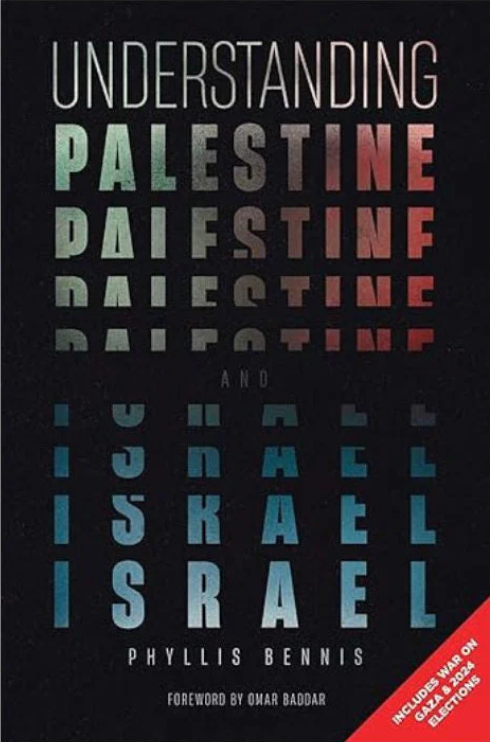
PB: Sure. If people want more information, the article you were referring to that was first published in Common Dreams, and later in Portside; that’s a useful one. If people want to take a look at my newest book, which is written in sort of an FAQ format, frequently asked questions, about all of this stuff. It goes up through October 7 and what happened after October 7, and up through the election of Trump. That’s available through Interlink Books.
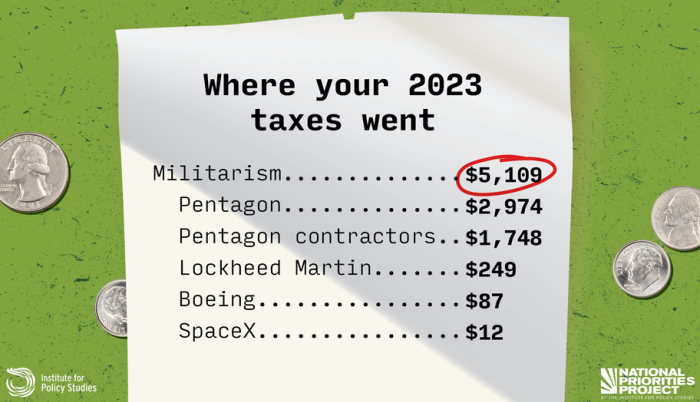
And if you want information about the link in the federal budget between paying for wars—this war in Iran, earlier wars and future wars, too—and what happens to our budgets here in the United States, my colleagues at IPS in the National Priorities Project, NationalPriorities.org, look at the trade-offs. It will tell you with two clicks, in your city or your county or your state, or the US as a whole, or your congressional district, a useful one, it will tell you how much money in tax dollars is going from that city, from that state, directly to the military budget.
Olive Branch Press (2025)
And what could you do with it instead? How many kids could get into Head Start? How many veterans could get healthcare? How many houses could be retrofitted with green technology? How many nurses could be hired? Take your pick, any of those.
But look at that. Tell people in your community about that. Remind them that they have something to say about this, and that the price of wars—which is paid for primarily financially in this country, but is paid for in human lives in the rest of the world—lies with us, as well as those here in Washington.
JJ: All right, then. We’ve been speaking with Phyllis Bennis. She’s a fellow at the Institute for Policy Studies, and you can find them online at ips-dc.org, and that’ll be the place to find the links to the projects that she’s talking about. Her most recent book is Understanding Palestine and Israel. Phyllis Bennis, thank you so much for joining us this week on CounterSpin.
PB: Thank you, Janine.
From FAIR via This RSS Feed.