


Amelia Schafer
ICT
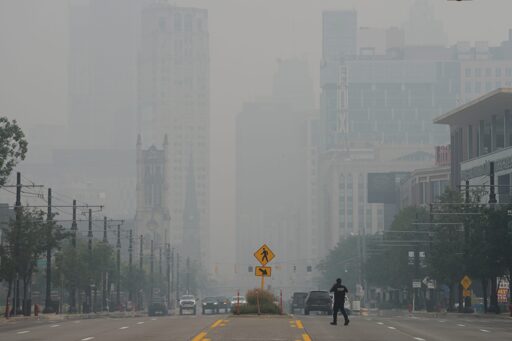
MILWAUKEE, Wisconsin – Smoke from Canadian wildfires that have ravaged entire First Nations communities continued to blow across the Great Lakes region Friday, even making its way into the Washington D.C. metro area.
Across that region are nearly 30 tribal communities and several cities with significant Indigenous populations. Communities in these areas are experiencing Air Quality Index levels exceeding 300. The Centers for Disease Control and Prevention identifies Air Quality Index levels exceeding 300 as being hazardous.
“I do worry about our community in regards to long-term health effects,” Araia Breedlove, communications director for the Lac Du Flambeau Tribe in Northern Wisconsin, told ICT. “But I know that our relatives in Canada are dealing with a lot of trauma, and I pray for them as well.”

A fire map provided by the Ministry of Natural Resources in Ontario (via APTN)
Cities like Milwaukee experienced record-breaking air pollution levels Thursday, with the city reporting an AQI of 640. In Detroit, levels reached 724. Detroit is bordered by several Indigenous communities and home to over 10,000 Indigenous people.
“It smells like burnt wood. We have like a pretty bad orange haze,” Breedlove said. “I have asthma. It’s very suffocating.”
Breedlove’s community in Lac Du Flambeau reported an AQI of 402 Friday.
In the Upper Peninsula, the Sault St. Marie Tribe reported Air Quality Index levels exceeding 760 on Thursday.
The extremely hazardous levels of pollution led to widespread closures of tribal services and even large events like the annual Michigan Indian Family Olympics, which was scheduled to take place in Mt. Pleasant, Michigan on Friday.
“Recognizing the significance of this event, which is eagerly anticipated by many, we have taken into account the current air quality conditions and the guidance provided by our health professionals,” said the Saginaw Indian Chippewa Tribe, which planned to host the event, in a statement. “We sincerely apologize for any inconvenience this decision may cause, but it is important that we prioritize the well-being of our community, particularly those who are most vulnerable during this time.”
In the Wisconsin Northwoods, Oneida artist and designer Harmony Hill told ICT she made the difficult decision to pull out of a vending engagement at the Lac Courte Oreilles Band of Chippewa Tribe’s annual Honor the Earth Powwow this weekend. Hill said the decision cost her the $400 deposit she paid for a vending booth, but it was ultimately the best decision for her health.
“While I do have underlying health issues that would irritate my symptoms, I think that I try to be more responsible about my health,” Hill said. “[There’s this] trend that I see across Indian Country constantly, where people don’t worry about their health until it’s too late. I try to be more proactive about that.”

Oneida artist Harmony Hill poses with her designs at a vending booth for her small business, Harmony By Design, which is based in Milwaukee, Wisc. Credit: Courtesy of Harmony Hill
As of noon Central Time on Friday, the powwow organizers have not announced if the celebration will be moved indoors, postponed or canceled. Organizers did not immediately respond to requests for comment from ICT.
The powwow is scheduled to take place outdoors, and Hill said she would have camped on the grounds while vending, providing her no relief from smoke.
“I don’t think I would have died if I had attended the powwow,” Hill said. “It’s just about being more responsible about caring about these particulates that I’m taking into my lungs that are going through my bloodstream and causing unknown long-term damage. So I made the choice to back out, and I’m not even mad about not being able to get my vendor fee back. I also host events, so I know how difficult a situation that would be for the organizers.”
With air this heavily polluted, individuals risk experiencing adverse health effects, such as immediate chest pain, severe shortness of breath, fatigue and the potential for heart attacks or life-threatening asthma attacks, according to the World Health Organization.
The danger comes from the abundance of fine particles within the air, the World Health Organization said. The smoke is bringing large amounts of carbon monoxide into affected areas. Fine particles can enter a person’s bloodstream where they begin to cause inflammation. With Air Quality Index reports this high, anyone is affected, not just sensitive groups like those with underlying conditions or the elderly. These effects happen when particles enter your bloodstream, causing systemic inflammation. This triggers immediate chest pain, severe shortness of breath, fatigue, and can even induce heart attacks or life-threatening asthma attacks.

The New York City skyline is seen through a cover of wildfire smoke, in Jersey City, N.J., Friday, July 17, 2026. (AP Photo/Ryan Murphy)
Instead, Hill said, she’s opting to hold an online pop-up sale via Facebook Friday night for her small business, Harmony By Design. Hill organizes the annual Milwaukee Indigenous art festival, Red Magic, each fall. Last year’s festival was derailed by record flooding in the city.
“It’s an unfortunate situation,” Hill said. “Obviously, nobody could have foreseen this, but I just felt that as kind of a public figure, and for myself, the responsible thing to do is to have some foresight when it comes to our health concerns.”
Air pollution is a threat to anyone’s health, according to the American Lung Association, but there are available precautionary steps.
Those experiencing unhealthy, very unhealthy or hazardous pollution levels are encouraged to reduce outdoor activity, consider wearing a KN-95 mask and ensure windows and doors are closed. If available, an air filtration system with a HEPA filter is recommended. In hazardous levels, some sources such as the City of Milwaukee recommend refraining from using gas appliances, as they can add to the pollution levels in homes.
As of Friday, it’s unclear how long the smoke will linger in the Great Lakes region as it continues to work its way east across the United States. The National Government of Canada reports a majority of fires across Ontario are still raging, classified as “out of control,” according to the nation’s database. Ontario is home to 133 First Nations communities.
“It’s been a hard situation to have to watch on the news,” Hill said. “ It’s very emotional, just the fires themselves, not just the smoke. But I mean, Native people are known for being resilient and working with whatever situation we have going on, and so I’m just doing my best to adapt to the situation while also trying to be mindful of long-term health threats.”
Impacts and closures
Indigenous nations, urban Indian centers, cities (as of 12 p.m. CST on July 17, 2026)
MINNESOTA
Affected tribes:
- Grand Portage Band of Chippewa – 402 (Hazardous)
- Fond Du Lac Band of Chippewa – 402 (Hazardous)
- Bois Forte Band of Chippewa – 402 (Hazardous)
- Leech Lake Band of Chippewa – 402 (Hazardous)
- Red Lake Band of Chippewa – 402 (Hazardous)
- White Earth Band of Chippewa – 161 (Unhealthy)
- Shakopee Mdewakanton Sioux Community – 57 (Moderate)
- Prairie Island Indian Community – 57 (Moderate)
Urban Indian Centers
- Duluth Indigenous Community – 411 (Hazardous)
- Minneapolis/Twin Cities Community – 63 (Moderate)
Closures
- Minneapolis American Indian Center Volleyball, cancelled July 16
WISCONSIN
Affected tribes
- Bad River Band of Chippewa – 402 (Hazardous)
- Red Cliff Band of Chippewa – 402 (Hazardous)
- Lac Du Flambeau Band of Chippewa – 402 (Hazardous)
- Forest County Potawatomi – 369 (Hazardous)
- Lac Courte Orellies Band of Chippewa – 402 (Hazardous)
- St. Croix Band of Chippewa – 402 (Hazardous)
- Oneida Indian Nation of Wisconsin – 367 (Hazardous)
- Menominee Indian Nation – 282 (Very Unhealthy)
- Stockbridge Munsee – 369 (Hazardous)
- Mole Lake/Sokagon Chippewa – 369 (Hazardous)
- Ho-Chunk Nation – 151 (Unhealthy)
Events
- Honor the Earth Powwow LCO: moved indoors Thursday, no determination yet on cancellations.
- Milwaukee IHS Summer Family movie night: scheduled for July 17, postponed until Aug. 28
- Milwaukee IHS Walking Club: Cancelled for July 16
Urban Indian Centers
- Milwaukee Urban Indigenous Community – 389 (Hazardous)
- Green Bay Urban Indigenous Community – 367 (Hazardous)
- Madison Urban Indigenous Community – 264 (Very Unhealthy)
MICHIGAN
- Hannahville Indian Community – 282 (Very Unhealthy)
- Bay Mills Indian Community – 118 (Unhealthy)
- Sault Ste. Marie Tribe of Chippewa Indians – 95 (Moderate)
- Little Traverse Bay Bands of Odawa Indians – 311 (Hazardous)
- Grand Traverse Band of Ottawa and Chippewa – 250 (Very Unhealthy)
- Little River Band of Ottawa Indians – 295 (Very Unhealthy)
- Match-E-Be-Nash-She-Wish Band of Potawatomi Indians (Gun Lake Tribe) – 310 (Hazardous)
- Saginaw Chippewa Indian Tribe – 298 ( Very Unhealthy)
- Pokagon Band of Potawatomi Indians – 383 (Hazardous)
- Nottawaseppi Huron Band of Potawatomi Indians – 403 (Hazardous)
Cancellations
Urban Indian Centers
- Detroit Indigenous Community – 269 (Very Unhealthy)
- Grand Rapids Indigenous Community – 440 (Hazardous)
ILLINOIS
- Chicago – 318 (Hazardous)
Closures:
- American Indian Center in Chicago
OHIO
- Cleveland – 259 (Very Unhealthy)
- Cincinnati – 72 (Moderate)
- Columbus – 386 (Hazardous)
NEW YORK
- Lenapehoking (New York City) – 142 (Unhealthy for sensitive groups)
- Seneca Nation (Allegany) – 280 (Very Unhealthy)
- Tonawanda Seneca Nation – 194 (Unhealthy)
- Tuscarora Nation – 194 (Unhealthy)
- Oneida Nation of New York – 56 (Moderate)
- Onondaga Nation – 56 (Moderate)
- Shinnecock Nation – 70 (Moderate)
Closures:
- Urban Indigenous Collective in New York City: CLOSED
WASHINGTON, D.C.
- D.C. Indigenous Community – 221 (Very Unhealthy)
PENNSYLVANIA
Impacted
- Pittsburgh Indigenous Community – 266 (Very Unhealthy)
- Philadelphia Indigenous Community – 201 (Very Unhealthy)
Miles Morrisseau contributed to this report.
The post Smoke heavily impacting Great Lakes tribes, Indigenous communities appeared first on ICT.
From ICT via This RSS Feed.