

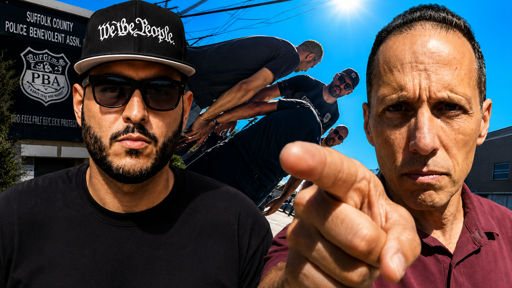
Sean Paul Reyes (@LongIslandAudit on YouTube) went to the headquarters of the Suffolk County Police Benevolent Association to ask a simple question: how is the county spending hundreds of millions of taxpayer dollars on police salaries, overtime, pensions, and misconduct settlements? Instead of an answer, he got handcuffed — while backing away from the building and repeatedly saying “I’m leaving.”
On this episode of the Police Accountability Report, Taya Graham breaks down the arrest video with Sean Paul Reyes himself, and reporter Stephen Janis lays out exactly what Suffolk County taxpayers are funding.
Credits:
- Written by: Stephen Janis
- Produced by: Stephen Janis, Taya Graham, David Hebden
Transcript
The following is a rushed transcript and may contain errors. It will be updated.
Taya Graham:
Hello, my name is Taya Graham and welcome to the Police Accountability Report. As I always make clear, this show has a single purpose holding the politically powerful institutional policing accountable. And to do so, we don’t just focus on the bad behavior of individual cops. Instead, we examine the system that makes bad policing possible. And today we will achieve that goal by talking to one of the most popular cop watchers and independent journalists on YouTube about his recent arrest, which we are showing you right now. It occurred at the police headquarters of a powerful law enforcement union. It’s an encounter that left him injured, but also drew the attention of the mainstream media. It’s a controversy that has thrust his tactics and unique approach into police accountability into the national spotlight and raised questions on how he approaches pushing back against law enforcement and power in general.
But before I get started, I want you watching to know that if you have video evidence of police misconduct or brutality, please share it with us and we might be able to investigate for you. Please reach out to us. You can email us tips privately at par@therealnews.com and share your evidence of police misconduct. You can also message us at Police AccountabilityReport on Facebook or Instagram or at Eyesonpolice on Twitter. And of course, you can always message me directly at TAS Baltimore on Twitter or Facebook. And please like and comment. You know I read your comments and appreciate them. I give out all those little hearts down there and liking and sharing and hyping can also help our guests and get their stories seen. So please take a moment if you can. All right, we’ve gotten that out of the way. Now, as we have reported consistently on this show, police power is far reaching and in some cases insidious, but often its implications aren’t fully understood.
Meaning the way police power infiltrates our system of government can often be hidden and not fully obvious. Well, the man we are going to speak to today is trying to expose the excesses of law enforcement by confronting its power head on. And it’s that work and the consequences for him that we will be unpacking for you today. His name is Long Island Audits and his videos of police encounters have literally been seen by tens of millions of people. But most importantly, he’s not just a random cameraman filming a car stop. He has continually confronted police over a topic that rarely gets the attention it deserves, law enforcement spending. And that’s where our story begins today because recently Sean Paul ventured into a pinnacle of police power, namely the headquarters of a police union. Now this bastion of law enforcement was located in Suffolk County, a jurisdiction that spends hundreds of millions of dollars per year on cops.
And Sean had some questions about that as you’ll see that the police simply didn’t want to answer. Now to help me unpack and share his perspective on what happened, I’m joined by the man himself, Sean Paul Reyes, also known as Long Island Audit. Sean, we are so glad to have you. So let’s get right into it. Now first, to set the scene, you arrive in the parking lot with your billboard truck. What prompted you to take your truck and show up at basically the summit of Police Power in Suffolk County? Let’s watch a little bit of the video and then we can discuss. All
Sean Paul Reyes:
Right. So the reason why I went there is because there’ve been multiple reports in my local newspaper Newsday about police misconduct lawsuits, settlements and there was recently a story that was just published regarding law enforcement officers in Suffolk County who agreed to general misconduct who have been found and plead to misconduct, who get to stay on the job for an X amount of time in order for them to collect their full funded taxpayer pension. And I thought this was very concerning these backroom deals happening between the police union and the Suffolk County government. In one instance, there was an officer who had used the surveillance tools improperly and he was given 14 years. In 2031, he will separate from the Suffolk County Police Department with his full taxpayer funded pension. And I believe that if you engage in misconduct, you should be immediately separated, not given some sort of deal where you can collect a full funded taxpayer pension.
Taya Graham:
Okay. So you go to the front door and there’s something interesting you discover. Let’s watch. And as we do, can you talk about what you’re seeing?
Sean Paul Reyes:
This is an interesting sign here. It’s a thin blue line gang flag of course with the text, “No body-worn cameras in building. Please leave your body-worn camera in the lockers at the security desk.” Yeah, so it probably is the body camera signage that’s posted on the front door. I thought it was very interesting that they have to remind officers to turn off their body cameras inside the police union headquarters. I would assume so that way their dealings inside remain private. The police union is a private entity that receives taxpayer dollars. So the lack of transparency there is already, they’re already not subject to any open records requests or anything like that. So I assume that they’re just trying to keep their dealings private. That’s why they have to remind their officers to turn off their body cameras, which again, I’m for transparency, not secrecy.
Taya Graham:
So you mentioned in the video you wanted to speak to Louis Cevello, the president of the Police Benevolent Association, the union. So you go to the lobby and ask to speak to him just like any journalist would. Let’s watch what happened and talk about it after.
Sean Paul Reyes:
So we’re trying to get ahold of somebody here. It doesn’t seem like anybody’s coming to the door. We just wanted to speak again to the president of the PBA, Lou Cevello. Two people working in the front desk at the PBA here or the PMA. Again, there’s nothing benevolent about the police union.
Taya Graham:
Just to just let me in. I have a
Speaker 3:
Lot to do with it. I know. Seems weird. Hello. Lou Savello, how are you? Sure, no problem. How are you? Have you seen me leaving? I immediately began to leave. Lou Savello, would you like to come –
Taya Graham:
Okay, so he appears and is immediately hostile and threatening arrest. He doesn’t really give you a chance to ask a question. So why is he so hostile about something reporters do all the time?
Speaker 3:
Have you seen me leaving? I immediately began to leave. Lucivillo, would you like to come on? I am leaving. Would you like to come on the channel? I’m leaving. I am leaving. You seem to leave me?
Sean Paul Reyes:
Yeah. So I really can’t speak to why he was immediately hostile with me, but I can speculate. And as far as you’re right, that’s what reporters do. They ask for comment, they show up to places. And I even had my reporter Mike with me to try and look a little bit more mainstream and legitimate, I guess. But I went there. His hostility probably stems from the… I’ve never had any previous interaction with the police union president, Lucivillo, but I have covered misconduct and lawsuit settlements by the Suffolk County Police Department and the Suffolk County government. I’ve covered Internal Affairs coverups. So I’ve been very critical of the Suffolk County Police Department.
Taya Graham:
Okay. So you exit the building and yet the threat of arrest continues. Let’s watch and I’ll ask you a question on the other side. I’ve
Speaker 3:
Seen your podcast. What do you think I’m doing? What do you think I’m doing? I’m leaving. So would you like to talk about the hundreds of millions of dollars withNo, I’m not? Would you like to talk about the hundreds of millions of dollars that the Suffolk County law enforcement agencies have?
Taya Graham:
Okay. So first you said you’re leaving. So why does he keep confronting you? It’s not like you weren’t obeying his order, but you were also asking questions that he ignored. What were those and why did you think they deserved answers? Well,
Sean Paul Reyes:
I think the Suffolk County residents here deserve the right to know how their tax dollars are being spent, and especially to the tune of hundreds of millions of dollars at this point in misconduct settlements. They have the right to know about these backroom deals regarding the pension. And that’s what I was asking him. Did he have any comment on the hundreds of millions of dollars in misconduct that is flown out of our tax dollars to victims of police misconducts and constitutional violations? I also in that time asked him to come on my show to talk about it, invited him there. But you’re right, immediately after he said this is private property, because I knew full and well that it was private property. Again, they received tax dollars. It’s a gray area, but it is private property and I knew that going in. I did my research, but it’s publicly accessible private property that I have every right to knock on a door and ask questions.
And when I was told to leave, he said, “This is private property, you need to leave.” My exact words were, “Sure, no problem.” And then I began to back away towards the door.
Speaker 3:
Have you seen me leaving? I immediately began to leave. Lucivillo, would you like to come on? I am leaving. Would you like to come on the channel? I’m leaving. I am leaving. You seem to leave me? I am leaving. I’m leaving. I’m leaving. Lucivillo, you go on talk, you go, “I’m leaving.”
Sean Paul Reyes:
And I continuously backed away continuously saying that I’m leaving. He continuously said, “You need to leave or you’re going to be arrested as I’m leaving.” So why it escalated that quickly and without any cause because I was leaving, I don’t know. I think it could only be his ego because at the end, I guess we’ll get to it, but at the end, before he puts the handcuffs on me, I told him, “You think you’re such a tough guy,” because he was bullying me. I think anybody who watches the video can see he was bullying me. He was trying to exert his authority. Pulled out his badge, identified himself as a Suffolk County police officer, which by the way, he’s not fighting crime or anything. He is a full-time police union president. He’s just a law enforcement officer per their contract. I believe there’s five different law enforcement officers that work.
Their detail is specifically the Suffolk County PBA headquarters. So it’s not like he’s investigating crime or doing or protecting the citizens. He’s just collecting a six-figure taxpayer paycheck to cover up misconduct. In my opinion, that’s what they seem to always do. So I mean, that’s why he became very aggressive. He wasn’t used to it and he wasn’t used to somebody asking him questions.
Taya Graham:
Okay. Now at this point, it seems clear he’s not going to answer your questions, but then he escalates and starts talking about arrests. Let’s watch and discuss.
Speaker 3:
I’m leaving. Get off the property. I’m leaving. I’m getting off the property. You are trespassing. I am leaving. You will be placed. I am leaving. I am leaving. I’m going to place you under arrest. Do what you need to do. I’m identifying myself as a police officer. So do what you need to do. I am leaving. You need to leave. I am leaving. You such a tough guy. Do it then. Do it. Do it. I’ leaving. Okay. I’m leaving. I’m leaving. No resisting. I’m not resisting. I’m not resisting.
Taya Graham:
Okay. It seems to me like you were retreating and yet he handcuffs you. What does the law say and what are your thoughts about the arrest itself? I mean, it seems to a certain extent he takes the bait. Let’s watch and discuss.
Speaker 3:
To do, I am leaving. You need to leave. I am leaving. You such a tough guy. You’re not going to do it then. Do it. Well,
Sean Paul Reyes:
It’s a completely retaliatory arrest. It lacks probable cause, a violation of my Fourth Amendment right. It’s pretty clear. The actual charge I’m being prosecuted on is criminal trespass in the third degree. And on the desk appearance ticket that I received seven hours later, it specifically says enclosed or fenced in and designed in a manner to exclude intruders. That’s the way the criminal trespass in the third degree statute is written here in New York State. That property is neither enclosed designed in a manner to exclude intruders or enclosed and fenced in any way. So the statute itself is just baseless and it won’t apply.
I guess shouldn’t have charged me with anything, but if there was any charge, it would be the charge of a simple trespass, which again, it doesn’t meet the statutory requirements because I have to remain and leaving while albeit slowly, and I will admit that I was leaving slowly, but I was continuously leaving slowly and backing up for a purpose. The purpose is that I knew I was dealing with bullies and thugs with badges and that wanted to do me harm. So the best way to keep myself safe is to make sure that they could see my hands at all times. If I turn around and leave, they can’t see what I’m doing with my hands in front of my waistband. Obviously I would never hurt a law enforcement officer or anyone, but they want to hurt me it seems.
Taya Graham:
You make a really good point about moving slowly and not turning around. If it was Baltimore City, if you turned around, a classic thing police would say is it’s a furtive movement, which has led to violence against suspects or arrestees.
Sean Paul Reyes:
Catch 22, right? Because either you’re moving too slowly, which appears to be the case I wasn’t moving at the speed that he liked or I moved too quickly and he had to take my life because he didn’t know what I was doing. So you can’t win either way, but I’m hopeful that I’ll win this in court.
Taya Graham:
As we’re watching this, I have to ask a bit more of a personal question. But what is the effect of being arrested? I mean, I’m not trying to trivialize it, but are you used to it? I mean, does it impact you beyond what we see on YouTube? Has it, I guess, taken a personal toll on you?
Sean Paul Reyes:
My family does not like to hear that I’ve been unlawfully arrested. I definitely don’t like it. I was chained to a desk for nearly seven hours. My back was killing me. And when he put on the handcuffs, he put them on… I’ve been unfortunately arrested a lot of times since I’ve started auditing. I think this is my 13th time. Zero criminal convictions in that time. But he put the handcuffs on so tight that I’ve never felt it that way before. And it was that way until uniformed officers came in about 10 to 15 minutes later and actually loosened them. I was in excruciating pain. I felt tingling in my right hand and I went to go get checked out two days later and it turns out that one of my nerves has been damaged. I have a pinched nerve and the back of my thumb, I can’t feel it.
I have pain when it changes temperature, just a bunch of pain associated with change in temperature, taking a shower, going in the pool, things of that nature. It’s just been very annoying and it reminds me every time I feel it of what a tyrant Lucivillo is and what he did to me. But yeah, it definitely affects me. No one wants to lose their freedom. I tell people who want to follow my footsteps and audit and film the law enforcement, I tell them their number one job is to not be arrested. And I thought I was doing that job. I thought I was complying. I know I was. I saw the video and I was there. So I was complying with his directives. I did everything I was supposed to do from a legal standpoint, but yet you still get arrested. And it’s because the process is the punishment.
They towed my 14-foot LED billboard truck. I had to pay a thousand dollars to get that out of tow out of impound. And I have to hire a lawyer to go back and forth. He hurt my wrist, pinched a nerve there. So the process, seven hours being hunched over, tied to a table, chained to a table where I can’t move. And it was definitely a horrible experience. It is unfortunately part of the job that I do. I’m not naive. I know that when I go out and record law enforcement and ask questions about their corruption and misconduct and these settlements, especially at a police union, there’s always a chance for retaliation. First amendment retaliation is a count you can sue for, for a reason. It happens not just to me. It happens to people all the time who record the police and are critical of the police.
I am blessed enough to have a big platform to share it with the world. But again, I’m not used to it. I don’t think I’ll ever be used to it. It definitely affects me. It affects my family the most. And it’s unfortunate, but it is part of the job and I have to accept that it is unfortunately part of the job. Hopefully one day it won’t be.
Taya Graham:
So was it just retaliatory? I mean, what does the law require you to do and do you think you were complying with the law? Yeah,
Sean Paul Reyes:
So the law requires you to immediately leave the property, but you have to have time to leave the property. You can’t teleport off of the property as much as he probably wanted me to teleport in that.
Taya Graham:
That’s very true. I didn’t think teleportation was an option.
Sean Paul Reyes:
This was escalatory by Lucivillo and the rest of the PBA from the moment they came down. They did not need to come down. There was a receptionist there who could have told me over the intercom, “You’re not welcome here. You need to leave.” And I would’ve left without backing up because I wouldn’t have to worry about armed me on my back. So I would’ve just left probably a lot quicker. But Lucavillo had the President of Police Union wanted to come down personally because of his ego. I do trainings with law enforcement all the time, and one of the big things I talk about is ego. His ego, he knew who I was. He wanted to come down and he wanted to tell me personally and he wanted to do harm to me. That’s clear from the video. So the legal standard is you have to leave from a place that you weren’t licensed or privileged to be at.
So everybody has a license or privilege to walk on any property that’s not restricted and ask questions. And just like solar panels, girl scouts, you have a right to just go up and ask questions or just knock on the door, a knock and talk. Law enforcement does it to us all the time.
Taya Graham:
Now, since this encounter, the right-wing Rupert Murdoch owned New York Post wrote a story claiming that your video has led to death threats against the union president. However, it didn’t really explore your allegations. First, what is your impression of the fairness of the story? And did they actually ask you for comment? So
Sean Paul Reyes:
Neither story that was printed by the New York Post didn’t reach out for comment to me for either one after, and hopefully on this next article that they say that they’re writing, that they will include my comment on there. But apparently it looks like to me that Lucivillo, the police union president, has contacts with the New York Post. Within hours of my arrest, it was on the New York Post saying that I did a billboard truck stunt and that I threatened the law enforcement officers, that I wouldn’t leave the property when told to leave. And I will say to the New York Post credit, to this particular writer’s credit, that once the video came out, he did call into question. He said the video calls into question some of the statements made by the police union president Lucivillo. But again, he wasn’t able to reach me for comment.
He said that he reached out via Instagram. I wouldn’t check Instagram. I’m better off emailing me. But either way, I’ve been in contact with him since and I’ve sent him the medical report for my pinched nerve. I gave him my version of events, which my version of events, lawyers always tell you not to talk to the press or to anyone and make any public statements, but anything I’m going to say is already in 4K, 60 frames per second online for the world to see. So I’m not really worried about… I’ll talk to the prosecutor right now. I don’t have no problem. It’s not a big deal. It is what it is. They’re the ones that try and distort reality and to fit their narrative and their crime and the statutes or whatever else. But I think the New York Post obviously could do a better job with the reporting to make the highlight of it that he’s receiving death threats without any proof of any death threats.
I didn’t see that included in the article. There wasn’t any proof. Just again, the word of a liar who is a proven a liar at this point since the video came out doesn’t hold any weight, but yet I have to provide medical documentation for my pinched nerve. But I have no problem doing it. I supplied the district attorney, the Internal Affairs and the New York Post with the unedited video. There is nothing I have to hide. The video speaks for itself. And I just hope in their third article, they keep asking me when I’m going to file a lawsuit. I think they want to see that. They want the headline, Long Island audit files lawsuit against the… Maybe I’ll put a number on this one so they can have a headline, but I think that’s what they’re waiting for. But we’ll see how their reporting involves.
And I think that for the Year Post, the second article was a lot better. Again, the title just trying to drag in clicks and views. So with the death threats against the police union president, again, none made by me. I can’t control what other people do. If somebody sees his actions and wants to commit a crime and send him death threats, I advocate for peaceful petitions of grievances to governments, not violence whatsoever. I’ve never even cursed in a video, but I would say I feel bad for him, but I don’t. When you take away my freedom and you put me in a predicament where my family’s worried about me and I’m suffering and all because you don’t like what I have to say and you want to disrespect the oath that you took to uphold our constitution, which I hold sacredly, obviously Lucy Miller doesn’t.
So we’ll see what the New York Post continues with, but at the end of the day, I’m not going to hold my breath for anything really groundbreaking there.
Taya Graham:
So just to directly adress the basic thrust of the story, it seems they’re imitating other critics who say your work is just about clicks and views. How do you respond to those critics who dismiss what you do? Well,
Sean Paul Reyes:
As I stated earlier, they put the headline police union president is receiving death threats for clicks and views. Let’s be real, that’s not the story here. The story is that the police union president unlawfully clearly from the video evidence arrested a journalist for his First Amendment protected rights. That’s what happened here because the ego couldn’t control his ego. So the framing of everything and the way sometimes people frame what I do for clicks and views, clicks and views are important to get your story out there to be seen by as many people as possible, especially for somebody like me who’s independent. I don’t have million dollar backers or anything like that. So I require or I hope for my audience to hit the like button and sharing it so that way it could be seen by as many people as possible because I think tyranny and I think misconduct and corruption needs to be seen by the American people, especially here in Suffolk County when it directly affects you and your tax dollars.
But most of the critics, it’s actually quite ironic that my biggest critics are I support them. I support their rights to be my critics. The police union and the police department do not support our rights to criticize them, but yet I support the rights of the police union and anyone else. They called me a thug in their posts. They called me an agitator, a thug, every name in the book trying to discredit me and paint me in a bad light when I’ve been nothing but polite to everybody I’ve ever come encounter with. I do police trainings. I’m not anti-law enforcement. I work with law enforcement. I’ve done ride-alongs. I’ve covered stories where law enforcement officers did the right thing during my audits. I don’t hide those videos. So it’s very unfortunate that some people want to see bad in what I do. I think what I do is a service for the community and I hope that people will see that you can respect the police and respect law and order as I do and at the same time hold the police to account.
And even with security of lock cameras and everything else. And it’s important. One of my favorite Benjamin Franklin quotes is those who give up their essential liberty to purchase temporary security deserve neither liberty nor security or safety, whatever the quote is, but it’s one of my favorite quotes. I might not always get it right, but the theme is don’t give up your liberties for this security of law enforcement officers. It’s very important. And I hope that people who are critics of me can see the other side and see that this is not about hating law enforcement. There are people who just hate law enforcement and there are people who just hate law enforcement that watch my channel, sure. I
Taya Graham:
Love that quote too. Those who would give up essential liberty to purchase a little temporary safety deserve neither liberty nor safety. It’s simply brilliant. Finally, after all of these encounters and the pushback you’ve received for what you have called accountability reporting, what scares you about police power in America? I mean, how formidable is it and can it truly be held accountable given what you have witnessed while covering law
Sean Paul Reyes:
Enforcement? Yeah. Well, I think the only way it could truly be held accountable is with public servants. County executives, mayors, administrative rules holds them accountable. They need to make policies and procedures that hold them accountable. They need to make the union less powerful because they’re very powerful. I don’t think that unions should exist in law enforcement whatsoever. I think unions are great when you’re trying to take on Jeff Bezos and Elon Musk’s of the world and all the rich, powerful elite. I think they’re great for that. I think when you are a public servant like a law enforcement, especially a law enforcement officer, you shouldn’t have a union because it leads to corruption like we see today. PBA endorsed candidates donating to support specific candidates that are going to make law enforcement less transparent, less accountable. So another way is to evoke people in that are going to hold law enforcement accountable.
And honestly on both sides, it really doesn’t matter who you choose. They seem to all want to be buddy-buddy with the police officers because at the end of the day, law enforcement is what separates the politicians from the people. I’ve seen it all over this country. They’re locking down every single county building, every single city hall, you’re making key card access and everything else. And I say to my viewers all the time, the reason why they want to keep you out is because they know that they’re not serving your best interests and they don’t want you anywhere near them. Why would they want you access to them? They’re scared of you. If they’re scared of you, there’s a problem. Why would they be scared of the people that they’re supposed to represent?
Taya Graham:
Long Island Audits, thank you so much for joining us. We are absolutely dedicated to covering your work on police accountability, and we look forward to speaking with you again in the future. And now I want to turn to my reporting partner, Steven Janis, who has his own perspective on the intersection of money and police power and how it alters our system of governance. Stephen, thank you so much for joining me.
Stephen Janis:
Tay, thanks Army. I appreciate it.
Taya Graham:
Now first, Steven, what are your thoughts on what you just watched? Why do you think the police union responded to his questions the way they did?
Stephen Janis:
Well, usually I say in journalism, people will answer questions if they have nothing to hide. However, I think this is a perfect example of overreach by police who are just accustomed to not being questioned too intensely by the media. Generally speaking, media relies upon police for sourcing, for crime stories, for whatever. And police also have a lot of rhetorical power in the sense that you’re either for or against us. And I think in this case, they just didn’t like being put under the microscope.
Taya Graham:
Now, Steven, as a member of the media and a person who’s covered policing for over two decades, what do you think about how the New York Post covered Sean’s encounter with the union?
Stephen Janis:
Well, I think there’s a couple issues going on here. Number one, there’s this intense pressure to cover social media, YouTube as a phenomena that doesn’t really make it easy to apply the same standards we do to regular journalism. But I think they should have gotten Sean’s side of the story and looked at the video too before. It was a very short story. It didn’t have a lot of details and didn’t really give Sean’s perspective. So I have to criticize him for that. But to that end, we did contact the Police Benevolence Association in Suffolk County through their Facebook account, through their email and through a submittal form on their website. So we have reached out to them for comment to ask them what they have to say about what Sean has said. In other words, he was retreating, he was trying to leave. He couldn’t teleport and why they arrested him.
So we have reached out and tried to do our due diligence. Hopefully the Post will do more to correct some of the things in the story.
Taya Graham:
Okay, last question. You’ve worked on plenty of stories involving police pensions and spending. What are some of the critical takeaways from Sean reporting on Suffolk County and police spending in general?
Stephen Janis:
Well, Suffolk County has some of the most generous police spending in terms of salaries and benefits I think I’ve ever seen as a reporter. I mean, it’s always very treacherous when you approach police on the thing that matters to the most in many cases, which is money. I mean, we published all the overtime earnings for police about 20 years ago and we almost got sent to jail. Well, my editor did get arrested. So they get very touchy about it because they really have better benefits than almost all of us. I mean, as we’ll see later on when you’re talking about in the show, they get very generous pensions. They can retire very early and that’s like a lightning rod for them because I don’t think they want people knowing how much better they’re doing than we are. So I think this is a typical standard case of follow the money.
And I think Sean did the right thing in asking these questions and expecting answers.
Taya Graham:
Thank you, Steven. I really think you bring a unique perspective to the topic of police spending. It’s a focus that your past reporting reveals is something we as journalists cannot take our eyes off of, especially if we truly want to hold police accountable. Now, one of the oldest adages in journalism is a fairly simple demand that often requires more than just a cursory glance at the numbers on a website. A requirement that we dig deeper to not just report on how much the government spends, but why. And that adage is a simple one. Follow the money. It’s a process every reporter knows is essential, but often doesn’t have the time to pursue with enough vigor. It’s a key factor at the heart of almost every political scandal in our country and also the ingredients that inform every bad public policy we witness in governance today.
Now the reason I’m talking about following the money is I want to do a little though experiment with you. I want to compare what the taxpayer of Suffolk County commit to funding the police department and by extension their union and the willingness of police officials to answer questions about how they use that money because that’s really what’s at the heart of the conflict we just witnessed. Not are you for or against the police or not that you back the blue until something happens to you or even whether or not you agree with the media coverage this incident has elicited? No, this is entirely unlike the typical American ideological rift that seems impossible to repair. This is simply a story of how much of our precious tax dollars we give police and how they treat us when we ask for accountability in return. So here’s a little rundown on what the hardworking taxpayers of Suffolk County fund to keep the police department running and their subsequent retirees happy.
Now all this information is courtesy of the Suffolk County budget documents or other media outlets. And just as a note, I have to say as a reporter who’s read a lot of budget overviews, we What they provide is not exactly easy to navigate, but let’s share a few facts we’ve gleaned from their own reporting. According to a section of the budget documents posted online, the burden of funding police is steep, roughly $1,400 per household. That’s $1,400 per household just to keep police on the street. It should be noted that the biggest line item in the documents other than the general operating fund, which costs taxpayers a meager $80 per homeowner. It also should be noted that police spending accounts for the largest net increase in the budget for that year according to those same documents. Now, next on the list is something that, again, often slips below the radar, but is worth noting employee pensions.
Now first, Suffolk County has some very generous police pensions. A study by the Empire Center for Public Policy found that officers who recently retired from Suffolk and nearby Nassau County qualify for a pension in excess of $100,000 per year. And that’s especially lucrative and costly for taxpayers because Suffolk County officers can retire after just 20 years in service. I mean, even my hometown of Baltimore with one of the largest police forces per capita in the country and a very powerful police union requires 25 years of service to retire. But I’m not done because I haven’t even mentioned one of the biggest contributors to police salaries, namely overtime. That’s right. The great amplifier police paychecks that can cost taxpayers tens of millions of dollars in extra spending. Now it was hard to obtain exact figures, but in 2025, overtime spending cost taxpayers an additional $74 million according to Newsday.
Almost 130 employees earned more than $100,000 in overtime pay, most of them police officers. So that’s quite a hefty amount of money taxpayers are being asked to fork over to keep Suffolk County Police working. And that doesn’t include all the multimillion dollar settlements Sean was talking about in the video we just watched. So how do these exceptionally well-paid people with extremely lucrative pension benefits treat a taxpayer when he arrives to ask questions about spending? How do they respond to very basic accountability questions when someone who pays their salary shows up? Well, let’s watch again and you can judge how they behave.
Speaker 3:
So would you like to talk about the hundreds of millions of dollars? No, I’m not. Would like to talk about the hundreds of millions of dollars that the Suffolk County law enforcement agencies have on pasta? Leave. Do it. I’m leaving. Okay. I’m leaving. I am leaving. No resisting. I’m not resisting. I’m not resisting. I’m not resisting.You were won multiple times. I’m leaving.
Taya Graham:
That’s right. The people who benefit from the generosity of Suffolk County taxpayers actually arrest a Suffolk County taxpayer for, wait for it, asking questions. And then a newspaper writes a sympathetic article to the police union officials who arrested him for asking questions. Now call me crazy, but why on earth is it a threat to ask a question of a public official whose salary you pay? Why is it so controversial for a resident of a county to query the people who work for the county they fund? Why is it so wrong for Sean to want to know where his tax dollars are going and expect the people who are spending them to explain how they spend? Let’s remember a simple principle. Government officials are spending other people’s money. Although the law requires people to pay taxes, it’s still not their money. It’s ours. And in this case, Sean’s, which gives him, in my humble opinion, the right to ask as many questions as he wants.
Just think about it. The union chief is paid by taxpayers, not to patrol the streets or assault crimes, but just to represent the union. That’s right. Taxpayer dollars to pay a salary, to run an entity that won’t answer questions. It’s really hard to fathom how that is even remotely fair, but I think this is also a cautionary tale about funding people with guns and badges wherever they are. Law enforcement has unique power granted them by us, the citizenry. They can take our freedom and even our lives. Now couple that with the ability to spend taxpayer dollars without accountability and you have a dangerous mix that I don’t think any healthy democracy can abide. The ability to rest and the ability to tax should never be one and the same, which is why the work of Sean and other copwatchers is so important. Why his showing up at police union headquarters, which has been depicted as a stunt or worse yet harassment should be viewed through a different lens.
I mean, what if the officials just calmly answered his questions? What if they just took the time to explain their side of the story instead of brandishing handcuffs? The point is that what Sean is doing is an essential task to preserving our freedom, asking the questions nobody in power wants to answer. That’s why both Sean and I and Steven will continue to ask them because I believe democracy itself is at stake. I want to thank our guests, Sean Paul Reyes, also known as Long Island Audits for his time, his insights, and his patience with my technical issues. Thank you so much, Sean. And I have to thank Intrepid reporter Steven Janis for his writing, research and editing for this report. Thank you so much, Steven.
Stephen Janis:
Tay, thanks for having me. I really appreciate it.
Taya Graham:
And I want to thank friends of the show, Noli D and Lacey R. For their support. Thank you both. Thanks Noli D. And a very special thanks to our accountability report, Patreons. We appreciate you and I look forward to thanking each and every one of you personally in our next live stream. And I especially want to thank you for your patience with us. And I have to thank Patreon Associate Producers Johnny R, David Kay, Louis P, Lucia Garcia, and our super friends, Shane B, Kenneth K, Pineapple Girl, Matter of Rights, and of course Chris R. And I want you watching to know that if you have video evidence of police misconduct or brutality, please share it with us and we might be able to investigate for you. Please reach out to us. You can email us tips privately at par@therealnews.com and share your evidence of police misconduct.
You can also message us at Police Accountability Report on Facebook or Instagram or at yesonpolice on Twitter, or of course you can message me directly at TeasBaltimore or Twitter or Facebook. And please like and comment. I do read the comments and appreciate them. And we do have a Patreon link pinned in the comments below for accountability reports. So if you do feel inspired to donate, please do. We don’t run ads or take corporate dollars so anything you can spare is truly appreciated. My name is Taya Graham and I’m your host of the Police Accountability Report. And as always, please be safe out there.
From The Real News Network via This RSS Feed.