

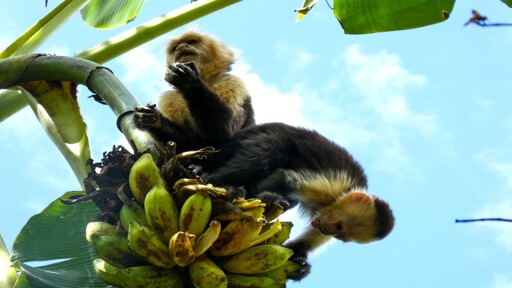
COSTA RICA: Dawn is yet to break when primatologist Susan Perry and her field research team move through Costa Rica’s tropical dry forest for a day in the field studying Central American white-faced capuchin monkeys. Despite the darkness, the forest is humming. Perry calls this juncture “the changing of the guard,” when nocturnal animals end their day and diurnal species are just beginning theirs. As the team approaches the site where the capuchin (Cebus imitators) sleep, the location of which changes nightly, spiders’ glittering eyeshine emblazons the ungraspable dark of the forest. Perry, an evolutionary anthropology professor at UCLA, has researched capuchin monkeys living in and near the Lomas de Barbudal Biological Reserve for the past 33 years. She documents their complex social behaviors and group dynamics with a revolving team of scientists, capturing the intricacies of capuchin society while remaining on the periphery. A new study analyzing Perry’s observations of 12 neighboring capuchin groups over her 33 years in the field documents how extreme climate events, such as El Niño, alter the costs and benefits of living in large groups for capuchins. In the field, the researchers go through a highly intentional process to remain separate: Perry leaves her study subjects untagged and uncollared, and instead, identifies and gets to know each individual. These monkeys are listed as vulnerable by IUCN. They live in one of the most endangered and biodiverse habitats in the world:tropical dry forest. Due to deforestation and fire damage, just 1% of the original primary…This article was originally published on Mongabay
From Conservation news via This RSS Feed.