

The Bear Trap and Thumb fires have each burned more than 55 square km and crossed into Canada.
Wildfires continued to burn in northeastern Minnesota on Thursday as evacuation orders remained in effect and smoke pushed air quality to hazardous levels in parts of the state. Hourly readings had already surpassed previous records in the Twin Cities overnight, with more record levels possible, the Minnesota Pollution Control Agency (MPCA) said.
RELATED:
Wildfire Smoke Threatens World Cup Final in New York
The MPCA’s alert, effective 8 p.m. Wednesday and scheduled to run through 11 a.m. Friday local time with potential extension, forecasts air quality reaching the hazardous maroon category across most of the U.S. Upper Midwestern state.
The Lake County Sheriff’s Office has ordered an immediate evacuation of the Fernberg Corridor east of Ely since July 14 due to the Camp Fire, and opened a temporary evacuation point, not a public shelter, at the Babbitt Municipal building, the county said.
St. Louis County ordered an evacuation of part of the Echo Trail near the Sioux Fire, while Cook County kept a lower-level notice near the Little Knife Fire at the end of the Gunflint Trail, according to a Thursday fact sheet from the U.S. Forest Service and the Minnesota Incident Command System (MNICS).
A wider evacuation-status display across the Boundary Waters Canoe Area Wilderness (BWCAW) this week reflects a federal closure rather than a new threat to homes, Lake County said. The Forest Service and MNICS said 15 wildfires remained active in the forest, with three inside the BWCAW, though dense smoke has hampered aerial surveys.
The Bear Trap and Thumb fires, the two largest, have each burned more than 55 square km and crossed into Canada. The Sioux Fire, now partly inside the wilderness, has burned about 30 square km, while the Little Knife Fire, which crossed from Ontario, Canada, has burned about 24 square km on the U.S. side of a binational blaze totaling some 121 square km.
800+ WILDFIRES BURN ACROSS CANADA
More than 800 wildfires are burning across Canada, with dangerous smoke spreading into several northern U.S. states.
Air quality in parts of Michigan and Minnesota has reached hazardous levels, prompting officials to urge residents to stay… pic.twitter.com/6eWZt4V1mn
— Rosa News Official (@Mirha1206) July 17, 2026
Favorable conditions, including cloud cover, weaker winds and higher humidity, have slowed fire spread this week, enabling fire crews to resume full suppression efforts, with upcoming rainfall forecasts expected to further aid containment, the agencies said.
Minnesota’s Executive Council voted Wednesday to extend Governor Tim Walz’s peacetime emergency over the wildfires, following his July 12 declaration, which also authorized the National Guard to assist suppression efforts.
“Wildfires have broken out in northeastern Minnesota and are putting local communities at risk,” Walz said in a statement.
CBS Minnesota reported, citing Walz, that Royal Canadian Air Force personnel evacuated 11 Minnesota teenagers and four staff members from wildfires on the Canadian side of the border.
The Camp Fire, first reported July 7, reignited on July 13 and grew rapidly, prompting evacuations, Lake County said. Rescuers airlifted 17 people to safety and authorities evacuated about 200 members of a Texas scouting group when the wilderness closed to the public on July 14, according to local media reports.
Nationally, the National Interagency Fire Center (NIFC) kept the National Preparedness Level at Level 4, the second-highest of five levels, with 158 new fires reported nationwide on Wednesday and 49 large fires still uncontained. More than 17,500 personnel are assigned to wildfires nationwide, and more than 39,000 fires have burned over 14,850 square km so far this year, the center said.
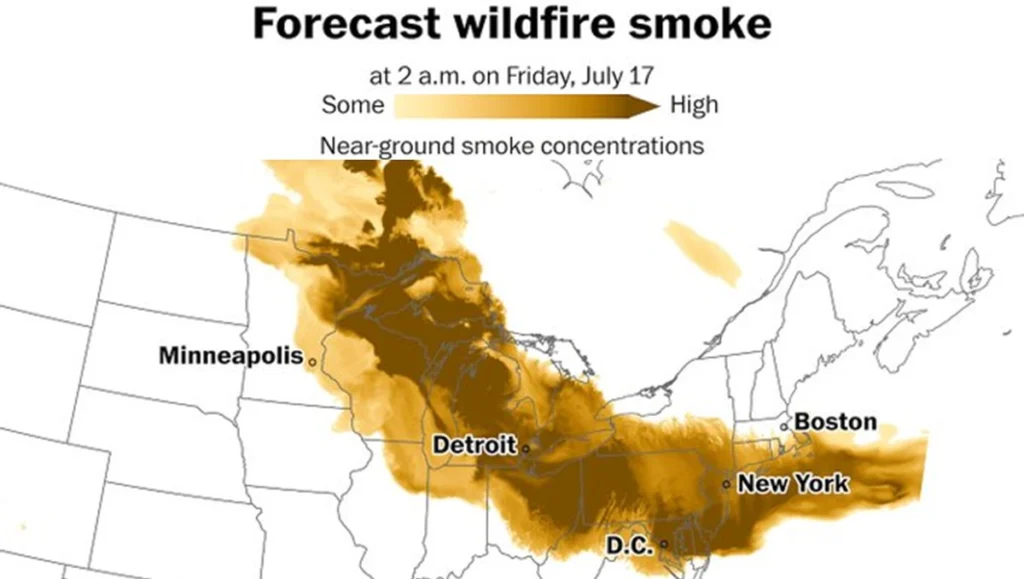
More than 800 wildfires were reportedly burning across Canada this week, adding smoke that spread into the U.S. Midwest, Great Lakes region and Northeast. Wisconsin, Michigan and New York each issued statewide air quality alerts or advisories this week, according to their environmental agencies.
The air quality in Minneapolis, the largest city in Minnesota, was ranked the worst among major cities globally Thursday afternoon as smoke from northern wildfires cloaks the region, CBS News reported.
After being in the top spot for hours, Minneapolis is ranked third as of 4:45 p.m. Thursday local time (2145 GMT) behind Chicago and Detroit, said the report, citing air quality data from IQAir.
teleSUR/ JF
Source: Xinhua
From teleSUR English via This RSS Feed.