

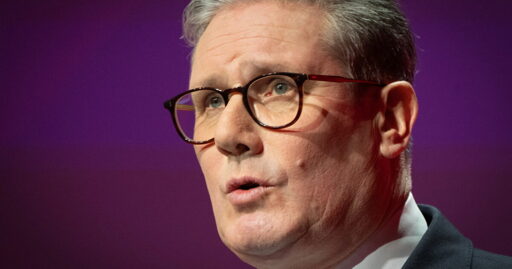
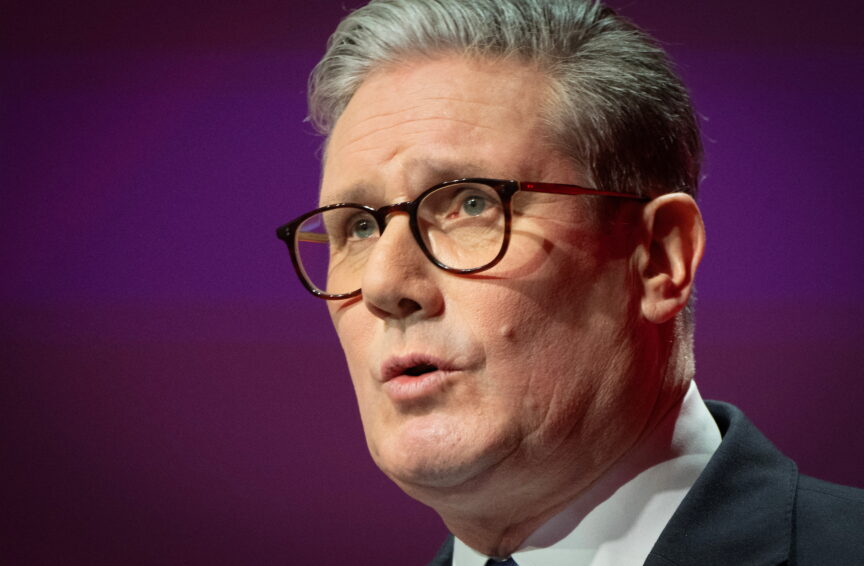
It’s hard to hear exactly what the heckler shouts to Sir Keir Starmer from the floor of Labour’s September 2024 conference, but snatches are caught on the ambient mics. “Does that include the children of Gaza?” is heard before the camera zooms in on the delegate. He is young, only a teenager, and he’s quickly moved out of the conference hall after saying something about “bombs” and “Palestine”.
It’s the first Labour conference since Starmer was elected as the first Labour prime minister in 14 years, and it is conducted with the swagger and brio one would expect of a triumphal political project. Even so, Starmer’s response was extraordinary.
“This guy’s obviously got a pass to the 2019 conference,” Starmer jokes.
The hall erupts in laughter and applause, some rising to their feet. Starmer, who has so often been criticised for failing to show that he enjoys politics, basks in the response, plainly savouring the moment. “We’ve changed the party,” Starmer explains in a sing-song tone.
The day after the heckler interrupted Starmer, the UN’s Office for the Coordination of Humanitarian Affairs reported that 41,495 Palestinians had been killed by Israel’s assault on the Gaza strip. 11,355 were children. A week before, the Gaza health ministry published a 649-page document listing every identifiable person killed in Gaza. The first 12 pages are exclusively of babies under one year old.
It’s a journalistic cliché – not to mention trite – to reduce a complex, decade-long history to a few vignettes to explain the downfall of a politician. But I keep coming back to this footage, drawn to Starmer’s discomfiting glee: his obvious contempt, his lack of political skill, and his staggering hypocrisy.
Starmer was on stage at Labour’s 2019 conference as part of Jeremy Corbyn’s shadow cabinet. He had campaigned for a Corbyn government. He would win the Labour leadership on the basis that he was an inheritor of Corbyn’s 2019 manifesto and a friend of Corbyn. The Corbynites that Starmer condemned on stage in 2024 used to be his allies and comrades; the people who went knocking on doors in 2015 and 2017 and 2019 to get him elected as an MP. They also used to be Labour voters: now, they have sought political and electoral representation elsewhere, largely in the Greens, where they have just helped to secure his political defeat by plunging the Labour party to its worst ever local election results.
More talented politicians might have used this moment to acknowledge concerns about Israel’s conduct but explain how incrementalism, not outrage, would eventually secure peace. Not so Starmer. In the face of anguish about the high-tech algorithmic massacre of children, Starmer responded with a juvenile factional taunt. He could only see calls for an end to ceaseless slaughter through the lens of an intra-party battle that he and his allies won long ago through Mandelsonian dirty tricks, dishonesty and bureaucratic force.
But in the end, this is all the Starmer project had: a factional animus that curdled into a wholesale repudiation of democratic norms and basic decency. As its frontman, Starmer became its caricature and its distillation, and, as a result, the harbinger of his own humiliation.
The hidden hand.
The arrogance of the Starmer project is not uniquely a product of Starmer’s own personality or politics. Indeed, as many more centrist commentators now ruefully note, Starmer does not appear to have any politics or ideology of his own – no ‘political economy’, as the saying goes.
The real motive force behind Starmer was Morgan McSweeney, the Cork-born Labour manipulator who would join forces with Starmer to briefly procure historically unparalleled power for himself and his faction. According to multiple accounts, McSweeney “despised” the Labour party’s Corbynite, anti-imperialist wing, whose politics he believed to be “evil”.
In this he was joined by a large cast of Labour rightwingers who refused to reconcile themselves to Corbyn’s democratic mandate, prime amongst them Steve Reed MP, the current minister for housing and local government and one of the last remaining Starmer loyalists.
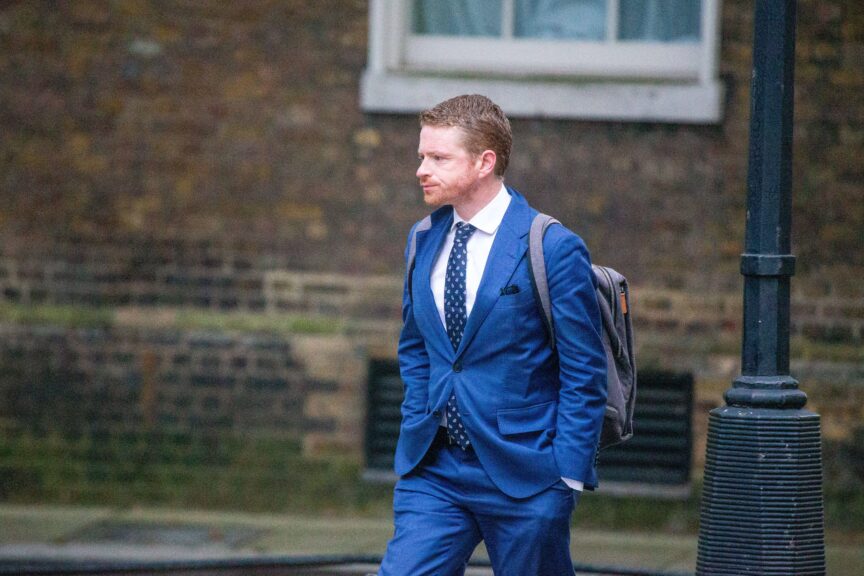
Morgan McSweeney. Credit: Zuma Press
In the summer of 2017, long before he joined forces with Starmer, McSweeney took up a position as the director of the think tank Labour Together. He moved there following the June general election in which Corbyn’s Labour had smashed expectations to win 40% of the national vote. For McSweeney’s inchoate rightwing Blue Labour-cum-Mandelsonian faction, Labour’s result was an emergency, as it meant that Corbyn couldn’t be directly removed as leader unless he lost the next general election.
It was to this task that McSweeney and his closest allies, including Reed and fellow Labour party insider Imran Ahmed, turned to with gusto. In a meeting at Reed’s parliamentary office, the MP printed out a strategy document plotting how Labour Together would have a dual purpose: first, to undermine the Corbyn project; second, to incubate a leadership challenge that would allow the Labour Together project to seize the party’s commanding heights.
What followed was a campaign of subterfuge, sabotage and dishonesty unparalleled in modern British political history – all lavishly funded with more than £700k in donations that McSweeney failed to report to the Electoral Commission. The money came from a clutch of millionaires and one of the country’s most prominent pro-Israel lobbyists, Sir Trevor Chinn. To prevent discovery, Labour Together pretended in public that it was an anodyne think tank looking to heal factional wounds within the party: a manoeuvre internally dubbed ‘Operation Red Shield’.
McSweeney used his undeclared funds to secretly support Labour rightwingers scared that a member-led democracy would curtail their careers. At the same time, he inserted himself, without any disclosure, into the ‘antisemitism crisis’ that was buffeting Corbyn’s party.
The full extent of McSweeney and Labour Together’s involvement in the antisemitism crisis is still fuzzy and has only been revealed by a combination of fortuitous leaks and post-facto bragging. But what has been revealed shows that McSweeney and Labour Together’s involvement was wide-ranging, profound and frequently despicable.
McSweeney and Ahmed worked to seed a stream of alarmist stories in the media that fed the impression that the Labour party was a cesspit of antisemitic hate. Their role was not contemporaneously disclosed, and only revealed years later. Their work fed a narrative that leftwing, redistributive or anti-imperialistic politics was intrinsically and inexorably antisemitic.
At the same time, McSweeney, Ahmed and Reed started astroturf campaigns like Stop Funding Fake News, which sought to destroy the livelihoods and careers of journalists working at The Canary, which took a pro-Corbyn editorial line. Labour Together’s internal polling had shown that Labour members trusted the Canary’s journalism, which included factually accurate rebuttals of the least convincing cases that made up the antisemitism crisis.
One recently disclosed internal briefing note bluntly noted that the Canary would have a major influence on who would be the next Labour leader. So it had to be taken out, which McSweeney and Ahmed achieved with a campaign of astonishing cynicism that recast the Canary as a peddler of fake news designed to stir up hate.
Scepticism about an antisemitism crisis riven with contradictions was recast as a form of antisemitic denialism under McSweeney and Ahmed’s nurturing. The end result was that many Jews, some leftwing and some anti-Zionist, would find themselves investigated and harried out of the party for antisemitism because they intuited – correctly – that the morally urgent fight against antisemitism (and there was, indeed, antisemitism that needed dealing with) was being recklessly intermingled with a factional project unable to win power through persuasion or the strength of its own ideas.
Slush funds, astroturf projects, unattributed stories inflaming ethnic tensions: this is the stuff of Russian disinformation campaigns, not a moral crusade to renew the Labour party. It was also the stuff of the Labour Together project, and it speaks volumes that Starmer’s leadership and government would emerge from its milieu.
A Faustian pact.
Starmer always had leadership ambitions. In early 2018, a small coterie of backers including Labour MP Jenny Chapman and Reed had started convening at Chapman’s house in North London to discuss Starmer’s future leadership tilt.
McSweeney was invited to address the group in July 2019. He presented the findings of his extensive internal polling, paid for with undeclared donations, which plotted the ideologies, emotions and faultlines of the Labour membership. The polling also provided a roadmap for how someone outside of the Corbynite left could win an eventual leadership challenge. McSweeney was immediately drafted in to craft it.
This was Starmer’s Faustian pact. McSweeney provided him with a pathway to power and the resources of the Labour Together project. That brought a (dishonest) plan, (undeclared) funders and the (covert) support MPs associated with the Labour Together project like Reed, Wes Streeting, Rachel Reeves and Shabana Mahmood.
But it also meant Starmer became the frontman of a project based on McSweeney’s way of doing things: premeditated dishonesty, hyper-factionalism and adherence to a fuzzy Blue Labour ideology that involved a disdain for the welfare state and the immigrants who keep it going and a full-throated ‘patriotism’ the venerates an establishment national security paradigm and treats environmentalism as ‘woke’ indulgence.
Practically it also meant that Starmer would become associated with McSweeney’s associative hinterland of creeps, factional warriors and corporate lobbyists – like Peter Mandelson, who happens to be all three of those things.
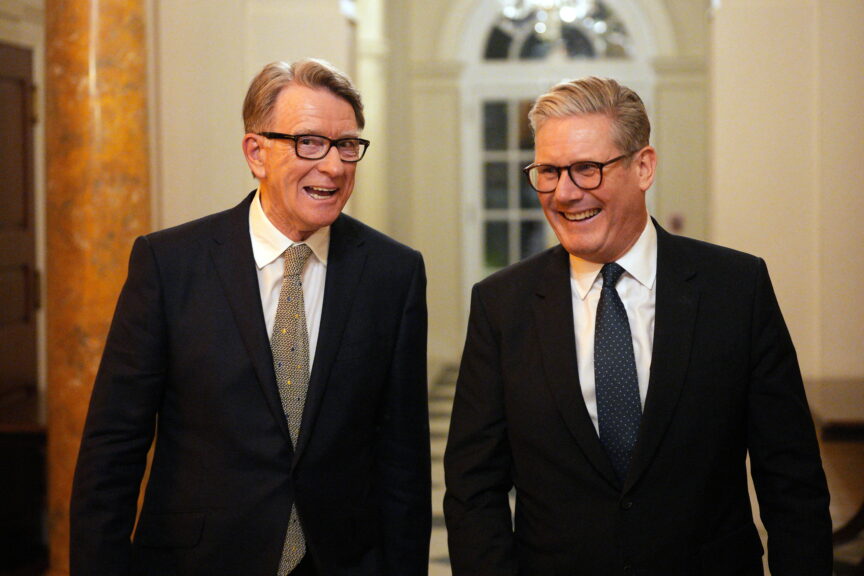
Peter Mandelson and Keir Starmer, February 2025. Carl Court/Reuters
This isn’t to suggest Starmer was some unsuspecting naif, or that he didn’t have any impact or influence over the political project he led. While Starmer had no ‘political economy’ of his own, he certainly had personal and cultural traits that coloured the project.
I’m no psychoanalyst, but it seems obvious that Starmer is a strange, complicated figure. In 2024, he told the Guardian he doesn’t dream and that he refuses to engage in any sort of introspection. When asked whether he would ever go to therapy, he answered that “I am self-aware enough not to go into side-alleys to have a chat with myself about these things”.
Starmer is moved by a steely, relentless ambition, but it’s not clear what purpose the ambition serves. When he is asked to explain his own political goals, he can only offer talking points and catch-phrases: duty, sacrifice or self-service, growth, security, making things better in some nebulous way.
It’s telling that in his current defeat there has been no lament for a political project unfulfilled, but only a brooding sulphuric anger at his betrayal and an emotional turn towards his family. If someone has political ambition but no political economy, then what are they looking to achieve, other than status and psychosocial gratification?
Yet even his own mythology of service and duty is hollow. This is a man that took £100k in freebies from corporate and millionaire donors between 2019 and 2024 – more than every Labour leader since Tony Blair combined. Before he’d come to power, Starmer had already embroiled himself in conflicts that would mean he would be unable to oversee key parts of governing without allegations of bias.
The freebie scandal reflected Starmer’s overwhelming self-regard, which led him to believe he was uniquely incorruptible. That sat alongside his lack of social intelligence, which led him to assume that millionaires and football clubs and gambling companies were giving him VIP tickets and holidays because he was a nice guy that deserved some downtime.
But Starmer’s most disturbing and consistent trait is his authoritarianism, which is one of the few enduring features of the last three decades of his career.
Following a period as a human rights lawyer, Starmer was the director of public prosecutions between 2008 and 2013. As his critical biographer Oliver Eagleton has detailed, Starmer’s tenure illustrated an abiding servitude to the security state both in the US and the UK – and a striking lack of mercy.
Take the case of Gary McKinnon, an autistic IT expert. Between 2001 and 2002, McKinnon hacked US military databases, looking for evidence of UFOs. Although he never published his findings, the breach was a major embarrassment, and US authorities sought to extradite him to face up to 70 years in prison.
It was plain McKinnon wouldn’t survive a year in prison, let alone a lifetime. His mother pleaded his case, including to Starmer, who’d refused to take steps to end his predicament, like agreeing to prosecute him in the UK so charges couldn’t be pressed in the US. When she confronted Starmer, he said he was “uncomfortable” with the discussion. “Did he have any idea how that sounded to me, when he was supporting the extradition of my son to some foreign hellhole,” she burst out. McKinnon eventually received a reprieve when his extradition was blocked by home secretary Theresa May – to which Starmer is reported to have reacted with fury.
Starmer might not have a political economy, but he certainly has a moral one. He inhabits a world where some people are deserving of attention, grace, kindness or deference. Usually this is determined by whether he thinks they are ‘proper’ people: the suit-wearers who hold zippy ‘bilats’ or who wield the sort of institutional power he alternatingly fears or valorises. These people Starmer treats with genuine warmth, care and respect – like the media class that repeatedly defends him as a ‘decent man’ because they fall within his internal Venn diagram of respectability, cultural cache and power, so they Starmer treats them decently.
But woe betide those who fall into his out-group of the contemptible. These are usually people other powerful and socially adept people think are worthy of ridicule, and will give Starmer a thumbs-up if he punches down. For this group, Starmer has nothing but disdain, or cruelty or indifference.
We know who falls into this category: leftwingers, Jeremy Corbyn and Diane Abbott, peace activists and Palestinians; those who stand up at Labour conference and demand accountability for genocide; the irresponsible idealists who refuse to put aside childish things like protest marches and human rights and justice and saving the climate in return for incrementalism, stoicism, ‘grown up’ politics, handshakes with dictators, dinner parties in Davos and accommodation with the ‘reasonable demands’ of capital. Or, more concretely, the hundreds of thousands of members he told to leave the party – and did.
Remaking a party.
In early January 2020, Starmer announced he was running for Labour leader. McSweeney had spent much of the previous months preparing to guide him to power. The result was an impressively curated and disciplined campaign of staggering mendacity.
Starmer presented himself as a radical inheritor of the Corbynite tradition, as a principled eco-socialist who wanted to nationalise rail, mail, water and energy; who wanted to tax the rich and help the poor; who promised an ethical foreign policy and a desire to review arms sales to dictatorships like Saudi Arabia. As we now know, Starmer campaign insiders were also telling multiple rightwing journalists and party insiders that it was all bunkum, a ruse designed to winkle the party out of the grip of feckless Corbynites who had driven it to electoral ruin and antisemitic torpor.
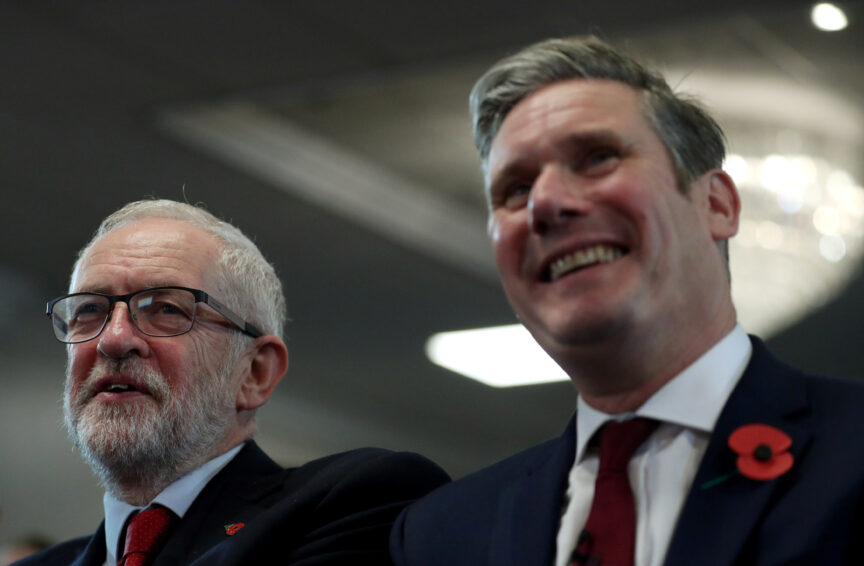
Jeremy Corbyn and Keir Starmer in 2019. Hannah McKay/Reuters
The emotional core of Starmer’s campaign was his promise to end the factional in-fighting that had made the Labour party toxic and dysfunctional during the Corbyn years. Starmer promised to bring “unity” and even published a manifesto about restoring party democracy, pledging to end the top-down imposition of candidates and fostering a culture of inclusivity.
Experience shows this was an outright lie, which succeeded because party members were voting in ignorance of what was really behind Starmer’s campaign. There was no inkling that Starmer, for example, was backed by Labour Together – because this was explicitly denied at the time by Shabana Mahmood, one of its outriders. It was only in 2023 that the think tank would brag of its centrality to Starmer’s campaign.
Starmer also failed to declare a sizable portion of his donations during the leadership period, saying he would do so according to parliamentary schedules. The public didn’t know that hedge fund millionaire Martin Taylor and the pro-Israel lobbyist Sir Trevor Chinn – who were the biggest donors to Labour Together – were also direct donors to Starmer’s campaign, as this wasn’t declared until the race was over.
McSweeney was quick to place allies throughout the party bureaucracy following Starmer’s election as leader. The most important of these was David Evans, who Starmer appointed as general secretary in May 2020. Evans was a close political ally of Reed and McSweeney: McSweeney had once worked for Evans’ political consultancy. Pesky Corbynites were slowly moved out and replaced by allies at every level of the party, allowing McSweeney to use bureaucratic force to control the party’s democratic processes.
The remaking of the party under the McSweeney and Labour Together project was supercharged in October 2020 by the conclusion of the Equality and Human Rights Commission (EHRC) investigation into how Labour under Corbyn had handled complaints of antisemitism.
Briefly, the EHRC investigation found (amongst other things) that Corbyn’s Labour party had violated equalities law because his office had “interfered” in complaints against members accused of antisemitism. In his speech accepting the EHRC report, Starmer acknowledged the finding and reiterated that “we will ensure that neither the leader, the deputy leader nor our offices will have any involvement in the outcome of complaints initiated under the Labour party processes”.
But Starmer broke this solemn vow within an hour, in response to Corbyn releasing his own statement accepting parts of the EHRC report but noting that some inside and outside of the party had exaggerated the scale of antisemitism for political gain.
As soon as Starmer finished his sonorous speech, he headed into Labour’s Southside HQ to meet with McSweeney, Angela Rayner (then deputy leader), Evans and Alex Barros-Curtis (the party’s head of legal affairs). The result of the meeting was to decide to suspend Corbyn and investigate him for antisemitism for his statement.
When all hell broke loose, Corbyn’s allies and Starmer’s people – McSweeney most notably – were tasked with negotiating a statement and settlement that would see Corbyn’s disciplinary process managed so that he was rapped on the knuckles but readmitted to the party. This was the very essence of “political interference”, the very ‘antisemitic’ crime for which Corbyn’s party had just been damned. If Starmer had cared a whit for the EHRC’s findings, he would have had nothing to do with Corbyn’s suspension or its resolution.
The news of Corbyn’s readmission infuriated the Labour right and Jewish communal groups. After he received a dressing down on the phone from a Labour grandee, Starmer decided to withdraw the whip from Corbyn. It was a straightforward betrayal: Starmer’s team had made it clear that if Corbyn released an emollient statement he would be returned to the party’s membership and the Labour benches. In the end, Corbyn was never again allowed to stand as a Labour MP.
Who can look at this mess, at this hypocrisy, this cowardice, this dishonesty, this blatant lack of care for issues of probity and the law and the very real issue of antisemitism, and believe that Starmer’s leadership was a crusade to rescue the party from moral bankruptcy?
A war on democracy.
Starmer staggered under the weight of public indifference for the first two years as Labour leader. He was slapped with the nickname “Captain Hindsight” for his stilted style and habit for shifting stances during the Covid pandemic. For months in 2021, it looked likely he would be deposed following a bruising byelection in Hartlepool, where Labour lost a seat it had held for decades to the Tories. Starmer barely survived a second byelection in Batley and Spen by just over 300 votes. I believe he only did so because the Guardian did not publish a damaging story about how the party had readmitted broadcaster Sir Trevor Phillips after his suspension for alleged Islamophobia until after the byelection was concluded, when it had been informed of the facts weeks beforehand.
With Starmer’s leadership hanging by a thread, McSweeney accelerated a long-running plan to prevent the sort of unacceptable outbreak of democracy that had allowed Corbyn to be elected as leader. At the party conference in September 2021, McSweeney and allies like rightwinger Luke Akehurst helped to pass rule changes virtually guaranteeing Labour would never again elect an outsider figure like Corbyn. Akehurst celebrated the victory on Twitter, raising a glass of wine followed by a chaser of “salty Trot tears”.
Soon Labour was issuing proscriptions and erasing the principle of natural justice from the party’s rulebook – all to facilitate the mass and immediate removal of unsavoury characters like the revered socialist filmmaker Ken Loach, or leftwing Jews, who were disproportionately investigated and expelled from the party under the new regime.
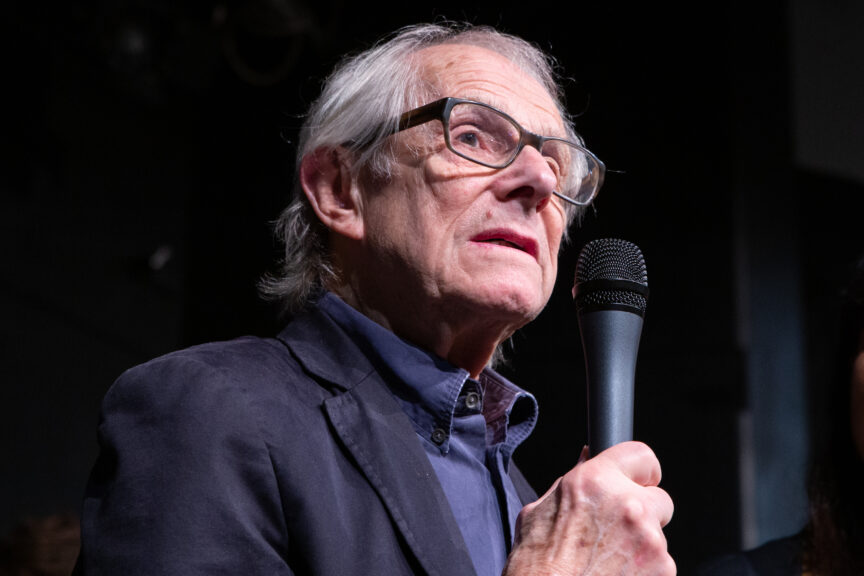
Filmmaker Ken Loach, who was kicked out of Labour for supporting others who’d been expelled. Matteo Nardone/Reuters
From early 2021, Labour party membership fell dramatically. In 2020, when Starmer took over, the party had more than 500,000 members. By the end of 2025, the membership had fallen to just over 250,000 – less than Reform. Internal party democracy was shrunk and disciplined, brought into line by repeated edicts from the general secretary’s office forbidding discussion of topics like the EHRC report, Corbyn’s suspension or Israel’s response to 7 October. A vibrant (if contentious) political habit of internal debate and dissent was snuffed out and replaced with a stultifying political monoculture.
Having hung on for two years, Starmer then benefited from a dramatic change in political winds. Boris Johnson was removed following the ‘partygate’ scandal. He was followed by the short-lived Liz Truss and then the beleaguered Rishi Sunak. By late 2022, it was clear Starmer’s Labour would form the next government.
The inevitability of a future Labour victory freed Starmer and McSweeney’s hand to radically repopulate the party’s elected representatives and to dump any pretence of leftwing policy. McSweeney sat above a system that hand-picked incoming Labour MPs. Approximately 260 of the current 400-odd Labour MPs were selected in this process, which was riven with controversy and allegations of ruthless political fixing.
A similar process played out at a local level, where long-running Labour councillors found themselves deselected. Many detected a predilection for the party to sideline or minimise BAME figures, a perception heightened by the party’s hostile and humiliating treatment of Abbott, the country’s first black female MP. Abbott would be subject to a lengthy suspension following a clumsily-worded letter to the Observer about the differences between anti-black racism and other forms of prejudice like antisemitism. Abbott immediately apologised, “wholly and unreservedly” withdrawing her remarks and citing an error in drafting for her ill-chosen wording.
Many would point out the difference between Abbott’s treatment and those of other Labour figures accused of making insensitive comments, like Reed. Reed had referred to a Jewish Tory party donor as a puppet-master in 2020, but escaped suspension when he issued exactly the same sort of apology as Abbott.
When pressed on the topic, Starmer would straightforwardly lie, claiming that the matter was still under investigation. In fact, Abbott’s party disciplinary process had concluded shortly after she agreed to take mandatory training on antisemitism. The party nevertheless failed to return her to membership or the whip. Abbott only achieved both when she finally broke ranks to inform the media of the truth of her situation.
She was re-suspended a year later, and deprived of the whip, when she gave an interview with the BBC in which she defended the original point she had tried to make. “I just think that it’s silly to try and claim that racism which is about skin colour is the same as other types of racism,” Abbott explained.
Abbott’s treatment was cruel, but it was not without reason. The performative disciplining of the likes of Corbyn and Abbott formed one plank of convincing the more conservative voters Labour was targeting that Starmer had remade the party. The other was the adoption of policies that increasingly came to shadow the Tories on topics like immigration, defence, law and order and public protest.
These moves uniformly appalled the progressive left. But McSweeney, backed with polling and reporting produced by Labour Together, could argue Labour faced no serious electoral consequences for doing so. With nowhere to go and the Tories loathed, progressive voters would stick with the Labour party come what may.
But then: Gaza. In October 2023, Hamas launched a devastating, violent assault on Israel, committing war crimes and taking hundreds of hostages. In return, Israel turned Gaza into hell on earth. Within a year, life expectancy in the Strip collapsed by 30 years. The public watched, horrified, as Israeli bombardments eviscerated the bodies of Palestinian men, women and children.
Starmer’s immediate response was to give Israel wholehearted support, even as it swiftly became clear that Israeli anger would only be sated by paroxysms of violence. He famously claimed that Israel had the “right” to shut off water, food, fuel and electricity to Gaza, after which he disappeared from public view. When he re-emerged, it was to explain that he didn’t mean what he’d said, which he then denied he had even said. Even so, Starmer refused to countenance talk of ceasefire for months, and then resisted the imposition of any meaningful restraints on Israel.
The effect was two-fold. The first was that Starmer, alongside the British establishment, gave cover and support as Israel set about destroying Gaza. The second was that disillusionment from leftwingers with Labour soon started taking nascent, electoral shape in the emergence of Gaza independents and, increasingly, defection to the Greens.
The loveless landslide.
On 4 July 2024, Starmer swept to power on the back of an overwhelming parliamentary majority: 411 Labour MPs were returned, only seven shy of Tony Blair’s 1997 landslide.
But that’s where the similarities ended. Blair, a genuinely popular politician, came to power on the back of a groundswell of popular optimism and support. Starmer was elected without any great enthusiasm, benefiting from a historic collapse in Conservative support and low voter turnout. In one YouGov poll following the 2024 general election, respondents were asked to explain why they had voted Labour. 34% said their main motivation was to get the Tories out. A measly 2% said because they “trusted/liked Keir Starmer”.
Despite appearances, Labour’s power was brittle. It had commanded the votes of only 20% of the UK’s eligible voting population, while sometimes only barely seeing off challenges from Gaza independents. Labour’s war on its own left, and particularly its brutal attacks on local government, had disconnected the party’s elite corps from its grassroots.
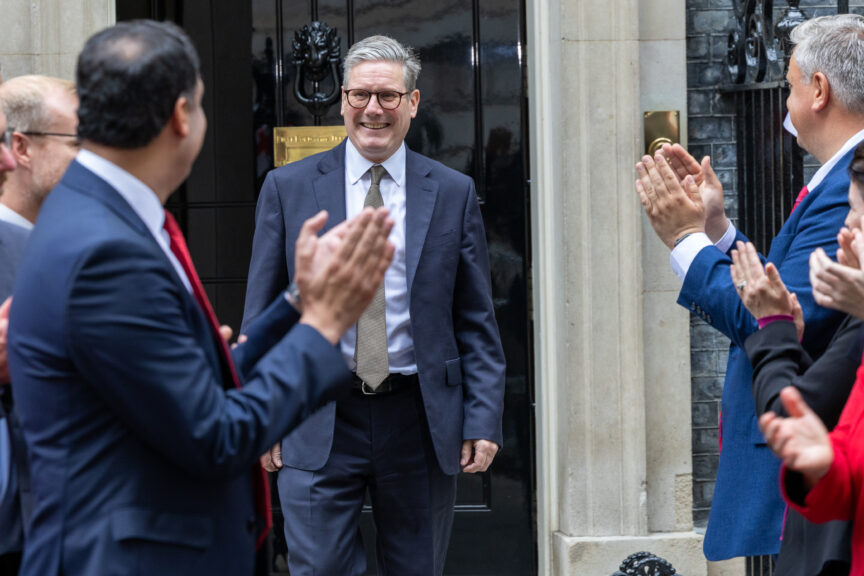
Keir Starmer emerges from No. 10 following his general election victory, July 2024. Phil Lewis/Reuters
It was nevertheless a total victory for the Labour Together project and the small, rightwing faction it represented. Starmer’s cabinet and its most senior offices were dominated by the figures who had cohered around McSweeney and his think tank in 2018 and 2019: Reeves, Reed, Streeting, Mahmood. Labour Together had funded the campaigns of over 100 incoming MPs, and was tasked with writing policy, like Digital ID, which would get preferential treatment and accelerated implementation by the Starmer government.
Within months of taking office, Starmer’s first chief of staff – Sue Gray – fell victim to an ugly briefing campaign. She was replaced by McSweeney, who had won himself extraordinary power and influence to shape the tone, policies and decisions of Starmer’s government. And herein lay the roots of Starmer’s downfall: the success of the Labour Together project also meant the long-term dominance of McSweeney’s cynical, knee-jerk political methodology.
McSweeney’s imprint on party policy and electoral strategy, and Starmer’s total fealty to the approach, almost guaranteed public disaffection. Labour’s 2024 electoral strategy echoed the con-job of 2020, as the party presented a manifesto and policy prospectus that would bear no relation to how it governed. Like the party membership before it, it didn’t take long for the public to realise they’d been sold a pup.
The story of the collapse in Starmer’s popularity is both well-known and easy to understand. Cutting winter fuel allowance, slashing disability benefits, refusing to scrap the two-child benefit cap that plunged families and children into poverty for a year and removing the whip from MPs who tried to push for it: these all shattered any residual illusions that Labour would deliver an end to austerity – no matter the later U-turns. Set alongside the freebie scandal, Starmer sent the message that he, like the Tories, was willing to administer harsh medicine that he would never swallow himself.
An embrace of anti-immigrant policies, an abandonment of trans rights, speeches like the “island of strangers”, continuity on Gaza – all communicated to large parts of Labour’s left-leaning electoral coalition that the party had been captured, neutered and corrupted. This wasn’t wrong.
In the face of an angry, disillusioned public, Starmer embraced authoritarianism, launching unprecedented attacks on basic civil liberties. Newly passed laws now give the police the power to restrict protests based on “cumulative disruption”, which has plainly been written to curtail the anti-genocide and pro-Palestine protests that have become a feature of UK life.
The proscription of Palestine Action as a terrorist organisation caused widespread fury, and a campaign of intentional defiance has guaranteed that the public frequently witnesses the arrest of pensioners and priests for holding up signs. Legal practitioners have been disturbed by the decision to scrap jury trials for all but the most serious offences.
It’s telling that, in its last few weeks in power, Starmer’s government has fast-tracked laws experts believe will have a seriously constraining effect on the ability of the media to report on places like Iran and Gaza, and for humanitarian agencies to work around the world – all under the unconvincing guise of a national security emergency.
It was McSweeney, in the end, who emerged as the driving force behind the appointment of Peter Mandelson despite the already damning evidence of Mandelson’s relationship with the sex offender Jeffrey Epstein. That decision and Starmer’s panicked, feckless reaction to its unravelling was central in convincing a previously credulous media his abstemious personal mode concealed a darker and grubbier operation behind the scenes.
That scandal intermingled with a further Labour Together scandal. In February this year, it was revealed that in 2024, the think tank had hired reputation management firm APCO to investigate and produce materials that would “proactively undermine” journalistic inquiries into McSweeney’s unlawful failure to report donations between 2018 and 2020. I was one of the victims of this investigation, which also targeted my family, colleagues and associates.
The APCO scandal led to the resignation of Josh Simons from a junior ministerial role in charge of overseeing the introduction of digital ID. Simons had directed Labour Together at the time of APCO’s appointment. It was Simons and his chief of staff who reported me, my family and my colleagues to the UK’s security services on the risible suggestion of supposed links to Russian intelligence. Newly revealed documents show senior Labour figures, McSweeney included, had been kept abreast of APCO’s investigation.
Not long after, Simons would stand down as the MP for Makerfield to clear the way for the return of Andy Burnham to Westminster. McSweeney’s scandalous past had, quite literally, created the conditions for Starmer’s humiliating displacement.
But what sealed the deal for Starmer was more hard-nosed: the left had cohered itself into viable electoral vehicles that ran to the left of Labour. Zack Polanski, elected leader of the Green party in 2025 on a promise of uncompromising eco-populism, rapidly stitched together a coalition of voters who were appalled by Labour’s rightwing, accommodationist turn and its complicity in Israeli war crimes. In May 2026, this coalition precipitated Labour’s worst ever return in local elections. The Greens won hundreds of seats from the party, and took over councils Labour had run, virtually unchallenged, for close to two decades.
Many Green councillors and council leaders elected in May 2026 were historical victims of Starmer and McSweeney’s purges; many of the Green party’s membership and campaigning army were likewise drawn from the hundreds of thousands of ex-Labour members who had fled Starmer’s authoritarian, sneering, hyper-factional administration. Through intransigence and obsessive factionalism, Starmer and McSweeney had engineered their own defeat – and the revenge of the left.
From Novara Media via This RSS Feed.