

A thrilling 2-1 semifinal turnaround pushes the Albiceleste, as it’s called the Argentina’s team, to the World Cup final while challenging Northern media narratives.
The semifinal match of the FIFA World Cup 2026 between England and Argentina was far more than a football contest. The fixture marked a modern chapter in a long-standing geopolitical rivalry, and on July 15, Argentina secured a 2-1 victory over the English squad.
RELATED: Argentina Defies FIFA Ban with Malvinas Claim After World Cup Semifinal Win
Matches between Argentina and England serve as a symbolic stage where post-colonial tensions and national sovereignty are actively contested.
So, the reactions before, during, and after this semifinal demonstrated that football remains a powerful vehicle for cultural resistance and national memory, particularly for nations like Argentina that have historically resisted British imperial influence.
Pre-Match Narratives
In the days leading up to the semifinal in Atlanta, mainstream British media outlets emphasized themes of tactical modernization, organizational discipline, and athletic professionalism.
Commentators, such as Jamie O’Hara, Wayne Rooney, and Ian Wright, characterized Argentina’s style as temperamental, volatile, and overly reliant on emotional intensity rather than systemic organization.
On the other hand, commentators positioned England as the representative of structured, rational European football, while often relying on subtle, patronizing tropes when describing the Argentine squad.
This dichotomy of the “rational European” versus the “emotional South American” is a recurring motif in hegemonic media coverage, serving to devalue the tactical sophistication of Latin American teams.
Furthermore, English media avoided addressing the historical scars associated with the Malvinas War of 1982 or the history of British economic intervention in South America.
By reducing these deep-seated historical grievances to mere “banter” or “ancient history,” the media attempted to neutralize the legitimate political consciousness of the Argentine players and fans.
Ver esta publicación en Instagram
Una publicación compartida de teleSUR English (@telesurenglish)
A Contrast of Footballing Philosophies
The semifinal on July 15, put two distinct sporting and developmental philosophies on display before a crowd of over 70,000 spectators in Atlanta, United States.
The English national team, built largely around the highly structured of the Premier League, established early dominance through disciplined positioning and possession.
This systematic approach of the British team, at the 55th minute when winger Anthony Gordon scored, putting England ahead 1-0. For much of the second half, the English side managed to neutralize Argentine attacks. However, the final ten minutes of the match highlighted the fluid, high-pressing style that characterizes South American football, a system deeply rooted in the informal, working-class neighborhood clubs.
Argentina’s technical staff adjusted their formation, allowing Lionel Messi to operate in a free-roaming playmaker role. In the 85th minute, Messi delivered a precise assist to midfielder Enzo Fernández, who equalized with a powerful strike.
In stoppage time, at the 90+2-minute mark, another buildup directed by Messi allowed striker Lautaro Martínez to score the decisive second goal. This tactical turnaround demonstrated how individual creativity and collective resilience can disrupt highly organized, corporate-style defensive systems.
The Players’ Post-Match Gesture and FIFA’s Regulations
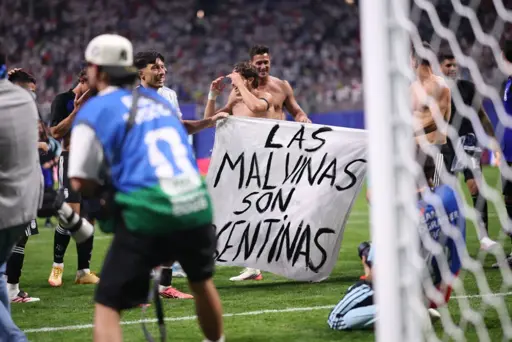
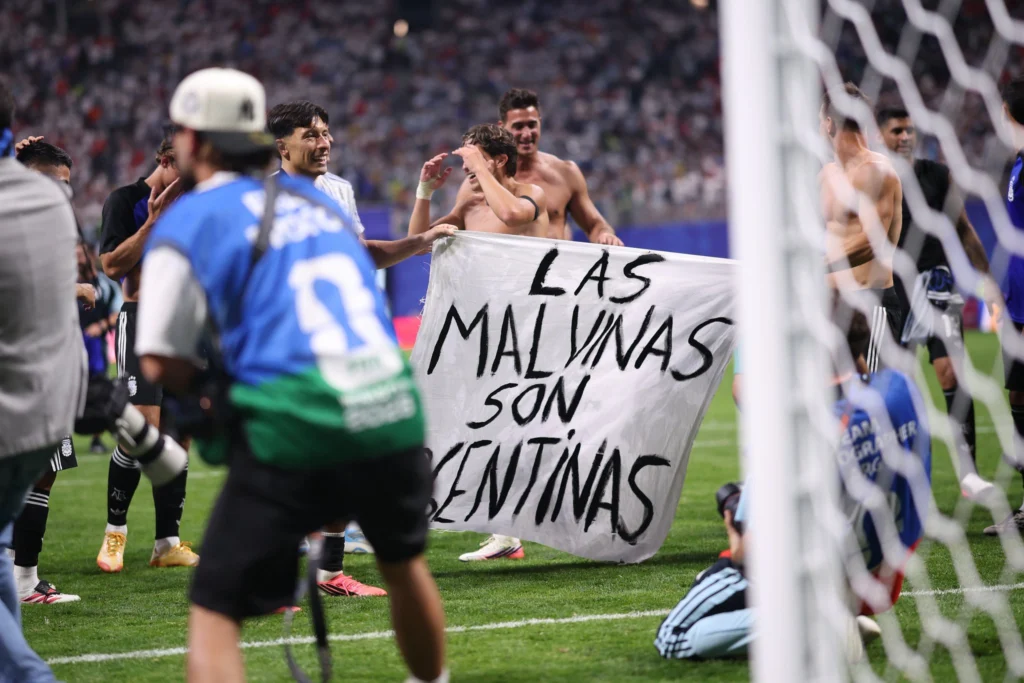
Immediately following the final whistle, the celebrations on the pitch transitioned from athletic joy to historical commemoration. Argentine defenders Lisandro Martínez and Giovani Lo Celso displayed a banner reading “Malvinas are Argentine” to the thousands of fans in the stands.
The gesture went viral on social media platforms, shifting the global conversation from sporting statistics to post-colonial geopolitics. This action immediately ran afoul of international sports governance. FIFA maintains strict regulations regarding political expressions during sanctioned tournaments.
FIFA and the International Football Association Board (IFAB) explicitly prohibit any kind of political, ideological, or religious slogan, motto, or demonstration on the field of play. Article 34.3 of the World Cup regulations stipulates that players may not display such messages before, during, or after matches.
Some sports analysts argue that this enforcement of neutrality is itself a political decision designed to protect the financial interests of Western-dominated sports conglomerates.
The actions of Martínez and Lo Celso demonstrated how high-profile athletes can use their global platforms to bypass institutional censorship, reclaiming the sporting arena as a space for historical memory and national dignity.
Argentina’s players held up a banner reading “Las Malvinas son Argentinas” (“The Malvinas are Argentine”) after their 2–1 victory over England in the World Cup semi-final on Wednesday, in an apparent breach of FIFA rules prohibiting political messages inside stadiums.
The match… pic.twitter.com/8QxOVl6dFh
— TRT World (@trtworld) July 16, 2026
The Reaction of the Media and the People
In the post-match reaction to Argentina’s victory in the United Kingdom, several mainstream outlets focused heavily on the political nature of the post-match celebrations.
Major British newspapers and broadcasters expressed concern over the “Malvinas are Argentinean” banner (“Las Malvinas Son Argentinas”, in Spanish) displayed by Lisandro Martínez and Giovani Lo Celso, characterizing the gesture as an unnecessary provocation that breached FIFA’s neutrality guidelines, and demanding regulatory action against the Argentine Football Association (AFA).
This reaction contrasted sharply with the response in South America. Across Argentina, thousands of citizens gathered in public squares, such as the historic Plaza de Mayo and around the Obelisco, to celebrate the semifinal victory.
Grassroots fans of the Argentina team viewed the players’ actions as a legitimate expression of historical memory rather than a rules violation. This perspective argues that forcing players to ignore historical wounds under the guise of “fair play” is an ideological choice that serves to protect the comfort of dominant nations at the expense of historical truth.
#buenosaires after #argentina victory
#worldcupcelebration pic.twitter.com/z9zpT2W4tg
— casmil Oduor (@casmil_oduor) July 16, 2026
Decolonizing the Pitch and the Path to the Final
Ultimately, the 2026 World Cup semifinal between England and Argentina demonstrated that soccer remains an active arena for cultural and political expression.
Argentina’s late comeback, sealed by goals from Enzo Fernández and Lautaro Martínez in the 85th and 92nd minutes, showed that the emotional and tactical legacy of South American soccer remains highly resilient against structured corporate models.
With this victory, Argentina advances to face Spain in the World Cup Final on Sunday, July 19, at the New York New Jersey Stadium.
Meanwhile, England is scheduled to face France in the third-place play-off in Miami. Regardless of the final outcome of the tournament, the geopolitical undercurrents of the Atlanta semifinal confirm that soccer is far more than a commercial product.
The match proved that as long as the historical legacies of colonialism remain unresolved, the soccer pitch will continue to serve as a space where marginalized narratives can challenge established global hierarchies.
Sources: BBC – Sports Illustrated – El País – Al Jazeera – teleSUR – FIFA – Diario As
From teleSUR English via This RSS Feed.