

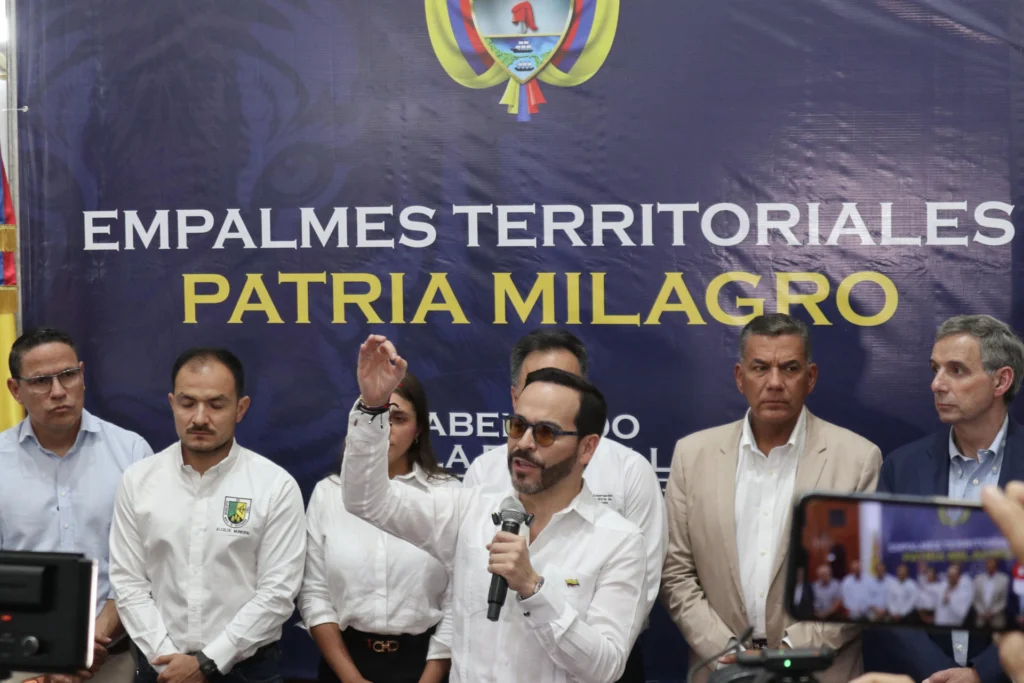
Colombia’s Peace Implementation Unit filed a criminal complaint today against president-elect Abelardo de la Espriella for aggravated harassment and incitement to crime, accusing him of targeting former FARC combatants protected under the 2016 peace agreement.
The complaint, presented before the Attorney General’s Office by director Gloria Cuartas, specifically cites remarks in which De la Espriella described former Revolutionary Armed Forces of Colombia (FARC) leader Rodrigo Londoño as a “war criminal who deserves to be behind bars for life.”
Cuartas argued that such statements exceed the boundaries of free expression, promote open hostility against a collective protected by the Colombian state, and exert illegal institutional pressure on the Special Jurisdiction for Peace (JEP, in Spanish), the autonomous tribunal established to judge crimes committed during the armed conflict.
RELATED: Colombia to Eliminate Peace Commissioner Position
The legal action identifies three potential criminal offenses: aggravated harassment, defamation and incitement to commit crimes. Cuartas warned that the repeated calls for imprisonment and dismantling of peace institutions create a concrete risk of violence against the 13,000 ex-combatants who demobilized under the historic accord. The complaint asserts that the President-elect’s rhetoric, amplified by his incoming executive authority, constitutes a direct threat to the physical and psychological integrity of all signatories.
Since the signing of the peace agreement in 2016, at least 492 former combatants have been assassinated across Colombia, many in rural territories where state presence remains weak. Human Rights organizations have documented a pattern of targeted killings against community leaders and peace signatories, a situation that the complaint argues is exacerbated by inflammatory official discourse.
Nosotros estamos firmes por la paz con justicia social y estamos siendo víctimas de una campaña de desprestigio y estigmatización.
No nos vamos a devolver a la guerra.
Quienes nos agreden no conocen de la convicción de la que estamos hechos.
Organización y lucha por la paz. pic.twitter.com/Z7uTJVFY3z
— Rodrigo Londoño (@TimoComunes) July 15, 2026
Text reads: “We are firm for peace with social justice and are being victims of a campaign of disrepute and stigmatization. We’re not going back to war. Those who assail us do not know the conviction we are made of. Organizing and fighting for peace.”
Peace Dismantling Begins
Beyond the verbal confrontations, the incoming administration has already initiated concrete steps to dismantle the peace architecture. De la Espriella’s team announced the elimination of the Presidential Council for Dialogue and its replacement with a security commissioner. Simultaneously, the president-elect proposed a constitutional reform to dissolve the Special Jurisdiction for Peace entirely, though the measure faces an uphill battle in a divided Congress where the ruling party holds a minority representation.
In response, Londoño and six other historical leaders of the former FARC secretariat sent an official letter to De la Espriella reaffirming their commitment to the peace process and requesting the opening of a direct dialogue channel. The letter seeks to establish communication lines before the president-elect takes office on August 7, in an attempt to de-escalate the growing tension.
The Peace Implementation Unit also issued an institutional statement warning that the dismantlement announcements generate an atmosphere of uncertainty and direct risks for the signatories. The institution reminded the incoming government that the peace accord possesses reinforced legal protection through Legislative Act 02 of 2017, a constitutional amendment that compels the Colombian state to fulfill its commitments in good faith and expressly prohibits any institutional regression or administrative decision that empties the agreement’s content of meaning.
The office emphasized that the institutional architecture built over the past decade has allowed Colombia to confront impunity, inequality, and social exclusion in the most affected territories. The current Framework Implementation Plan contains 593 active commitments distributed across more than 60 national entities, representing a complex web of obligations that cannot be simply dismantled by executive decree.
Faced with this situation, the Peace Implementation Unit formally requested the Constitutional Court to maintain judicial oversight to safeguard peace institutions against pressure from the incoming Executive Branch. The court’s intervention could provide a legal shield to prevent the new administration from unilaterally dismantling the transitional justice system and rural reform programs that form the backbone of Colombia’s peace process.
From teleSUR English via This RSS Feed.