

A devastating double earthquake hit Venezuela on June 24, leaving a trail of destruction and thousands dead. Dozens of buildings collapsed in coastal La Guaira State, the worst affected in the South American country.
The natural disaster followed two unnatural catastrophes: a decade-plus of US-led economic sanctions, and the January 3 US bombing attack and kidnapping of President Nicolás Maduro.
But rather than sympathize with the beleaguered country, the Western media establishment seized the opportunity to continue demonizing the Bolivarian Revolution—while whitewashing Washington’s economic terrorism and its present efforts to tighten its semi-colonial stranglehold on the country (FAIR.org, 2/27/26).
An assault on public housing
The ground had barely stopped shaking when corporate media oligopolies took aim at one of the most visible pillars of Hugo Chávez’s legacy: Venezuela’s Great Housing Mission (GMVV).
A Washington Post headline (6/27/26) declared: “These Homes Rose out of Venezuela’s Socialist Revolution. Now They’re Rubble.”
An architect was quoted claiming that the damaged apartments had been “constructed hastily” to “meet a political deadline.” Though the Post claimed Chávez launched the housing program to secure votes for the 2012 election, the only beneficiary the paper could find received her home in 2014.
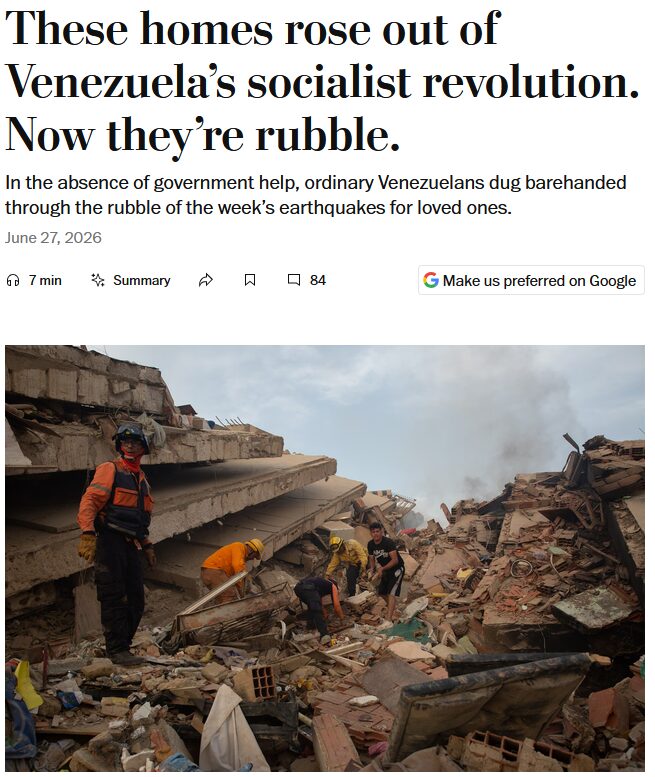
The Washington Post (6/27/26) blames the disaster on “mismanagement by the socialist government” and “government lapses…evident long before the worst of the economic crisis.”
AFP (6/29/26) singled out damage to a GMVV complex—“once touted as part of former strongman leader Hugo Chavez’s flagship housing program”—arguing that it “symbolize[d] the country’s dire situation.” Dozens of buildings geared toward tourism, including hotels and high-rises built for short-term rentals, in this neighborhood of Catia La Mar, were also flattened by the devastating tremors, but AFP made no effort to provide that context.
The New York Times (7/5/26) likewise attempted to besmirch what is one of the most ambitious public housing projects worldwide by repeating the unfounded claim that homes were assigned as a “reward for loyalty to Mr. Chávez.” However, the paper of record at least admitted that “Misión Vivienda buildings are far from the only apartments to have fallen.”
The Wall Street Journal (6/28/26) could not hide its elitism in describing how Chávez “rushed to provide apartments to the poor” in a town “beloved by the rich,” with a golf course and a “marina for yachts.” It went further by promoting a social media hoax that styrofoam found in damaged buildings meant that the housing mission used absurdly unsuitable materials in its construction. In reality, expanded polystyrene (EPS) foam is widely used to lighten the load on structures and for thermal insulation, a key factor in such a hot climate.
Venezuelan officials have called for a review of the collapsed structures and building codes, though they have claimed that the public housing buildings fared better than their privately constructed neighbors.
There is little evidence to suggest that GMVV buildings suffered a worse fate than their private sector counterparts. According to the open-source tool Terremoto Venezuela, only 11 out of 258 buildings reported as collapsed (“daño total”) belong to the housing mission.
The definitive figures will need to be put in perspective to see whether affected buildings and non-complicity with existing codes were prevalent in the GMVV developments or the recent tourist-driven real estate boom in La Guaira. But the media establishment immediately jumped to its politically motivated verdict before any thorough investigation had been conducted.
Whitewashing sanctions
While multiple outlets stressed that it is necessary to scrutinize whether authorities enforced the appropriate regulations in what is known to be vulnerable terrain (France 24, 6/29/26; Reuters, 6/29/26), no evaluation of the Venezuelan state’s record is accurate if it ignores the wide-reaching sanctions regime imposed by Washington.
Yet many Western journalists completely overlooked sanctions in their coverage of the earthquakes and the Venezuelan state’s capacity to respond to a natural catastrophe.
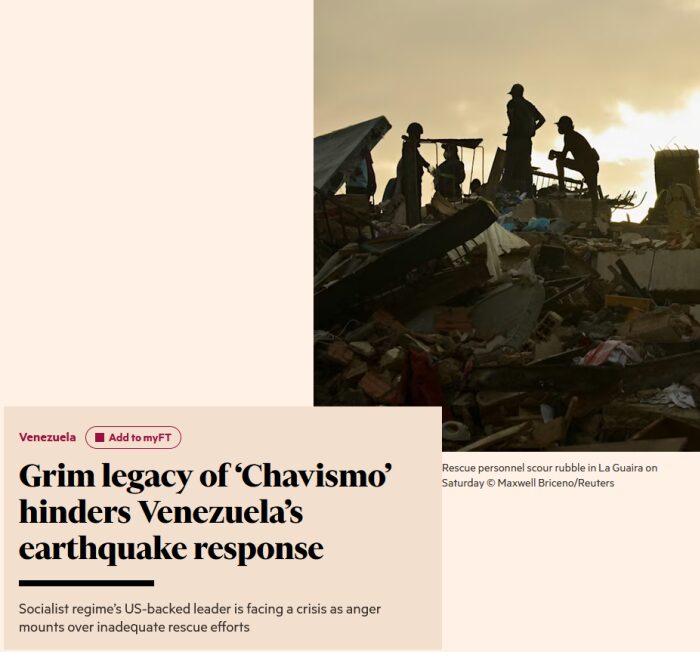
For the Financial Times (6/28/26), it was the “grim legacy of ‘Chavismo’”—and not the fact that the United States has stolen the revenues from Venezuela’s main export—that has hindered the earthquake response.
Corporate outlets like the Financial Times (6/28/26) wasted no time in proclaiming that the “legacy of ‘Chavismo’ hinder[ed] Venezuela’s earthquake response,” while AP (7/3/26) decreed that the government’s response was “slow” and the BBC (6/29/26) claimed survivors were “left to fend for themselves.”
None saw fit to even mention that Venezuela has been under economic coercive measures for years. NBC (6/25/26) avoided the kneejerk verdicts and offered lots of testimony on the natural disaster, but when concluding that “Venezuela already faced economic challenges and poverty,” chose not to name sanctions as a key economic challenge and poverty factor.
In other reports, the whitewashing of sanctions was more subtle. The Guardian (7/3/26) attributed the government’s “sluggish response” to “years of corruption, economic mismanagement and investment in political repression and domestic security rather than emergency services and healthcare.” As almost an afterthought, it added that sanctions “have further enfeebled the Venezuelan state.” The Washington Post‘s anti-public housing article (6/27/26) called Venezuela’s economic collapse “the result of mismanagement by the socialist government exacerbated by US-imposed economic sanctions.”
The New York Times (7/4/26) wrote that “Venezuela’s fragile infrastructure—including rail, electricity and healthcare systems that have suffered from years of corruption and mismanagement.” In a later section it added, “Venezuela is reeling from years of economic turmoil and crippling US sanctions.”
Over the years, Western media have pulled all the stops to legitimize Washington’s hybrid war on Caracas and conceal the murderous impact of sanctions (FAIR.org, 6/4/21, 6/13/22). There is no shortage of documentation on how these coercive measures represented collective punishment (CEPR, 4/25/19). In an extensive 2021 report, UN rapporteur Alena Douhan thoroughly discussed the impact of sanctions on Venezuelan public services and infrastructure.
The current framing of earthquake coverage aims to separate US sanctions as much as possible from their direct consequences. Rail, electricity and healthcare systems became much more “fragile” because sanctions blocked the Venezuelan government from servicing equipment and importing spare parts, not to mention brain drain resulting from mass migration of qualified personnel largely trained in public universities. Similarly, the “economic turmoil” is a result of US sanctions, not a parallel phenomenon.
Indeed, economist Francisco Rodríguez, senior research fellow at the Center for Economic and Policy Research, dismisses arguments that the bulk of Venezuela’s economic decline preceded sanctions (CEPR, 5/19/26). Instead, the rate of GDP contraction nearly quadrupled following the US imposition of unilateral coercive measures in 2017.
And the need to conjure elaborate intermediation schemes in order to circumvent sanctions opened more avenues for corruption. To present the latter as an issue that uniquely and disproportionately plagues a government facing an economic blockade is disingenuous, to say the least.
Ignoring the semi-colonial straitjacket
In their recent coverage, most corporate media sources were quick to decree that the Venezuelan government’s response was “slow” (Financial Times, 6/27/26; Guardian, 6/29/26), “inadequate” (Reuters, 7/5/26), “faltering” (AP, 7/1/26) or “completely ineffective” (PBS, 7/2/26).
It is understandable that ordinary people would not sing the government’s praises after losing a relative or while looking for one trapped under rubble. But journalists have a responsibility to add context. In this case, a significant mitigating circumstance is that the tremors heavily hit the local authorities, which run civil protection and other services.
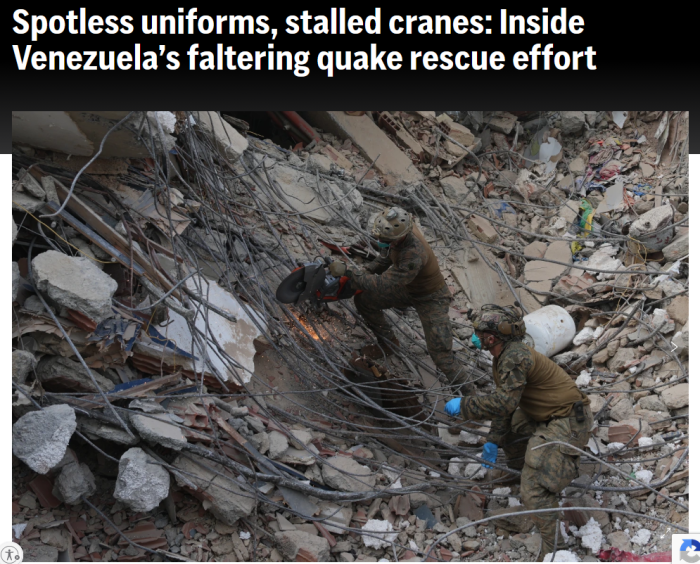
This AP article (7/1/26) reports that “the dismal response is linked to the huge numbers of people who have left the public sector because of extremely low pay”—but the words “sanctions” and “Trump” don’t appear anywhere in the piece.
Acting President Delcy Rodríguez stated that nearly all the directors from the La Guaira regional government were lost in the tragedy. Coupled with a collapse of communications, this added more hurdles for response efforts.
Another overlooked element is just how rare and deadly this double earthquake was. The New York Times was a notable exception, with a thorough piece (7/3/26) explaining how the disaster unfolded and why it caused so much destruction.
But the most relevant element to understand Venezuela’s present constraints is, once again, the role played by the US government. Just like with sanctions, corporate news outlets whitewashed Washington’s current semi-colonial impositions on the South American nation.
Since the January 3 attacks, the Trump administration has seized control of Venezuelan export revenues, particularly from oil sales (Venezuelanalysis, 2/20/26). Secretary of State Marco Rubio stated that the Venezuelan government would need to submit a “budget request” to access its own funds held by the US Treasury (Venezuelanalysis, 1/29/26). Neither US nor Venezuelan authorities have offered any transparent information on the amounts collected and disbursed, including Washington’s intermediation fees.
Trump is not known for precision in his statements, but he has not been shy in boasting that the cost of the January 3 military operation has been paid “many times over” from oil profits (New York Times, 6/29/26; Guardian, 6/28/26; Al Jazeera, 6/24/26). While there is no information to verify the claims, economist Francisco Rodríguez, analyzing Venezuelan Central Bank data, concluded that there is at least a significant delay in the US disbursement of Venezuelan funds back to the country (Banca y Negocios, 6/22/26). The suspicious lack of transparency has even drawn questions from traditional foreign policy paladins like the Council on Foreign Relations.
With few exceptions (Reuters, 7/1/26; AP, 7/3/26; New York Times, 7/6/26), this key, semi-colonial constraint on the Venezuelan state is completely overlooked. Even worse, some outlets mistakenly stated that the White House has “lifted” or authorized “relaxation” of sanctions (PBS, 7/2/26; Financial Times, 6/27/26). Actually it has only issued licenses for select Western corporations, and with the condition that proceeds be deposited in the US Treasury account. Following the recent natural disaster, the Trump administration issued a four-month waiver allowing earthquake relief-related transactions, but left all restrictions and asset freezes in place (Venezuelanalysis, 6/26/26).
Another ominous development has been the US forces’ takeover of operations at the Simón Bolívar International Airport, the country’s main air hub, and the La Guaira port. Despite regular Southern Command press releases, and even photographic evidence, the media establishment has paid little attention to this serious (further) encroachment on Venezuelan sovereignty.
The outlook is bleak for Venezuela, with this tragedy likely to increase dependency and semi-colonial plundering. But there is room for hope. The limits of US power are being exposed all over the world, and resorting to more and more violence will not stem this inevitable decline. Peoples in the Global South, including in Venezuela, will eventually (re)take control of their destinies. But they know that the corporate press barons are no allies in this struggle.
Source: FAIR
The post Neo-Colonial Coverage of Venezuela Earthquakes Adds Insult to Injury appeared first on Venezuelanalysis.
From Venezuelanalysis via This RSS Feed.