


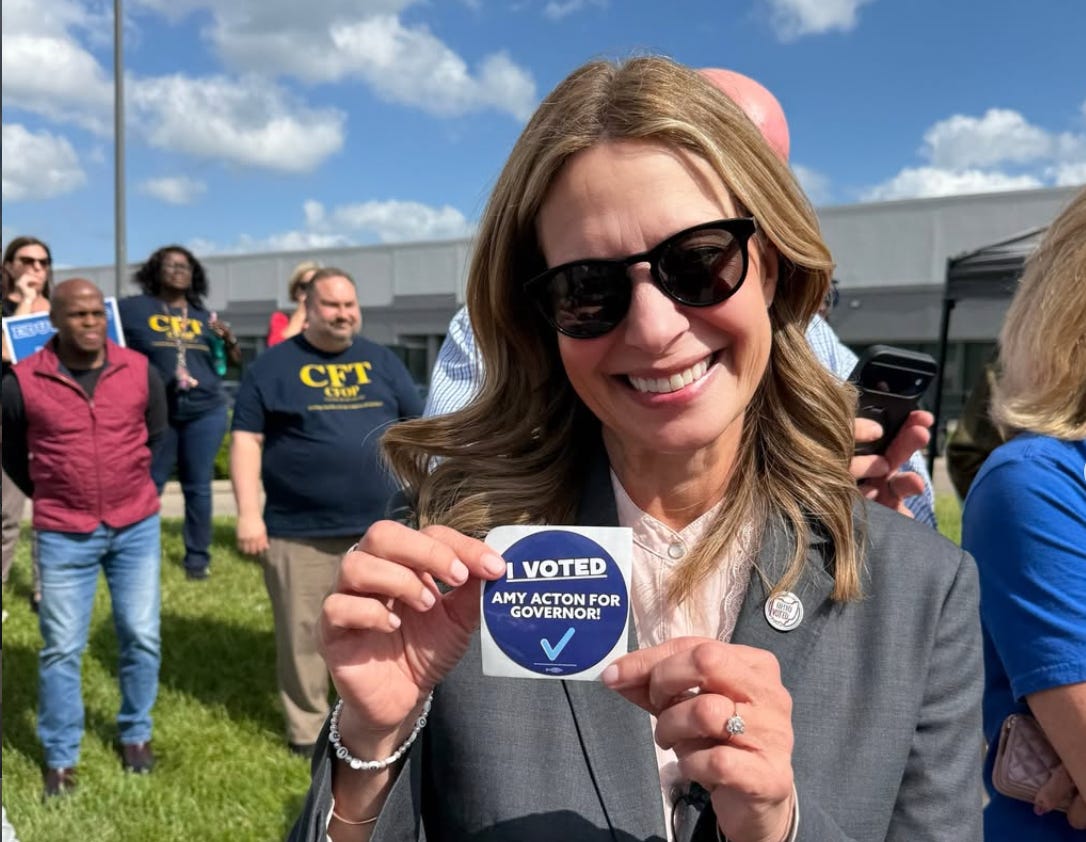
Amy Acton For Governor Instagram Account
Erin In The Morning is a reader-supported publication. To receive new posts and support my work, consider becoming a subscriber.
A growing uproar is consuming the Democratic Party after Ohio gubernatorial candidate Amy Acton, locked in a dead heat with Vivek Ramaswamy, took her turn at anti-transgender politics. In the wake of the Supreme Court’s ruling that Title IX does not protect transgender people—a sweeping victory for the conservatives who have spent years engineering it—Acton was asked for her thoughts by a local newspaper, the Toledo Blade. She could have offered boilerplate responses or defended transgender kids. Instead, Acton embraced the ban, casting it as a matter of safety and vowing to enforce Ohio’s “settled law.” The fallout was swift: Democratic equality groups posted, then quietly deleted, criticisms of their own nominee, an intra-party rupture that now threatens the race itself—a pointless own-goal by a Democrat who apparently bought the idea that attacking her own most vulnerable constituents is how you win an election.
“I do not support boys playing in girls sports. This is already settled law in Ohio, and as governor I will enforce and uphold the law,” Dr. Acton said in a response to the Toledo Blade after the Supreme Court decision. “As a doctor, public servant, and a mom, I will always stand up for fairness and protect kids’ health and safety… While my opponent tries to divide us, I’m laser-focused on issues that matter most to Ohioans: lowering costs, cracking down on corruption, and cutting taxes for working families.”
Acton’s response was quickly seen for its anti-trans sentiment. Ohio is home to some of the most extreme anti-trans laws in the United States, pushed by the same organizations whose attorneys defended trans sports bans at the Supreme Court. In 2024, the Republican supermajority overrode Governor Mike DeWine’s veto to enact House Bill 68, which simultaneously banned gender-affirming care for trans youth and barred trans kids from school sports from kindergarten through college. Months later, legislators slipped a bathroom ban into an unrelated college-credit bill. The resulting law forces trans students out of bathrooms matching their gender identity at every school in the state—including private colleges like Antioch, where more than 80 percent of students identify as LGBTQ+. Trans Ohioans now risk their education, their healthcare, and their safety simply by existing in public.
The statement drew swift condemnation from Democrats across the state. The Ohio Democrats Progressive Caucus, an official advisory arm of the state party, issued a blistering rebuke: “ZERO Ohioans have become better able to buy groceries by keeping child sport players away from their favorite sport. Our hearts break for those kids. Those who disagree with that will never vote—let alone doorknock—for Amy Acton.” The caucus warned that its members were less willing to volunteer for her campaign "not out of malice, but out of the bad feeling in our chests.” The party’s Pride Caucus answered Acton’s framing directly: “There are no boys in girls’ sports. Trans girls are girls.” Maria Bruno, executive director of Ohioans Against Extremism, called it “frustrating to see an otherwise strong candidate take the bait by trying to triangulate a response rather than just being frank: can we please just leave trans kids alone and get back to talking about how we can make life more affordable for Ohioans?” And in The Buckeye Flame, writer NV Gay put it plainly: “On the last day of Pride month, the transgender community of Ohio was betrayed—all for the sake of winning an election.” But the condemnation itself became a controversy. The Progressive Caucus’s post vanished from the group’s Facebook page. The caucus has not responded to questions about why—leaving Ohio Democrats to wonder who, exactly, wanted the warning unsaid.
The candidate’s statement is all the more puzzling given recent elections. In Virginia, Abigail Spanberger had every opportunity to throw transgender people under the bus with similar statements and never took the bait—even as Republicans poured millions into anti-trans attack ads, with more than half of all GOP ad spending in the race devoted to the issue. Spanberger won by more than 15 points and Democrats flipped 13 House of Delegates seats, transforming a razor-thin 51–49 majority into a commanding 64–36 majority. New Jersey told the same story: Mikie Sherrill faced a similar anti-trans barrage and won by nearly 14 points, outrunning Governor Phil Murphy’s 2021 margin in all 21 counties. And in 2023, Andy Beshear vetoed both a trans sports ban and a sweeping ban on gender-affirming care in Kentucky—a state Trump carried by 26 points—then won reelection by 5. The evidence is not ambiguous. Democrats who refuse to abandon trans people have a good track record. Acton chose the one strategy with no record of success.
The law Acton has promised to enforce reaches far beyond the marquee sports conservatives fixate on. While bans like Ohio’s are sold through images of swimming and volleyball, House Bill 68 prohibits athletic associations from making case-by-case judgments about competitive fairness and instead imposes a blanket ban on transgender participation from kindergarten through college—replacing the Ohio High School Athletic Association’s individualized policy, which functioned without incident for eight years and saw a grand total of 19 transgender girls compete among roughly 400,000 student athletes. This sweeping approach means transgender Ohioans can be excluded from activities such as darts, billiards, dancing, disc golf, fishing, and other sports where claims of unfair advantage are tenuous at best. Even chess—recognized as a sport by multiple universities—could fall under the ban’s scope, echoing a recent move by FIDE, the international chess organization, to bar transgender women from women’s chess competitions. Notably, each of these sports has seen targeted attacks from Republicans in recent years. This is what “settled law” looks like in practice: a teenager barred from throwing darts with their classmates or from playing chess with other girls.
What Acton’s statement will cost her is not yet measurable. What is measurable is the race: the polling average separates her from Ramaswamy by less than a single point. In an election that close, transgender people are not a rounding error. They are one to two percent of the population—more when nonbinary people are counted—and every one of them has partners, parents, siblings, and friends: a web of people who love them and vote like it. If Acton loses this one by a point, it will not be because she stood up for transgender kids. More likely, it will be because she didn’t.
Erin In The Morning is a reader-supported publication. To receive new posts and support my work, consider becoming a subscriber.
From Erin In The Morning via This RSS Feed.
I don’t trust terfs and nobody ever should. Anyone looking to take anyone else’s rights away is always capable of taking your rights. Simple as that. Trans rights are human rights.
Glad you seeing liberals for what they take.🤝