

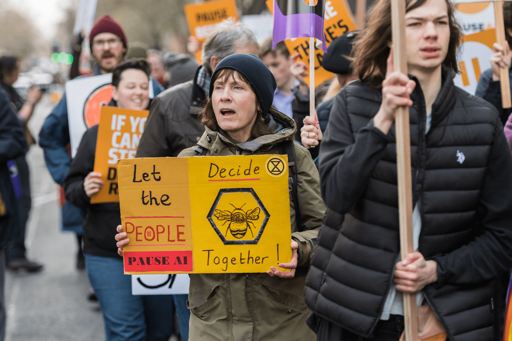
Disinformation is impacting our lives. Much of it is being pushed by unregulated Silicon Valley tech companies and their billionaire owners. But people in Europe are pushing back.
In this episode, Michael Fox goes to Spain, to look at how members of the Spanish far right have been inspired by Charlie Kirk. Then we look at grassroots organizing against Big Tech in Ireland, media education initiatives in Finland, and European measures regulating Big Tech.
“This has now been a topic of discussion very much in Europe,” says Finnish educator Saara Salomaa. “Should we actually trust any US tech companies, or should we try to get rid of US tech companies as soon as possible?”
Michael is joined in the episode by Laura Flanders. She is the host of Laura Flanders and Friends on public television — formerly known as the Laura Flanders show.
The Battle for Free Speech Podcast is a production of The Real News Network.
Hosted by Michael Fox and Marc Steiner. Theme music by Michael Fox, Jordan Klein and Daniel Nuñez. Other music from Blue Dot Sessions and Epidemic Sound. Production and Sound Design by Michael Fox and Stephen Frank. Editorial support by Kayla Rivara. Research by Ben Schweiger.
Guests
Many thanks, also, to Ilona Taimela for taking the time to speak with me about media education in Finland.
Resources
- Here is a link to TikTok about the Puchaina Avocado videos.
Follow The Battle For Free Speech on Spotify or Apple Podcasts.
Support Michael Fox’s reporting at patreon.com/mfox. Never miss an episode — sign up for The Real News newsletter at therealnews.com.
Transcript
The following is a rushed transcript and may contain errors. It will be updated.
Michael Fox: Hi folks. Just a quick heads up before we get started. There are a few curse words in this episode. Okay, here’s the show. And you can hear me all right?
Laura Flanders: I can hear you fine.
Michael Fox: Lovely. Okay. And I will begin. Last fall, I visited the Autonomous University of Barcelona in Spain. It’s located on this big campus in the hills west of the city. And I was there to interview people about something that had happened just the week before. So this was October, October 2025. The month before on September 10th, Charlie Kirk was killed. Remember he was a young, far right US activist, Christian nationalist, founder of the conservative organization, Turning Point USA. And he used to do these speaking tours on US campuses where he would debate people in public and put forth his controversial, conspiratorial and office racist or sexist ideas. So back in Spain, following Charlie Kirk’s killing, a young far right Spanish activist named Vito Kiles decided he was going to do the same thing in Spain, in Kirk’s honor. He was going to visit universities across the country and hold Kirk style debates in public with controversial or incendiary rhetoric.
And he kicked off his tour at the Autonomous University of Barcelona. The problem was he never really kicked it off. See, the autonomous university is one of the most radically progressive universities in the country. It has staunchly defended the independence movement for the region of Catalunia. And the university actually told him he didn’t have permission to speak because of the chaos that could ensue. So he arrived anyway and so did anti-fascist protesters who filled the main plaza. They squared off with Qiles supporters holding Spanish flags. Both sides protested, shouted at each other until the Catalunia police force showed up. And then they pushed the groups back with batons and shields and riot police and shut it all down. The following week, I traveled to the university to ask students what they thought about what happened and about Vito’s plan to try and speak. So I spoke with this one journalism student. His name is Pune Velez.
He said, Vito Quiles came here to stand with a megaphone, to shout a few things, to give a speech and not to answer questions, he said. In fact, he told me that’s even worse than what Charlie Kirk did. Another student told me everyone can have their own thoughts, but to come to a university to do anything, you have to ask for permission. And from what I understand, he didn’t have permission to come here. And he was warned in fact not to come. Jugo Guillaro sees it differently. He’s a history student who was in the group of Qiles supporters with the Spanish flag. I wanted to have a debate, he said, to share ideas even if we didn’t agree because that’s really the spirit of the university and to keep that spirit. But then he said he ended up trying to separate people and almost got hit several times.
So here’s the thing. Most of the students I spoke with, but not all of them, told me that Vito Quiles wasn’t just trying to do a speaking tour in the name of free speech. He was using Charlie Kirk’s death as a way to push his far right vision of the world and a US style free speech definition across Spain. And they say his goal was to get exactly what happened. Chaos, protests, police violence, media attention. Can you introduce yourself real fast?
Sergio Villanueva: Yeah. So my name is Sergio Villanueva Barcelova. I’m associate professor in the University of Barcelona in the communication studies and media studies.
Michael Fox: And I spoke to him about this as well. And he said
Sergio Villanueva: Every time that a right wing politician watch some notoriety, he or she goes to the Autonomous University and she gets a riot. She gets public in media. She gets publicity. So Bitokiles went to that specific university because he knew that in that specific university there is this big contestation that is very politically affirmed and he would get that reaction. He wanted this. He wanted attention.
Michael Fox: And so he got it. I think it’s important to say that the next universities where he tried to also speak on his tour also blocked him from doing so. The University of Regents essentially wouldn’t give him permission because they said he wasn’t there to have an open debate. He was there to stir up trouble and to create a media attention. And I think this is interesting because again, it shows the difference in definitions of free speech in the United States and abroad. Charlie Kirk found the space to speak on university campuses in the United States despite his controversial and incendiary rhetoric, but not in Spain. And there’s a reason for that. One student I interviewed told me,
She said, “I believe that freedom of expression is the right to say whatever you want, but the limit is when you disrespect other groups of people that have a different ideology perhaps. You can debate with a person who’s different from you, but without disrespecting them, that you have freedom of expression until you disrespect the other or the other person’s ideology. In her opinion, Vito Kiles and others on the far right have a discourse that is disrespectful to others. They thrive on attacking, dividing and using others as scapegoats. And again, as I’ve looked at a lot in this podcast, this in the United States is protected speech under the First Amendment. Their free speech is seen as absolute, but in Brazil, Europe and elsewhere, the right to free speech is balanced amid other rights. So your right to free speech doesn’t trump my right not to be harmed by your speech.
But the far right and the powerful owners of US tech firms are hiding behind the discourse of free speech to push their incendiary rhetoric. And they’re doing it far beyond the borders of the United States. Spain is not the only place where far right activists or US tech firms are trying to push their agenda abroad into Europe and their US definition of free speech. But people are pushing back. All of that in a minute.
This is the Battle for Free Speech, a multi-part narrative podcast brought to you by The Real News. In this series, we take you on a journey to understand the important role free speech has played in US history and the fight being waged over it today. I’m your co-host, Michael Fox, and I’m honored to be joined today by Laura Flanders. She is the host of Laura Flanders and Friends, formerly known as the Laura Flanders Show on public television. And she has had a long illustrious career in journalism. Laura, thank you so much for joining me today.
Laura Flanders: Michael, it’s so great to be with you and I’m fascinated by that story you just told.
Michael Fox: It is crazy and I’m sure we will dive into more of this. Laura, I just want to say I’m so excited to chat with you in particular because you kind of have a foot in these two worlds in the United States, in Europe. You grew up in the UK. You’ve had most of your professional career in the United States. And I think that’s so important for understanding this conversation today, right? Because we’re talking about free speech in these two different worlds and the different definitions and also disinformation. What does that mean? I just wanted to start, Laura, what is your definition of free speech?
Laura Flanders: Well, before we get there, I think what your story illustrates and makes a think about and what you’re alluding to in terms of what are the distinctions between a kind of European sense of free speech and an American one takes me right back to the core distinction I think really between our two cultures. One being a culture of the individual with all of its wonderful assets. In the US, we have this supposedly invilable individual right to free speech and it sort of trumps everything not to use that word. In Europe, societies there actually think about the social. It’s not horrifying to imagine a collective and to think about collective rights. Now we can always take that too far and there’s certainly histories of abuse in both countries and I hope we get a chance to talk about that. But in broad strokes, what I’m reminded, I’ve been in Barcelona also when you go back to the history, the history’s everywhere on the walls of the Civil War and that sense of a collective struggle for freedom and for a different set of priorities.
Barcelona was at the heart of that Civil War struggle for an anti-fascist, anti-authoritarian style of government complete with communists and anarchists and the autonomous university has a lot of its roots in that strugle. So anyway, you’ve kicked us off in a really interesting place because I think as we’ll see through this conversation, that comes up over and over again that European governments have a long tradition of balancing individual rights with other rights for better and for ill as well here.
Michael Fox: That’s right. That’s right. Laura, thank you so much for grounding us in that because it’s so true. And I don’t think that enough people in the United States understand this core difference and also understand this idea of society as the whole outside of the United States. So thank you for grounding us in that. So this episode, we’re going to be traveling to Europe to understand how Europeans consider free speech and also look at kind of the threats from big tech moguls to push their agenda. And in particular, this episode, I really want to focus around disinformation, fake news, and the battle against it in particular that’s happening in Europe. So Laura, I want to continue our conversation in a place that you and I were just speaking about recently and that is Northern Ireland.
Audio Clip: In a capital city in the British Isles, people are forced to flee their homes by a mob, which was intent on causing havoc and setting fires.
Michael Fox: Violent riots and fires in Belfast in Northern Ireland just took off in mid-June. They rippled across the city for several days after a violent knife attack went viral over social media. The attacker was reportedly either from Sudan or Chad and his nationality sparked a wave of anti-immigrant violence. Migrant families were forced to flee their homes. And here’s the thing, Elon Musk, owner of the social media platform X, played a key role in fueling this violence. According to a report from the Center for Countering Digital Hate, a US and UK-based NGO, Musk’s role was “instrumental” in the Belfast riots. He helped to spread calls for protests from anti-immigrant activists and politicians on X. One of them read, “Only by protesting repeatedly and loudly will there be change?” According to the report, more than half of the more than 100 million views across three accounts came from Musk’s reach on the platform.
People responded to those posts on X with nearly 4,000 comments calling for lynchings and other offenses against immigrants. And the director of that organization Imran Ahmed said no individual played a bigger role in spreading this content on X than Musk himself. As the owner of X and its most followed user, Musk has unparalleled power to shape what people see online. With that power comes responsibility for the content and conduct his platform promotes. Laura, did you see this unfold? And what are your thoughts about Musk’s role here?
Laura Flanders: Well, it’s fascinating. You know, Michael, I started as a journalist in Northern Ireland. I don’t know whether you know that, but when I was like 23, I was in Belfast in the 1980s during the so – called troubles. The Irish of course called it the trouble with England and saw conflict in the streets of the sort that we saw in the story that you just told. So for many of us, it was like a flashback to that earlier era. And younger generations who had memories of that conflict where there were Molotov cocktails thrown and bombs in the streets and troops and guns and regular gunfire, I think almost sort of dug into their roots maybe to sort of revive some scene that they’d seen in the histories of their families. I was reminded in the context of this conversation of what the free speech situation was in the ’80s when British anti-terrorism law, again, this is the other side of the collective approach to speech rights in the name of protecting the British, especially the interests of the British in Northern Ireland that were being contested by a liberation nationalist independence movement at that time led by Sinfeig and the Irish Republican Army in the name of protecting certain people from other people.
The government of Margaret Thatcher passed these Prevention of Terrorism Act laws that restricted broadcasting rights for Sinfeigh, the political party that represented the nationalist’s point of view.
Audio Clip: Hello and good morning. Yesterday, the government banned all British television and radio stations from broadcasting interviews with members of Xinfein. How are their supporters? But will it reduce terrorism or merely curb press freedom?
Laura Flanders: And they literally were not allowed on the broadcast airwaves. Now this is pre-internet, pre-YouTube, any of that. But you had this ridiculous scenario that I remember where the broadcasters got around this ban by hiring actors to say the words of the politicians. So it didn’t stop the ideas getting out there. I just made an absurdity out of the situation. And it did reduce the number of interviews that were conducted with Sinfeig politicians who had members of parliament elected to parliament by, I don’t know, I’ve seen statistics of 60 to 85% because broadcasters just didn’t want to deal with it. So they have an example of very heavy handed use of censorship by the government in the name of protecting some people from other people. And this was a period of a lot of violence. Most of it in Northern Ireland, which was at the time occupied by British troops, just to remind people.
So I’m thinking, okay, well there you have the government censoring a whole political party and point of view and its representatives. Today, it’s not the government that’s causing the problem, let’s say. It’s the owner of a for – profit privately held monopoly business. And I think you can say that X is kind of a monopoly in the sense of it holds disproportionate power, sort of uncontestable power in that sphere of commentary social media, which is worse, which is better. I mean, it’s really a very good question. And when you asked me to defin free speech and I savvily avoided answering your question, I think it’s partly because I could agree with the Barcelona students who you interviewed who said anybody has a right to say anything. They just don’t have a right to say it without contestation. They don’t have a right to say it and not be confronted by another point of view.
That’s all fine and good until you get to the point of this kind of monopoly control, this corporate control. In principle, I left the UK and came to the US because it was a land of greater freedom and independence, less sort of nanny England control of life in general. But now we’re in kind of musky United States. We’re in musky world where that control is being exerted not by the nanny state, but by corporations with a private interest, a profit motive to stir up a certain kind of conflict. So we can talk more about that, but you’ve really hit at a very fascinating place, Northern Ireland, to discuss this question of speech.
Michael Fox: This brings me back to what I was speaking with my co-host Mark Steiner in an earlier episode about how speech, when it was censored throughout the history of the United States and elsewhere, it’s always been the powerful censoring the voices, the marginalized, the poor, the black and brown, the people fighting to stand up, to rise up. And this is what reminds me when you mentioned Margaret Thatcher censoring Xin Fin and censoring the speech coming out of Ireland, it is the powerful censoring the people who do not have power. That is where you see speech. And it’s the same thing now. It is the powerful, although it’s coming from a corporation, it’s coming from Musk. It is the powerful that are doing this against others.
Laura Flanders: Although interesting, they are not so much censoring as exploiting this free speech right in the name of their corporation as an individual. And I think that’s where it all gets very complicated because they are presenting themselves as bastions of free speech, opposing censorship and sort of calling the bluff of governments that say they defend free speech. We can’t possibly talk about the history of Ireland and England without mentioning that the whole Irish language was banned under British colonial rule. So the control through language control is a part of this picture too.
Michael Fox: Absolutely. And that is exactly what this woman who I spoke with this week told me about. Her name is Jude Ferrell. She’s Irish. She’s actually a former tech worker. She worked at Google for several years. And I wanted to speak with her because last year she founded this organization, Your Tech: Their Deaths, to protest against big tech in Ireland and in particular the role of big tech in supporting the genocide in Palestine. And
Jude Ferrell: It’s a grassroots led initiative, but it’s very much so brick by brick. And a small committed group of people can impact change. And that is in Irish blood, that is in our DNA.
Michael Fox: And in fact, when she spoke, she had just left a protest in Dublin against an Israeli tech company, Sneak Technology that’s trying to sign a contract with one of Ireland’s largest banks. Anyway, about the Belfast riots, she told me it was easy for these big tech companies and Elon Musk to put the blame on immigrants.
Jude Ferrell: There is a very big issue in Ireland with a cost of living crisis, with public transport, with infrastructure, with healthcare, with education.For all this money the imperialist assets are throwing in here. Ireland is really, really struggling. And it’s very easy for social media to target immigrants, which you can’t be Irish and be racist. And
Michael Fox: I just love this quote. “We are a nation that is built on immigration, “she said.
Jude Ferrell: “We had to leave Ireland due to our own genocide thanks to the British, to our own manmade famine thanks to the British. And we went to the places like America and Australia and built those countries. You cannot be Irish and be racist. But fear is a very powerful tool to use on social media and Irish people are struggling.
Michael Fox: And this is what we saw. And I just want to give a little context about Ireland today and big tech because I don’t think a lot of people understand this. Remember first that Belfast is a city in Northern Ireland. So politically it’s actually part of the UK. But regardless, Ireland and Northern Ireland have become major tech hubs over the last two decades. More than 10% of the Irish GDP comes from the tech industry. They provide more than 160,000 jobs across the country. Although AI is already taking its toll and roughly, I think the figures from earlier this year is that 20,000 people have lost their jobs to AI just recently. Almost all of the major tech companies have their European headquarters here. And in fact, some people have even called Ireland Europe’s Silicon Valley. These tech platforms chose Ireland because they speak English clearly and because the country’s low corporate tax rate.
And Jude told me in the beginning they were really excited that these tech companies chose them. She says she was really happy to work for Google, but those times have clearly changed. She says today she is really worried about the discourse from the tech billionaires and so – called free speech absolutists infecting Ireland and Europe because they have this international reach and there are no regulations coming out of the United States. So one of the things I think that she said that was really interesting is that your future, America, is linked to ours.
Jude Ferrell: So if you fuck shit up, you fuck it up for everybody. And it’s the same with the United Kingdom. It’s the same with America. It’s same with Germany. You cannot view big tech or freedom of speech in isolation. It would be the biggest and the most naive error for any of us to take that aproach. What happens in imperialist countries like the United States trickles down to us here in Ireland.
Michael Fox: And she also told me about how, this is what you were just speaking to Laura, is that how important free speech is for her, but not the absolutist free speech that we hear about from the United States or from Musk. Not free speech where you’re inciting hatred on others, but that free speech is the most important thing in Ireland.
Jude Ferrell: Ireland, we lost our language. It was illegal to speak to learn Irish. And that impact we see generations later. And we’re only starting to understand the impact. It’s like we’ve got a hangover from our own oppression, the silencing of our religion, the silencing of our language, of our culture. So yeah, free speech is incredibly important in Ireland.
Michael Fox: So free speech, but not the freedom for the big tech platforms to run ram shot over everyone in defense of their quest for evermore power and money. Laura, how do you see all this? What does all this mean as these tech companies are arriving in Ireland and what Ireland means within this context for Europe?
Laura Flanders: Well, this takes us down a different trajectory. At least my mind goes to a different, most kind of conspiratorial place. And just for what it’s worth, I think, Ireland, Barcelona. You’ve talked about right-wing activists in these two places. What are these two places have in common? Ireland North and South has been a place of progressive activism for different reasons coming from different roots in some cases, but progressive activism for sure. If you think of the conflict, if you think of the genocide in Palestine over the last few years, it’s been Ireland that has led the United Nations along with South Africa and a few others in the calling out of the genocide and the supporting of resolutions of the United Nations that use that language and call for the prosecution of Israeli leaders.
Audio Clip: To do nothing is not neutrality. It is complicity.
Laura Flanders: Barcelona, interestingly, had one of the most anti-monopoly, anti-corporate, anti-gig economy regimes until recently with the election about a Kalao years ago. Barcelona, going back to those roots in the Civil War, has been a place of progressive foment and really strong anti-capitalist collectivist experimentation, let’s just say. It’s very proud of its cooperatives and its collectives, as I’m sure you found out. So I think, well, why are these people focusing in these places? And I can’t help but get curious about what their political motivations might be. So I’ll just say I was in Ireland recently and with respect to immigration, at least according to public opinion polls, you have majorities not just supporting immigration, but saying that they appreciate migrants. So they’re taking on, I think, a big challenge, the Bannons and Musks and Peter Thiels of the world, but it’s a challenge they seem to be up to and up for.
I just saw a report that Peter Thiel is holding a conference in Dublin convening some of the same people he convenes in this country to talk about world dominance through AI. All of this is not exactly an answer to your question, but it’s the kind of thoughts I’m having prompted by your interviews and your reporting. So thank you.
Michael Fox: Yeah. Well, there’s two very interesting things. First, so Jude told me when I asked her about kind of the far right and this discourse and immigrants and kind of the rise in the country, she said actually their bark is worse than their bite.
Jude Ferrell: I think they’re like one of those yappy little dogs. They don’t have much power or control in Ireland yet, thankfully.
Michael Fox: And in fact, what we saw in the big fuel protests that were happening back in April, big protests around the country, people standing up. She said the right was also trying to steer this in the direction of blaming immigrants and blaming immigration and people just weren’t having it. They were shut down fairly fast. So that’s on the positive side. People are standing up against that narrative.
Laura Flanders: I think one thing that’s different, the two cultures going back once again, is in the US you have our two-party system and that makes it much easier to say we’re great, you’re terrible, we’re wonderful, you’re evil, you’re the threat to all things good. In Europe, generally in Ireland certainly you have a multi-party system and you may have far right parties, but you have other parties too. There’s a much more diversity of discourse and you have, of course, a long history of multiple media at each other’s throats. People are used to weighing different opinions and the idea of one enormous megaphone influencing an important and large part of the population I think is harder to pull off there than it is here.
Michael Fox: Yeah. And you mentioned Peter Thiel, Laura, which is really important because he was going to hold his event in Ireland. And of course for people that don’t remember, he’s the Silicon Valley tech financier, co-founder of PayPal, Palantir. And he was planning this international conference of his secret organization known as Dialogue. And then they wanted to talk about World War III battlefield technologies and also how to build a cult, which were some of the things that were on the agenda. Anyway, the meeting was going to take place in this upscale hotel in Ireland, but Jude and her organization and several other groups started to organize against it. They held some protests. They were going to hold more protests over the next week. And in the end, the meeting was canceled just a couple days ago. Ah,
Laura Flanders: There you go. Popular action, go for it. They didn’t even need to protest. They just needed to say they were going
Michael Fox: To protest. Exactly. Excellent. Exactly.
Jude Ferrell: It’s not just Peter Thiel. It’s not just Palantir, but it is the audacity and arrogance of individuals like Thiel that they think that they would be welcome in any country when we know that they are entirely focused on their own power and privilege. They are not using technology or data for the good of humankind. They’re only using it to fill their own coffers.
Michael Fox: This is just one of those moments that I think we need to pause to remember that sometimes A, standing up against these things, standing up online, but also getting active, getting organized and people getting out in the streets can have an impact against what we’re seeing right now.
Laura Flanders: Well, that brings me back to our US media. How come I didn’t know that? I’ve been looking at that story. Where is it? This is why the real new This is programs like mine, independent media is so important to bring people the stories not just of the threats and the dangers, but also the victories of people’s movements. So just a little self-promotion for us.
Michael Fox: Love it. Laura, I wanted to say one more thing about that Ireland that I did not know before I move on. Jude told me that the term boycott, did you know that that was coined in Ireland?
Laura Flanders: Yes, I actually did.
Michael Fox: It’s amazing. So apparently this was when tenant farmers demanded a rent reduction in the 1880s from a British captain named Charles Boycott. That’s so cool. So cool. So anyway, again, it’s kind of a reminder of the excitement and the power and the organizing of Ireland and just gives us a little bit of hope I think. Collective
Laura Flanders: Spirit. Collective spirit.
Michael Fox: That’s right. That’s right. Laura, I want to dig a little bit deeper into this question of fake news and disinformation and the attempts to fight it. And I just want to say very quickly that I kind of feel like there’s this elephant in the room in the United States that no one’s discussing because around the US elections, 2024, pretty much all the social media platforms suddenly said, “You know what? I don’t think we’re going to fact check anymore. I think that Trump is now in office and we don’t really need to do this. ” And so it’s this thing where everybody realizes that there’s a bunch of misinformation and disinformation and fake news out there, but at least from the tech billionaires and from Silicon Valley, there’s nothing being done about this. And let me just also say that not only is there nothing being done, but Musk continues to push his narrative.
And in Ireland, that wasn’t the first time that Musk was throwing his weight around. And I just have a couple of statistics that I wanted to throw out. So first off, just remember he has 240 million followers on X. It’s the most, he’s the highest number of followers on the platform. According to a report from the European Council on Foreign Relations in recent years, he has attacked prime ministers, calling them criminal tyrants or traders. He’s backed far right parties, fabricated statistics, and reorganized X’s algorithm to amplify right-wing voices and suppress democratic accounts. In Germany, he boosted the far right party before the 2025 election and spread fabricated quotes. He posts attacks against the press roughly three times a day. And here’s the thing, he has his agenda. And of course, in the name of free speech, he is then pushing his own agenda out there.
But Europe has been pushing back in more ways than one. One way was in Ireland. The other way is the attempts to battle this information by another very unique way. And Laura, I want to take us to Finland right now.
Laura Flanders: All right, let’s go.
Michael Fox: So Finland is a Nordic country. It’s in Northern Europe, just to the east of Sweden. About a third of the country lies above the Arctic Circle and it shares a border that is 830 miles long with Russia. Russia actually controlled Finland for most of the 1800s. And that’s important because Finland has faced a barrage of Russian propaganda, troll farms and fake news in recent years, in particular beginning around the time of the Russian invasion of Crimea in 2014. And what Finland did is pretty revolutionary. So as we’ve looked at this in this podcast, countries have tried to battle fake news and disinformation by taking content down or going after troll farms. Like in the case of Brazil, they’ve protested and tried to regulate speech in other parts of Europe. And in Finland, they’ve tried to battle against disinformation with education. So by teaching –
Laura Flanders: Shock horror.
Michael Fox: Exactly. So by teaching the young and old to how to distinguish between facts and opinion and propaganda, how to spot it, how to critically assess where the information is coming from and what are the reputable sites and what aren’t. And before I get into this, I just want to say that this is not new in Finland. So I’m just going to give a really quick history lesson here, Laura. Remember that this country, Finland, like much of Europe, was devastated by World War II. Almost 100,000 Finns died. They fought a bloody Soviet invasion from the East.
Audio Clip: The big boulder is being press into service as part of a roadblock or tank obstacle. And here in the depths of the Caribbean woods, Finnish artillery lays down a protective barrage beyond the Manaheim line.
Michael Fox: They lost parts of their territory to the Soviet Union and then they fought alongside the Axis Powers, Germany and Italy. So they were on the losing side of the war.
Audio Clip: A Finnish communique reports that 600 Russian planes bombed Helsinki last night causing fires and heavy damage. The raid lasted nearly 12 hours, the longest and heaviest air attack of
Michael Fox: The war. Anyway, the point is this, that was a time of tremendous propaganda used by all sides, in particular from Nazi Germany. And in Finland, they were just inundated with it. And when the war ended, they began to teach what they called then communication education in schools, which also came alongside the rise of film and cinema.
Saara Salomaa: Because people have always been worried about new media. And in 1950s, they were very worried about what will happen to young people when they see all kinds of garbage in cinema. And that’s how it started. And then it has been modified over the years.
Michael Fox: They now call this media education and media literacy. And Finland outlined a national policy around this in 2013. It was the first European country to do so. And I spoke with Sara Saloma about all of this.
Saara Salomaa: I work at the Finnish Arts and Culture Agency, which is a national body responsible for media education and promoting media literacy.
Michael Fox: She told me that in her life she actually wanted to be a kindergarten teacher, Laura, but that she took a class in college about this and she got hooked. And so she ended up doing her PhD on media education for kindergarten teachers.
Saara Salomaa: So I didn’t totally give up on kindergarten, but my work is now targeting all people in Finland.
Michael Fox: So she coordinates media education across Finland. And here’s what she told me. First, it isn’t just about one class. It’s something they do across all grades from kindergarten up to high school and also for adults and even seniors. And it doesn’t just happen in schools, but also libraries and NGOs. And it kind of crosses multiple disciplines. So they incorporate this in many, many different ways. I asked her the difference between media education and media literacy because I was confused about this. And she explained that media literacy are the skills you need to learn to analyze media. And media education is the actions that promote media literacy. So how to learn this. And so she explained that it’s not just discerning fact from opinion, but understanding the social perspective of media. So what’s being said, who’s being said? And I asked her to take a step back and just explain to me what this looks like actually in a classroom on a typical day.
Saara Salomaa: It’s hard to say what is a typical school day in Finland because our municipalities, schools and teachers all have a great freedom to choose how they implement our national curriculum. But if I think about, for example, 13 year olds, a media literacy lesson would be about reading a text and trying to discern what is a fact and what is opinion, for example.
Michael Fox: Or looking at a video or ads and trying to understand what’s behind the ads, like what’s the hidden message. And this is where I want to go right now to explain this a little bit more. We’re going to travel to Helsinki Finland’s capital late 2024, November. It’s cold and snowing outside. So put on your jacket, Laura.
Laura Flanders: All right, here we go.
Michael Fox: Inside the room, a teacher passes out these pages of different images to groups of teenage students sitting around desks. They’re analyzing what the media content is trying to say, who produced it, where it’s coming from.
Teacher says, “Who has produced the material that you watch? How do you produce it? Do you have your own ethical responsibility?” I think these questions are really important everywhere. One of the students said, school has taught me to interpret media as messages written in between lines. For example, through ads or fake pictures.” She says she started to look at it from a slightly different perspective more critically in terms of propaganda and disinformation. And here’s the thing, it’s not just one subject. It’s something that’s incorporated across all aspects, all subjects. And Laura, for me, I just feel like this is so important because you would imagine that this would just be a no-brainer. Everything, our entire lives is inundated today with media.
Audio Clip: In today’s fragmented media environment, it can be hard to know which news sources you can trust. Even I don’t always know where to turn if only there
Michael Fox: Was something. In social media, it’s every place. And yet we never step back and kind of analyze critically. I looked at some of the figures and the stats in the United States around media literacy. Is that happening in the states? And from what I found, it’s roughly half of the states have passed some laws mandating some form of media literacy, but it’s really incipient. It’s really early on. They’re trying to figure this out.
Laura Flanders: Michael, it’s so interesting because what I’ve been looking at a lot recently are these age-specific digital access bans.
Audio Clip: Yes.
Laura Flanders: So in Australia, you have a ban on under 16s. In the UK, you had the Labor Party leader Starmer talking about a ban on under 16s using social media, things like TikTok and X and so on. Facebook, I think even YouTube. And the aproach is very much, let’s keep people off these platforms. And conveniently enough, in order to assess people’s ages, it all involves uploading biometric data to the web so that there’s yet more information that these huge corporations have on all of us. Biometric meaning eyes and fingers and whatever else they can use. They’re even proposing having AI assess photographs to see what age people are. You can imagine the mistakes. But the whole approach is how do we keep people off this platform rather than how do we regulate the platform? What you are providing is yet another idea is why don’t we just make people smarter?
Why don’t we just educate people? And that it seems to me is a classic collectivist in a good way approach of let’s actually inform people and give them the tools to assess this. And frankly, I think younger generations are going to be smarter about all of this than we are because they’ve seen the damage that it’s doing to their fellows. And I don’t know about you, but I know a lot of high schoolers and middle schoolers who are simply going off social media themselves because they don’t want to be tortured the way that they’ve seen their friends be tortured. So I think this is an interesting third way. And gosh, wow, how far we are from Finland.
Michael Fox: In so many ways, how far we are. Yeah. In fact, there was a stat in this one organization that had done a report about media literacy, the push for media literacy in the United States. And they said that more than 80% of students in the US would like to have media literacy classes taught. And it makes sense.
Laura Flanders: Yeah. I used to host a radio show that still is out there. It’s fabulous. Now hosted by Janine Jackson for FAIR, the Fairness and Accuracy and Reporting, the media watch groups called Counterspin. And we would sometimes go to classrooms and do simply a one-off demonstration, have people pick up their local paper or look at the news for a week and just say, okay, who got to speak? Who got to apear? How many sources were cited? How much space was used by ads versus by print? People loved it. Kids loved it. And it was the kind of thing anybody could do anywhere. Any teacher could actually initiate such a thing. People at FAIR could help. But it’s a fascinating exercise just to have people think twice about what they’re reading and listening and watching.
Michael Fox: Yeah. That’s awesome, Laura. And this was one of the questions I asked Sada. I said, “What does success look like for this? What does this look like really? ” And she said, “It’s actually kind of hard.”
Saara Salomaa: Because we don’t have a parallel version of Finland in which media literacy was never taught.
Michael Fox: I love this. But she said one of the ways is the fact that they’ve had several governments in power, the left and now the right is in power right now. And none of these governments have pushed to try and roll this back.
Saara Salomaa: Both of these governments, they have had media literacy in the program of government. So I think that is success story that regardless of what kind of political parties are in power, they still want to promote media literacy in Finland. Of course, if you would ask very right-wing politicians and very left-wing politicians what they mean with media literacy, that can be a different story. But on the other hand, they are not handpicking the initiatives themselves.
Michael Fox: And they also have something going for them in that their curriculum around media literacy isn’t governed by necessarily the government that’s in power. It’s a 10-year-long plan that they set up. So it’s not one government that can come in and then derail things and whatnot.
Saara Salomaa: And here I also think that it’s very important to stress that media literacy is not there to dictate what to think, but it’s supposed to be teaching how to think.
Audio Clip: Yeah.
Michael Fox: She also brought up several things that I think are important now. She said they’re facing many challenges, in particular reaching immigrant communities, poor communities in Finland. And the other thing is, of course, AI, which is making everything so much more complicated.
Saara Salomaa: Things are moving very quickly and it was kind of surprise for me how the big tech companies, how they took a side in the US elections and then US government.
Audio Clip: The golden age of America begins right now.
Saara Salomaa: And this has now been a topic of discussion very much in Europe that should we actually trust any US tech companies or should we try to get rid of US tech companies as soon as possible? Our chessboard is constantly changing. In media education, we have to run really fast even to stay where we are.
Laura Flanders: Well, I love her idea that there’s no alternate Finland to have as your control because that’s what we have in this country too. We’re constantly told we have free choice when it comes to media, but we don’t really. We have a limited array of options. So it’s not like you can just say, “I hate those networks. I’m going to go pick another one.” So that’s another way in which our media diet is presented to us as this wonderful universe of freedom, but it’s really not. It’s really who has the power, money to get to your eyeballs and that isn’t everyone.
Michael Fox: Exactly. So Sada said in closing that this was not a silver bullet.
Saara Salomaa: We can provide people possibilities to learn and to discuss these topics, to understand that not all the information is the same. So there are more and less reliable sources and they can develop practices that help them to recognize this information, for example. But at the same time, we need to also strengthen people’s trust in trustworthy media.
Michael Fox: It’s one answer to the threat and there need to be multiple answers. And that is the direction that I want to go into right now because as the United States has always pushed for deregulation and as we see Musk and Silicon Valley tech barons always talking about how regulation is actually another form of censorship, Europe has been pushing to fight with regulation. And I think it’s important to just underline this point before we dive into this, is that in the United States, this question of tech barons talking about regulation as censorship is kind of repeated daily. It’s the same thing as the absolutist free speech thing. But we have a ton of regulation in the United States. Television, radio, newspapers, print, all the legacy media. It’s all regulated. It’s all there. So why not tech companies and social media?
Laura Flanders: It’s useful to go back and see, well, how did it get regulated?
Audio Clip: I am not for a return to that definition of liberty under which for many years a free people were being gradually regimented into the service of a privileged fuel. And
Laura Flanders: For much of it, we’re talking broadcasting. It got regulated in the 1930s and ’40s under the FDR administration and just before when you had a rise of right-wing demagogues using what was then the most influential media, namely radio, to stir up fascist movements in this country, movements that we forget we ever had. But it wasn’t like it just suddenly got regulated. It got regulated as an effort to protect democratic values and a democratic society when a threat was observed in a growing media. So in that case, it was radio and then those broadcasting regulations were extended, some of them, to television. We’ve had a huge fight around new technology, whether it’s online or online or social media technology where the tech companies have done their best as they would to keep themselves free of regulation and to present themselves as these bastions of free speech.
Well, that’s the same thing that the fascist demagogues in the ’30s presented themselves as bastions of free speech. European law again takes us back to where we began in the sense that they do guarantee under their Ministry of Injustice Acts, they do guarantee that there is a right to free speech, an individual right to freedom of expression, but they give a little bit of wiggle room and say the restrictions are allowed in the defense of a democratic society. So a democratic society trumps your right to call someone a name in public and to rally crowds to take out unwanted folks in your community or whatever. So again, it’s that balancing act that the Europeans are explicitly doing even in their law in a way that we don’t. And where we do in regulatory law, the public’s not educated about it. And instead we get this very binary black white attitude to free speech.
And I don’t know about you, but I’m kind of over binaries in general and get very suspicious whenever they crop up.
Michael Fox: Amen. Absolutely, Laura.
Laura Flanders: Let’s live in the squishy middle.
Michael Fox: Amen. I love it. I love it. I want to underscore really quick the links that tech platforms have gone to to push their agenda and to stop the possibility of regulation. According to a 2025 investigation led by the Brazilian media outlet Ajen Shepublica together with Reporters Without Borders and several other outlets and journalists across numerous countries, between 2019 and 2025, big tech companies carried out nearly 3,000 lobbying actions across 10 countries and the European Union. It involved more than 1,400 company representatives and 2,500 public officials. Among the tactics were disinformation campaigns, funding supposed independent groups to oppose legislation, hiring former public officials to lobby in favor of the companies and arguing that national laws don’t apply. So the tech companies have gone to very unfair extreme lengths to push their agenda to ensure that regulations are not imposed