

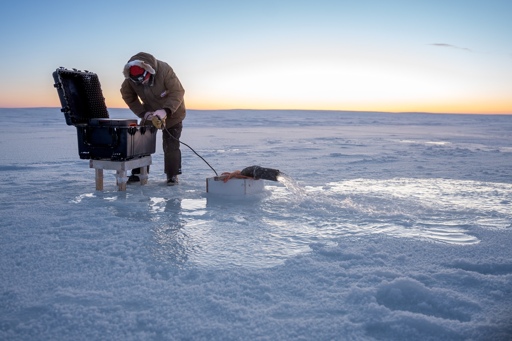
Indigenous peoples living in the Arctic rely on sea ice for many aspects of their lives, from hunting and fishing to travel and cultural practices. Owing to human-driven climate change, the ice is disappearing at an alarming pace. According to data compiled by NASA and the U.S. National Snow and Ice Data Center (NSIDC), a research organization based at the University of Colorado Boulder, the extent of Arctic sea ice cover has decreased by more than 12% per decade since satellite records began. Scientists even predict that the region could experience its first near-ice-free summer as early as the 2030s. The loss of sea ice threatens coastal communities in many ways, jeopardizing traditional livelihoods while accelerating coastal erosion and amplifying the impacts of sea level rise. To slow the melting of Arctic ice, researchers have proposed a number of innovative but controversial solutions, including spreading glass beads across the ice to bounce sunlight back into space, and spraying sea-salt aerosols into low-lying clouds to increase their reflectivity to slow down heating effects. In 2017, astrophysicist Steven Desch also proposed what was then considered a wild idea: Using millions of wind-powered pumps to draw seawater onto the surface of the ice during winter, allowing it to freeze and thicken the ice sheet. Real Ice, a UK-government-funded and UK-based climate tech startup, is attempting to thicken sea ice in the Canadian Arctic by drilling holes in it and pumping seawater onto the surface during winter. Image courtesy of Real Ice. At the…This article was originally published on Mongabay
From Conservation news via This RSS Feed.