

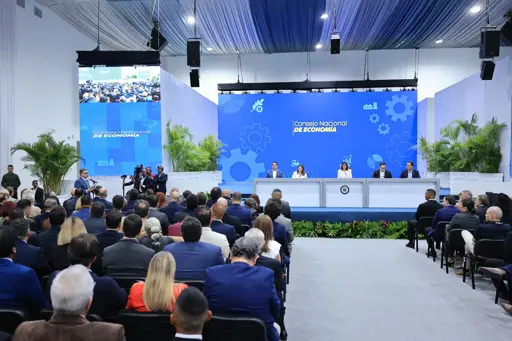
The sectoral vice president of Economy and Finance of Venezuela, Calixto Ortega, stated that the country will continue the process of restructuring its external debt, despite the economic impact generated by the devastating earthquakes of June 24.
During the National Economic Council meeting on Monday, July 14, he said that the evaluations of the past few weeks showed that the national productive apparatus demonstrated a resilience greater than initially expected, adding that both the productive fabric and the oil sector have remained intact and are operating normally.
According to Ortega, “the restructuring of the debt is an indispensable condition for restoring the country’s access to financing,” and that the ultimate goal is “to create the necessary fiscal conditions for the reconstruction of the country.”
Venezuela’s strategy is currently focused on three lines of action aimed at mobilizing support from international organizations, informing the economic and financial community, and sustaining the goal of debt restructuring.
Regarding the first line of action, Ortega highlighted that “the negotiations with the International Monetary Fund, the World Bank, CAF, and the Inter-American Development Bank, as well as other strategic partners, is currently ongoing in a constructive manner and oriented toward concrete results.”
Similarly, in conjunction with multilateral partners, the Venezuelan government is analytically documenting the consequences of the earthquakes and quantifying the damages in real time to generate precise macroeconomic metrics, while addressing the humanitarian consequences and protecting the health and safety of the population.
The continuity of the process ratifies the comprehensive and orderly process of restructuring Venezuela’s external public debt and that of the state oil company Petróleos de Venezuela (PDVSA), announced by the government of Venezuela on May 13.
This measure, described by the government as responsible, nationalist, and social, aims to free the nation from the accumulated financial burden that, since 2017, has seen its ability to pay hindered due to the impact of the US blockade.
Due to these coercive measures, Venezuela lost its access to international credit. This, in turn, restricted the possibility of investing in fundamental sectors such as health, education, water, electricity, infrastructure, and the reactivation of production, which has directly impacted the well-being of Venezuelans.
(Telesur)
Translation: Orinoco Tribune
OT/SC/SH
From Orinoco Tribune via This RSS Feed.