

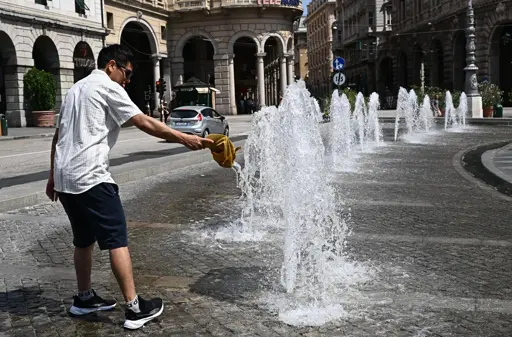
Italy’s Ministry of Health raised the maximum emergency alert level in 15 cities Wednesday as an extreme heatwave continues to grip the peninsula for over a week, with officials warning that climate-related deaths could double within 15 years.
Bolonia, Brescia, Florencia, Frosinone, Perugia, Roma, Turín, Cagliari, Campobasso, Génova, Latina, Palermo, Pescara, Rieti and Viterbo are the cities under red alert, the highest level of danger issued by Italian authorities. The rest of the monitored municipalities remain under yellow or orange warnings, with no territory classified at minimum risk.
Rome faces particularly critical conditions. According to estimates from the environmental organization Legambiente, in 12% of the capital’s neighborhoods, average daytime ground temperatures exceeded 45 degrees Celsius between June 1 and August 31 over the past decade. In 124 of Rome’s 155 localities, the average temperature oscillated between 40 and 45 degrees. Only 8% of these sectors recorded averages below 40 degrees in the same period.
RELATED: Four Colombian Departments Declare Emergency After Devastating Floods
Experts warned that extreme heat not only causes heatstroke but also aggravates cardiovascular, respiratory and metabolic diseases such as diabetes, while increasing mental health problems including anxiety and depression.
The National Association of Consortia for the Management and Protection of Irrigation Lands and Waters (ANBI), based on data from the European Commission’s Joint Research Centre, reported that approximately 10,000 people die each year in Italy due to extreme heat.
Authorities warned that this mortality rate is expected to double by 2040 if average temperatures rise by 3.0 degrees as projected. “We are facing a systemic health emergency that requires immediate structural responses,” Gargano stated.
A new heatwave sweeping across Italy has prompted red alerts in several cities, while firefighters continue to battle wildfires in different parts of the country
→ A wildfire broke out in an area between Naples and Pozzuoli in southern Italy
→ Driven by strong winds, the… pic.twitter.com/6UZadg2R9u
— Anadolu English (@anadoluagency) July 13, 2026
Continental Crisis
The heatwaves recorded across Europe in June have already caused at least 3,700 deaths, primarily among elderly populations, and generated substantial structural economic losses.
France registered the highest toll with 2,025 fatalities, followed by Belgium with 1,200 and the Netherlands with 480.
Simultaneously, electricity prices reached historic records, with 1,038 euros per MWh in Belgium and 902 in the Netherlands. Dependence on liquefied natural gas from the United States, following the abandonment of Russian sources, has aggravated Europe’s energy vulnerability. Peak demand for air conditioning coincides with the decline in solar production at sunset, creating a systemic crisis that hinders growth and weakens the continent’s future productive capacity.
Ocean and Polar Records
Sea surface temperatures reached a new historical maximum for June at 20.86°C between latitudes 60°S and 60°N, with El Niño conditions intensifying in the tropical Pacific. In polar regions, Arctic ice extent was 5 percent below average, while in Antarctica the reduction reached 8 percent, marking the sixth lowest records for the month of June.
The situation in Italy exemplifies a broader global trend where extreme weather events are becoming more frequent, intense and prolonged. Scientists attribute this acceleration to the ongoing climate crisis driven by greenhouse gas emissions from fossil fuel dependence.
Italian health authorities recommend avoiding outdoor exposure during peak hours, staying hydrated, and checking on elderly and vulnerable neighbors as the heatwave is expected to persist for at least another week. Hospitals across the affected cities have activated emergency protocols to handle the surge in heat-related medical consultations.
“This is not just a weather phenomenon,” warned climate monitoring team. “It is the new normal for Mediterranean countries, and public policies must urgently adapt to protect lives and livelihoods.”
From teleSUR English via This RSS Feed.