

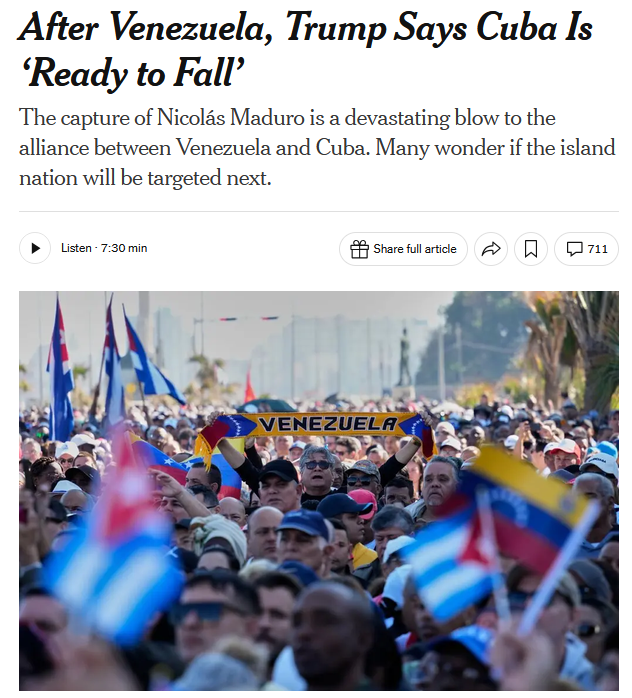
The New York Times (1/5/26) and Miami Herald often reported Cuba news from the perspective of the US government.
After kidnapping Venezuelan President Nicolás Maduro and his wife Cilia Flores on January 3, President Donald Trump set his sights on Cuba, saying the country was “going down” and “ready to fall.”
On top of decades of economic sanctions, the US now cut Cuba off from Venezuelan oil, its largest fuel supplier, steering the country into a deepening humanitarian crisis with widespread power outages, medicine shortages, water failure and rising food prices. Trump tightened the screws on January 29, proclaiming a national emergency in order to effectively blockade all oil entering Cuba.
The New York Times, Miami Herald and Associated Press covered the story extensively as the crisis built, but the coverage varied dramatically across outlets, creating contrasting narratives about the blockade. Where AP reporting—frequently from on the ground in Cuba—emphasized the experience of everyday Cubans, the Times and Herald elevated official voices, and gave those from the US far more room to speak than those from Cuba. The Herald also stood out for the platform it gave to Cubans living outside of Cuba, marginalizing the voices of those still on the island.
Methodology
Using the Nexis news database, FAIR gathered every news article published between January 1 and March 31, 2026, from the New York Times, Miami Herald and Associated Press that had “Cuba” in the headline and used the words “crisis,” “blockade,” “embargo,” “oil” or “sanction” in the text.
We collected a total of 181 articles and recorded 862 quoted sources. Sources were counted once for each article. Many sources—such as US President Donald Trump—appear across articles and outlets, and therefore are counted multiple times in the dataset.
FAIR coded each source’s occupation(s), political party affiliation (for US government officials and politicians) and country of residence. Where possible, for sources living outside of Cuba, we recorded whether they (or their families) were emigrants or refugees from Cuba.
Cuban voices
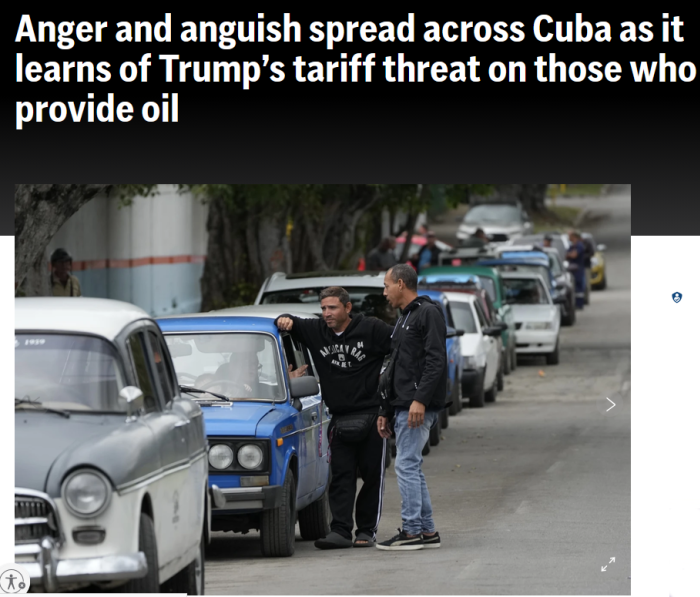
Stories from AP (1/30/26) featured many more quotes from Cubans in Cuba.
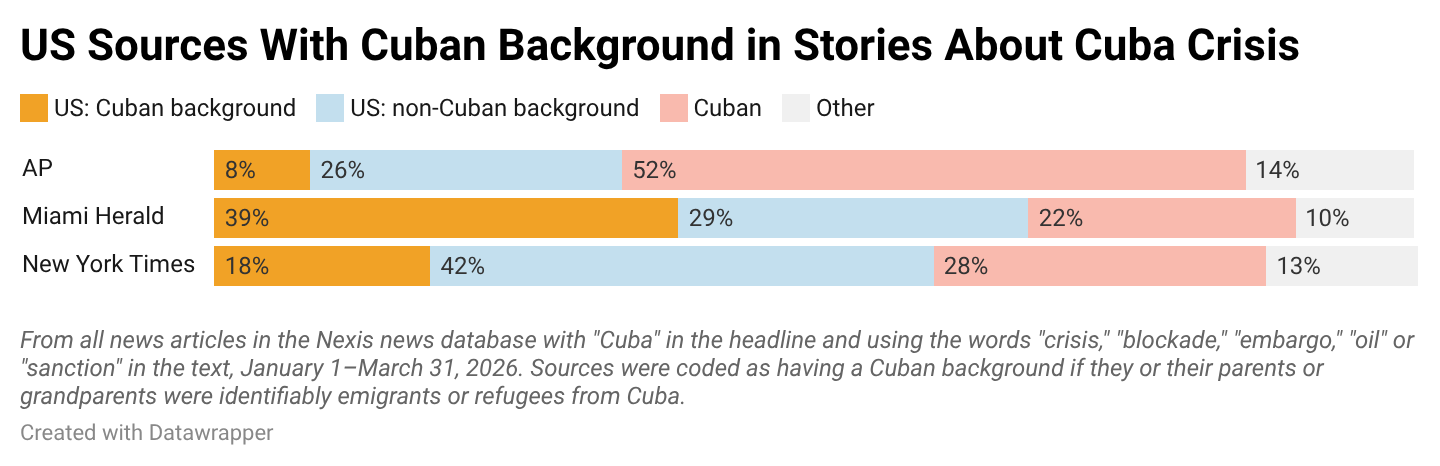
In the first three months of 2026, coverage of the crisis from the New York Times and Miami Herald was dominated by sources from the country inflicting the pain, rather than those suffering from it. At the Times, US sources outnumbered Cuban sources more than 2-to-1 (60% to 28%), while sources at the Herald were even more US-centric, at over 3-to-1 (68% to 22%).
In contrast, AP’s coverage centered sources in Cuba over US sources, 52% to 34%.
Those coded as having a Cuban background made up a substantial portion of US sources (and a few living in other countries as well), especially at the Herald. These sources—which include Cubans in exile as well as US citizens of Cuban descent, and who skewed toward critics of the Cuban government—made up more than half (57%) of the Herald’s US sources, and 39% of all its sources. At the Times, such sources were 30% of US and 18% of all sources, while at AP they were 25% of US and 8% of all sources.
US Secretary of State Mark Rubio, a Floridian of Cuban descent, was the most prominent. After Trump and Cuban President Miguel Díaz-Canel, Rubio was the most frequently quoted person in our study. At the Herald, he was the second-most quoted source, appearing 18 times, compared to Trump’s 29 appearances; Díaz-Canel, who appeared 16 times, was pushed to third.
Some of the Herald’s skew can be explained by its local audience. Cuban Americans make up 31% of Miami’s population (and 35% of Miami-Dade County), and include some of the area’s prominent government representatives. Fifty-three of the Herald’s 127 Cuban emigrant sources were current or former US government officials; aside from Rubio, most of these represented some part of the Miami area at the national, state or local level.
Because many small businesses and corporations in Miami are connected to Cuba’s economy and helmed by Cuban Americans, it also makes sense that they were a majority of the Herald‘s total sources in those categories (5 of 9 business sources and 7 of 10 corporate sources).
But sources of Cuban descent also made up a strong majority of all sources at the Herald in less obvious categories—such as academics (15 of 19) and think tank sources (8 of 10). In contrast, people with a Cuban background were 9 of 22 academic sources at AP and 18 of 35 at the Times, and they accounted for none of AP’s five think tank sources and 3 of 7 at the New York Times.

Non-expert sources
One of the most striking differences among the papers was in their use of non-expert, everyday person sources, interviewed based on their proximity to events, not their occupational expertise. Outlets use these sources to provide a glimpse into public opinion about an issue, and to show the human impact of an event or policy.
At the Herald, 21 of its 24 everyday person sources (88%) were people in the United States with Cuban backgrounds. The other three were Cubans in Cuba.
Meanwhile, at AP, which featured 78 such sources (26% of all sources), the proportions were reversed: 71 (91%) were Cubans in Cuba, and only four were people in the US with Cuban backgrounds. And while the New York Times only featured 16 (7%) everyday people, 15 of them were Cuban residents and none were people in the US with Cuban backgrounds.

So when the Herald runs a headline like March 13’s “What People Are Saying as Talks Continue Between US and Cuba,” what it actually means is “What Cubans in the US Are Saying.” All of that article’s eight sources were based in the US, seven of them identifiably Cuban or of Cuban descent. Perhaps to drive the point home, the same day the paper (3/13/26) ran “‘Same Old Story’: Cubans in South Florida Skeptical After Díaz-Canel Confirms US Talks.” That article had 10 sources; eight were South Florida Cubans, one was Canadian Cuban and one—an anonymous “mother of two”—lived in Cuba.
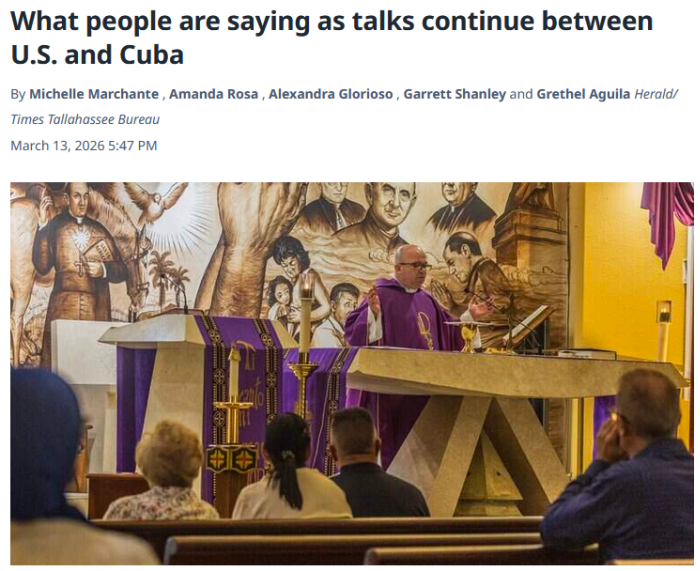
When the Miami Herald (3/13/26) says “people,” it doesn’t mean people in Cuba.
Unsurprisingly, none of the Herald‘s sources in either article were at all supportive of the Cuban government, with quotes referring to Cuban leaders as “trash” and calling for a revolution with “bloodshed.” None were openly critical of the Trump administration’s approach, though quotes ranged from “all in” to expressing skepticism that negotiations could work.
Unlike AP and the Times, the Herald made virtually no effort to include the perspective of everyday Cubans in Cuba. Across its 61 articles, the anonymous mother of two was the only everyday Cuban resident it quoted that it appeared to have interviewed; she was quoted in two articles (3/13/26, 3/13/26) the same day, in both describing the struggles of life on the island.
The Herald (1/21/26) also quoted one non-expert Cuba resident whose quote had previously appeared in Miami-based Cubalex, a news outlet funded by the US government. In response to the prospect of US forces kidnapping Díaz-Canel in a similar manner to the kidnapping of Venezuela’s Maduro, Cubalex (and the Herald) quoted this anonymous source saying: “How happy that would make me. Get them all the f–k out of here, to see if we can be happy, to see if we can see the fruit of our work.”
AP gave readers much more of a sense of the struggles and ambivalence of the people on the island under the US blockade. These perspectives varied widely. Some supported their government (1/5/26): “Give me a rifle, and I’ll go fight.” A few offered criticism (1/30/26): “Cuba is a threat to Cubans, not to the United States. For us Cubans here, it is the government that is a threat to us.”
The AP published many articles over the three months that focused on the Cuban people’s perspectives and experiences, such as “Anger and Anguish Spread Across Cuba as It Learns of Trump’s Tariff Threat on Those Who Provide Oil” (1/30/26); “Concern, Anger and Hope Simmer in Cuba after Trump Calls for ‘Imminent Action’ Against Government” (3/18/26); and “One Cuban Family Navigates Daily Life Under a US Oil Embargo and a Deepening Economic Crisis” (3/31/26).
Dateline choices
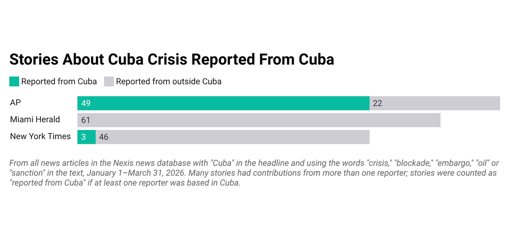
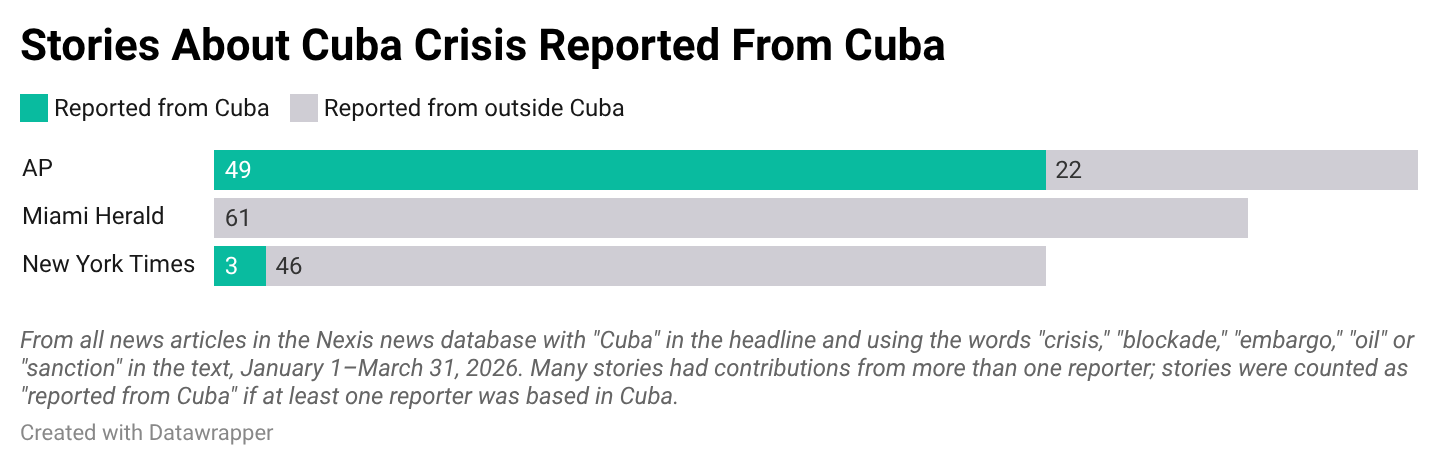 These notable differences across outlets are strongly correlated with staffing choices. AP has had a bureau in Havana since the late ‘90s; 49 of its 71 stories were written solely by or with contributions from a Cuba-based reporter.
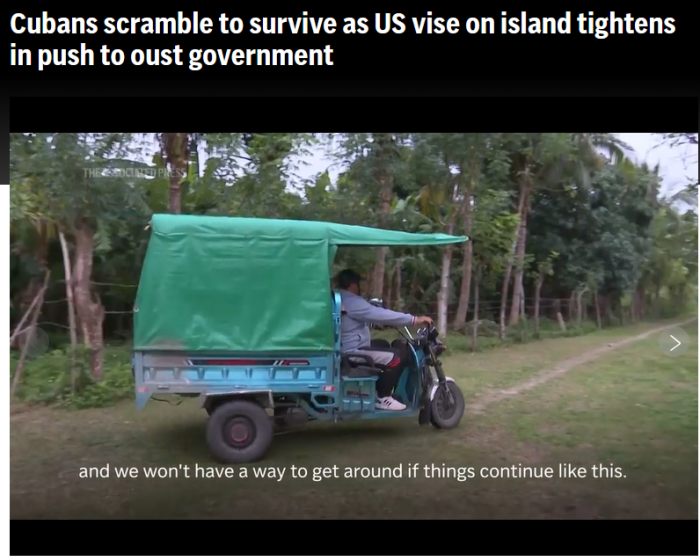
AP (1/30/26) was the only outlet studied that frequently reported from Cuba.
The New York Times, in contrast, has no reporter based in Cuba. The paper’s longtime Cuba specialist, Frances Robles, who authored many of the Times‘ reports in the study, says she hasn’t been granted a visa to report out of Cuba since 2016. The paper does occasionally get local perspectives from independent journalists in Cuba, but only three of its 49 articles (3/2/26, 3/13/26, 3/26/26) had even a shared Cuba dateline—unless you count the two stories it filed from Guantánamo Bay, which is under US control.
Each of those three articles had a majority of sources from Cuba, offering local perspectives. One piece (3/26/26) by Ed Augustin and Jack Nicas, for instance, headlined “Cuban Patients Are Dying Because of US Blockade, Doctors Say,” was reported with a Havana dateline, and quoted three doctors and the mother of a 21-year-old patient who requires a ventilator to breathe: “I don’t know how long we can keep going…. His life depends on electricity.”
The year 2016 is also the last time the Herald’s main Cuba reporter, Nora Gámez Torres, got a reporting visa. Yet during the intense three-month news period in which the US blockade of the island brought conditions there to a crisis, the paper didn’t even manage to get a stringer to help cover the story for any of its 61 articles in FAIR’s study.
Government officials

Across all three outlets, government, military and intelligence officials (current and former) were heavily quoted—but only AP made an effort to offer balance between the two governments. The most notable imbalance was at the Herald, where US officials outnumbered Cuban officials 38% to 16%. At the Times the imbalance was 32% to 16%, while AP was nearly even, at 23% US to 22% Cuban.
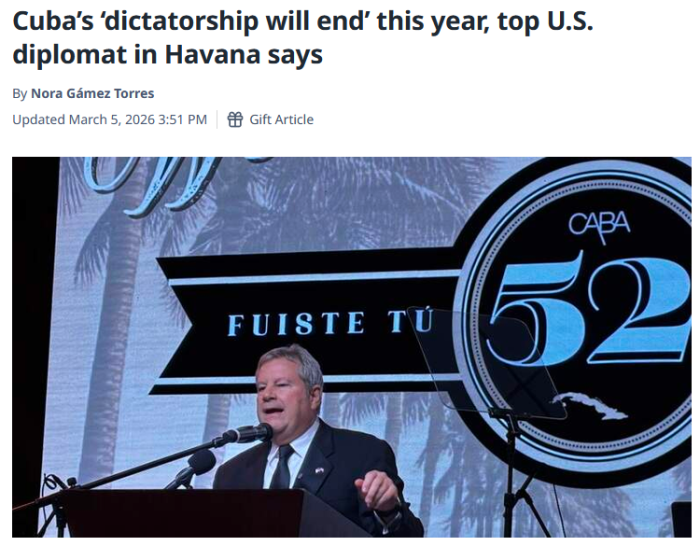
The Miami Herald (3/5/26) featured US government sources more than twice as often as Cuban government sources.
The 2026 blockade imposed by the US on Cuba is portrayed in diametrically opposed ways by the two governments. Where the Cuban government (Miami Herald, 3/18/26) describes it as, for instance, “the fierce economic war being waged as collective punishment against the entire population,” Donald Trump (New York Times, 1/17/26) proudly declares, “THERE WILL BE NO MORE OIL OR MONEY GOING TO CUBA—ZERO!” and that, as a result, Cuba must “make a deal” or, in the paraphrasing of the Times, “suffer the consequences.”
But what those consequences look like, or who exactly suffers them, US government sources nearly always decline to say. That’s because those who suffer are the people, much more than the government. (As CUNY professor Katrin Hansing, one of the rare sources quoted in the Herald—2/25/26—that talked about the humanitarian crisis without blaming the Cuban government for it, explained: “The lack of fuel has already made people suffer enormously, and if this continues people are going to die.”)
When an outlet publishes far more quotes from US officials, then, that means far less criticism of the blockade.
Of US officials, Republicans overwhelmingly dominated. They constituted 84% of partisan US sources at the Times, 91% at the Herald, and 97% at AP. Most of the Democrats quoted were former, rather than current, officials. While Republicans do control the US government, prominent Democrats have spoken out against Trump’s threats of aggression against Cuba—yet only AP (3/13/26) quoted any such comments.
AP was also the only outlet that quoted any international governmental organizations, with five such sources. In one example (2/16/26), the outlet quoted UN human rights experts who said the US blockade had “no basis on collective security and constitutes a unilateral act that is incompatible with international law.”
Other experts
 Activists, protesters, and those speaking for humanitarian or human rights groups—all of whom could have important perspectives about the human impact of the US blockade on Cuba—occupied the margins of all outlets’ coverage. They made up 7% of total sources at the Herald, 5% at AP and 6% at the Times.
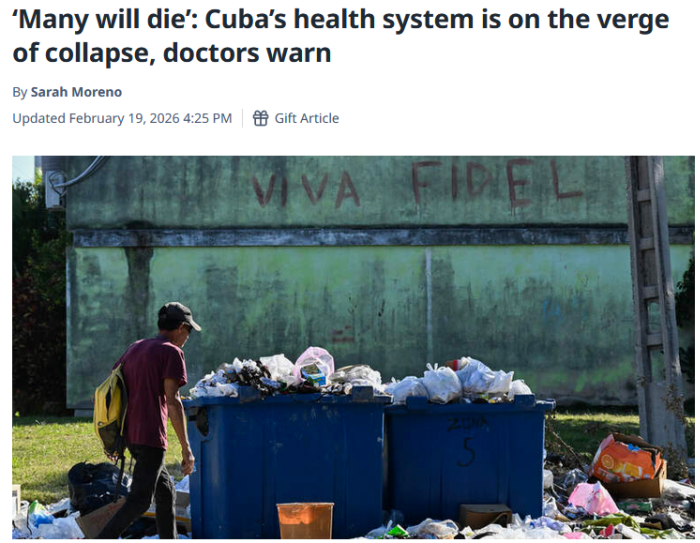
After likening Cuban healthcare to “scenes from a horror film,” the Miami Herald (2/19/26) turned for analysis to Dr. Antonio Guedes, who said the crisis was “a direct result of the political decisions of the Communist regime.”
On the rare occasions that the Herald published quotes about the humanitarian situation, it typically looked to critics of the Cuban rather than US government, like Cuban exile and activist Dr. Antonio Guedes (2/19/26): “The crisis, a direct result of the political decisions of the Communist regime, manifests in increased preventable mortality and morbidity.”
Academics, who typically offered perspectives on foreign policy or Cuba’s oil economy, made up 6% of sources at the Herald, 7% at AP and 14% at the Times. Lawyers and economists were 2% of sources at the Herald, 1% at AP and 6% at the Times.
Think tanks were not heavily cited (22 sources total), and most were only cited once; the one think tank that stood out was the Cuba Study Group, cited once by the Times and six times by the Herald. The executive director of the Miami-based group, which believes that “Cuba needs to transform into a different political and economic order,” was quoted in the Times (2/28/26) as supporting Trump’s announcement that the US would allow “modest” shipments of oil to private businesses in Cuba. He argued that the US can use the oil—in the midst of the US-imposed blockade—as “leverage to extract concessions from the Cuban regime.”
Notably, while the Times and AP managed to report on Cuba without the use of any anonymous sources, the Herald frequently granted sources anonymity—30 times, accounting for nearly 10% of their sources. Many of these were described with some identifying information, such as “a Cuban American entrepreneur” or “a Trump administration official”; ten were simply explained with descriptions like “one expert” or a “source with knowledge of the plan,” from which not even an occupation could be identified.
These sources often offered commentary that hardly seemed to deserve anonymity: “They won’t fool Marco Rubio,” one anonymous US official told the Herald (3/5/26), about the idea that Cuban leaders might try to stall negotiations. Another article (3/4/26) quoted “a Cuban American who has met [Díaz-Canel]” saying: “He lost the little legitimacy he had left during the July 11 [2021] protests.”
Research assistance: Louise Liu, Emily Spencer, Priyanka Bansal
From FAIR via This RSS Feed.