

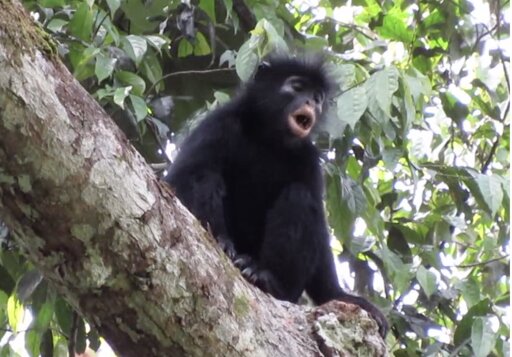
In 2008, wildlife researchers surveying a massive, underexplored forested region in the Democratic Republic of Congo photographed a black monkey. That region eventually became Lomami National Park. And now, nearly 20 years later, the team has confirmed in a study that the black primate is a new-to-science species of colobus monkey. The monkey isn’t well known by local communities, but those who have encountered it call it likweli, said John Hart, study lead author and scientific director at the Lukuru Wildlife Research Foundation, which spearheaded the creation of Lomami. The researchers have given the monkey the scientific name Colobus congoensis. Both male and female likweli are almost entirely black. What makes the species easy to distinguish from other colobus monkeys is a prominent patch of pinkish to orange-cream bare skin surrounding the mouth, Hart told Mongabay in a video call. When the likweli was first photographed in 2008, it was one of several monkeys the researchers couldn’t identify. “They are not in our field guides,” Terese Hart, the Lukuru foundation director, wrote in a blog post in 2008. Another of those monkeys, locally named lesula, also turned out to be new to science and was scientifically described as Cercopithecus lomamiensis in 2012. With the focus on the lesula and conservation work in the area, the likweli went on the back burner, John said. It was only 10 years later, in 2018, that local field researcher Jean Pierre Kapale photographed likweli several times during surveillance patrols and surveys. Kapale insisted the…This article was originally published on Mongabay
From Conservation news via This RSS Feed.