

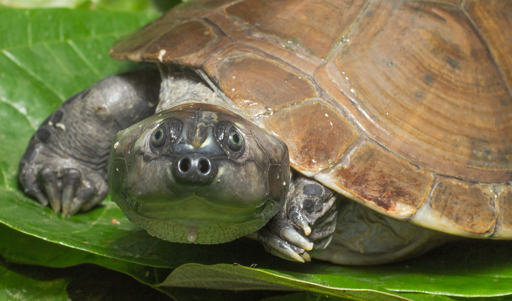
A traditional food source for Amazonian communities, freshwater turtles have been included in Brazil’s list of fauna threatened with extinction for the first time. The cágado-iaçá, or six-tubercled Amazon River turtle, had its risk elevated from near threatened to endangered in a new national list recently released by the Ministry of Environment and Climate Change. Known in the Amazon as tracajás, freshwater turtles have been classified as nearly threatened for a long time, but it’s the first time that one of its species was classified as endangered, said Marília Marini, general coordinator of conservation strategies at ICMBio, the Brazilian agency in charge of conservation units. “For the Amazon, the main highlight is the inclusion of the tracajá,” Marini told Mongabay by phone. “That is a more delicate situation, because it also involves [traditional] communities that use them [for subsistence]. So, great care is needed regarding communication and how to direct actions — ensuring they don’t negatively affect those communities that have historically coexisted with the area.” Despite protection programs and conservation efforts, cágado-iaçá’s (Podocnemis sextuberculata) populations over the past 36 years — equivalent to three generations — declined by more than 50% in Amazonas and western Pará states, which accounts for approximately 70% of the species’ total distribution, leading to an endangered classification, according to ICMBio’s Biodiversity Extinction Risk Assessment System (SALVE). Six-tubercled Amazon River turtle (Podocnemis sextoberculata). Image by © Rafael Bernhard via iNaturalist. CC BY 4.0. Six-tubercled Amazon River turtle (Podocnemis sextoberculata). Image by © Andrés Camilo Montes-Correa…This article was originally published on Mongabay
From Conservation news via This RSS Feed.