

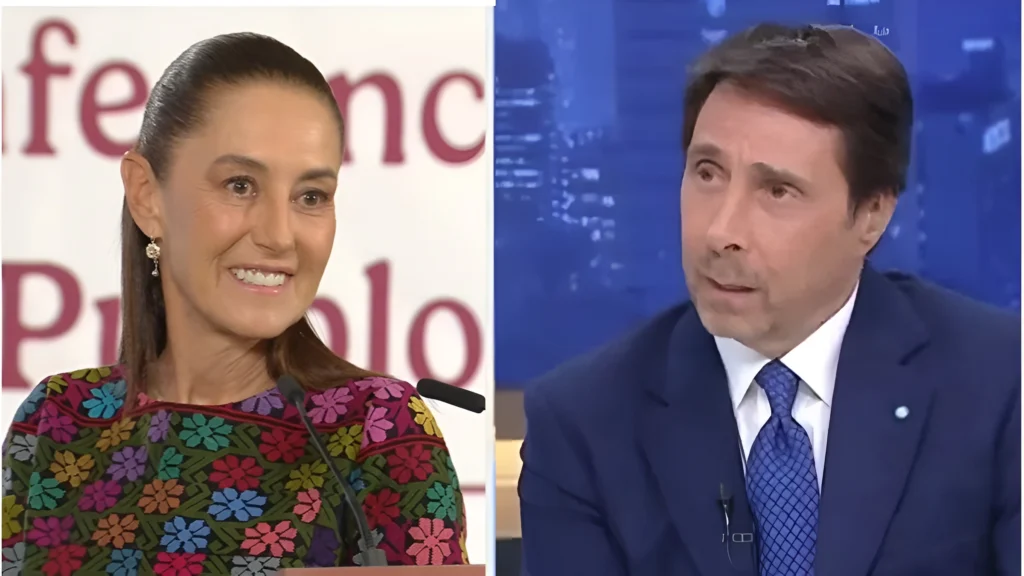
The Mexican president refuses to accept the excuse of ‘sports jokes’ as justification for systemic prejudice.
In the landscape of mass media, the line between regional sports rivalry and deep-seated social prejudice is often blurred by figures who command significant airtime, and the 2026 FIFA World Cup is no exception.
RELATED:
The 2026 World Cup Highlights Discourses on Racism and Colonization
On July 06, 2026, the Argentine broadcaster Eduardo Feinmann launched a strong criticism of Mexico on live television. The incident quickly escalated into a transnational political dispute involving Mexico’s President, Claudia Sheinbaum.
This controversy highlights a structural pattern: outlets aligned with the conservative establishment provide platforms for figures who deploy xenophobic rhetoric to divide regional solidarity.
By examining the exchange between Feinmann and Sheinbaum, we can trace how corporate media formats hostility disguised as love for sports, uses fake news to prime audiences, and weaponizes cultural divisions to serve a political agenda.
Sports Rivalry as a Vehicle for Hostility
The catalyst for this diplomatic friction was the elimination of the Mexican National Team from the 2026 FIFA World Cup. On July 5, 2026, Mexico was eliminated in the round of 16 after losing 3-2 to England.
On July 6, 2026, during a live broadcast on the Argentine cable news channel LN+ (and later discussed on A24), Feinmann was asked about his stance on the Mexican team’s performance. Rather than offering an objective analysis of the match, the broadcaster said:
“I detest the Mexicans, I detest them with my soul,” he declared on air. He went on to assert:
“Those guys are despicable. Mexicans are so jealous of Argentines, not just in soccer; they want to be like us, but they just can’t cut it.”
This outburst did not occur in a vacuum. In the days preceding the match, Feinmann had actively disseminated unverified claims. Specifically, he promoted a rumor alleging that Ecuador’s selection lost to Mexico because the Ecuadorian players had received threats from organized crime groups to influence their performance. Information that the Ecuadorian team issued a public denial.
EDUARDO FEINNMANN APOLOGIZES TO MEXICO AFTER…
Accusing without evidence that drug cartels had threatened Ecuadorian players.
Claiming that he “hates Mexicans” because, according to him, Mexicans envy Argentina not only in football, but in everything.
A complete…
— NextMex (@NextMexOficial) July 9, 2026

The Presidential Response: Claudia Sheinbaum Confronts Hate
The xenophobic remarks made by Feinmann quickly escalated at the highest levels of politics. On July 8, 2026, Mexican President Claudia Sheinbaum addressed the controversy during her daily morning press conference at the National Palace in Mexico City.
During the broadcast, Sheinbaum played Feinmann’s audio to the public and labeled the broadcaster’s rhetoric as “outrageous”. She argued that such language reflects the underlying prejudice of conservative political figures.
Sheinbaum used the opportunity to draw a direct connection between foreign commentators like Feinmann and the Mexican conservative opposition. She specifically criticized Mexican billionaire Ricardo Salinas for amplifying Feinmann’s hostile statements on social media platforms.
The Mexican president explained this dynamic through what she described as political transitivity. She stated that if a foreign media figure openly hates Mexicans, and the domestic political right supports and echoes that figure, it logically follows that the domestic right holds the same contempt for the Mexican people.
Facing severe international backlash, Feinmann attempted to clarify his comments on his July 8 television broadcast. He conceded that millions of Mexicans had a valid reason to be angry with him, but he denied that his words constituted hate speech or xenophobia. He claimed his criticisms were aimed strictly at the performance of the Mexican national football team rather than the country’s population as a whole.
However, President Sheinbaum rejected Feinmann’s defense during her press conference on July 9, 2026. She maintained that targeting the national football team is still deeply offensive to the country’s national identity.
Sheinbaum asserted that nobody should offend the national team under the guise of sports commentary, adding that her administration would not tolerate degrading remarks about Mexican citizens or their representatives, even if framed as a joke or football banter.
The Backlash and Cultural Solidarity
Following the public broadcast of Feinmann’s statements, cultural figures, digital creators, and ordinary citizens across Latin America spoke out against his rhetoric.
The backlash highlighted a clear division between the exclusionary narratives and cooperative sentiments. Many commentators emphasized that Feinmann’s comments were representative of a small media elite rather than the general population of Argentina.
One of the widely shared responses came from the Mexican content creator and entrepreneur Luisito Comunica. In a video message addressed to his millions of followers, he criticized Feinmann’s statements, describing the broadcaster as highly ignorant of regional culture.
Crucially, he urged his audience not to let the broadcaster’s comments spark retaliatory hatred toward Argentine citizens. He affirmed his respect for the people of Argentina and reminded his viewers that a single corporate media figure does not represent the values of an entire nation.
By utilizing independent digital platforms, ordinary citizens successfully show a growing public refusal to let corporate media figures dictate regional relationships, serving to mobilize civil society against xenophobia and reinforce the necessity of cultural solidarity across Latin America.
Eduardo Feinmann (@edufeiok), who’s the propaganda mouthpiece for Milei, says he hates Mexicans and that we envy them.
Envy them for what, exactly?
Argentina can win all the World Cups they want, but that won’t help ordinary Argentines make ends meet. pic.twitter.com/l7aczWVtbP
— Voice of Mexico (@VOMexico) July 8, 2026
Eduardo Feinmann’s History of Reactionary Journalism
To fully understand Feinmann’s attitude, it is necessary to examine his broader career trajectory as a figure in Argentina’s conservative media establishment.
Working for corporate networks like Radio Mitre (Clarín group) and the television channel LN+, Feinmann has consistently built a personal brand around confrontational and highly ideological rhetoric.
Critics and media analysts argue that his recent anti-Mexican outbursts are part of a long-standing pattern of targeting marginalized groups, social movements, and progressive political initiatives.
One of the most contentious aspects of Feinmann’s career is his open alignment with historical revisionism regarding Argentina’s last civic-military dictatorship (1976–1983). On multiple occasions, he has publicly questioned and mocked the widely accepted figure of 30,000 forcibly disappeared citizens.
During the COVID-19 pandemic, he drew sharp criticism for posting on social media, “Now yes, 30,000,” when Argentina’s official virus-related death toll reached that milestone.
Feinmann has also consistently targeted youth and student-led activism. During periods of public school protests in Buenos Aires, where students organized to demand better infrastructure and educational funding, Feinmann routinely invited young student leaders onto his programs and frequently patronized, mocked, and aggressively cross-examined minor students, framing their civic participation as delinquent behavior.
Additionally, during the massive legislative and social campaigns for reproductive rights in Argentina, often referred to as the “Green Wave” (Marea Verde), Feinmann acted as an outspoken detractor.
Feinmann publicly criticized artists and public figures who displayed the green handkerchief, the movement’s symbol, during official events, such as singer Ángela Torres’s performance of the National Anthem at the Youth Olympic Games. He labeled such actions as a desecration of national symbols, illustrating his broader tendency to utilize nationalist talking points to oppose structural social change.
Argentine journalist Eduardo Feinmann launched a fierce attack on Egypt head coach Hossam Hassan:
•
•
He also brought up images of Hassan holding the Palestinian flag.
•…
— Sportica (@SporticaMedia) July 10, 2026
Toward a Democratic and Sovereign Latin American Media Model
The diplomatic incident triggered by Eduardo Feinmann’s hostile statements illustrates how corporate-owned news channels and broadcasters can weaponize cultural chauvinism and disseminate unverified claims to generate high ratings and drive right-wing political agendas.
The prompt response from Mexican President Claudia Sheinbaum highlighted the structural connection between international media figures and domestic conservative elites, shifting the conversation from a simple sports dispute to a critique of transnational political alliances.
Ultimately, the widespread public pushback from artists, digital creators, and citizens across both Argentina and Mexico suggests a growing collective resistance to divisive media strategies.
Rather than severing ties, the controversy catalyzed a defense of Latin American solidarity, highlighting shared cultural identities that transcend television networks.
Sources: teleSUR – Página 12 – BBC – El País – Animal Político – El Heraldo de México – El Universal – Medio Tiempo – Univisión – TRT World – Revista Noticias
From teleSUR English via This RSS Feed.